

N
H
N
NO 2
H
2-Nitropyrrol
+ HNO 3
Acetic anhydride
+ H 2 O
S
S
NO 2
2-Nitrothiophene
+ HNO 3
Acetic anhydride
+ H 2 O
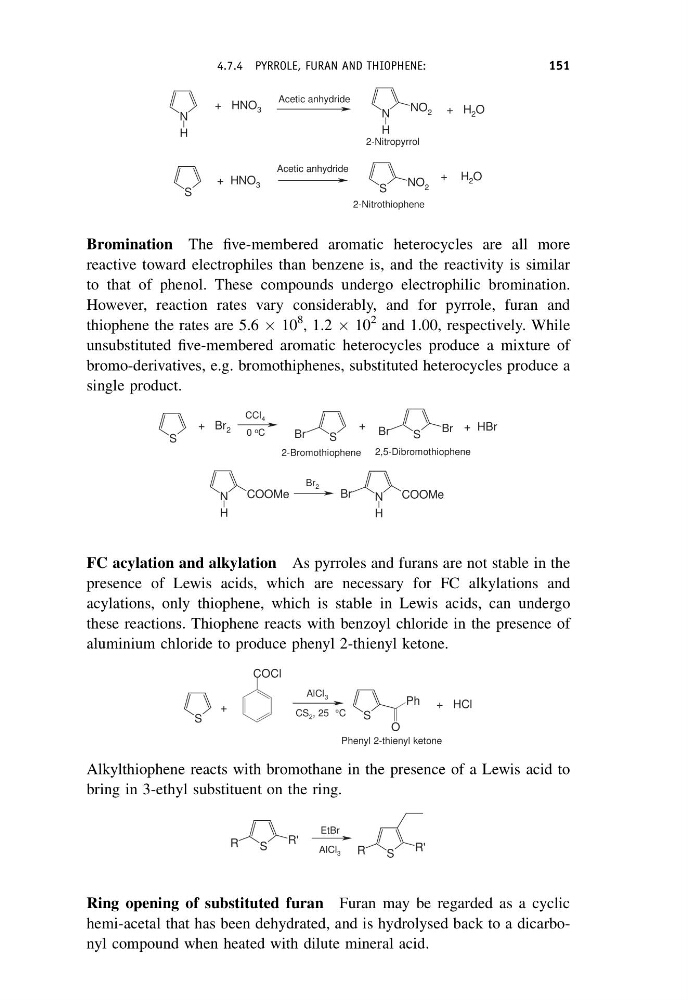
Bromination The five-membered aromatic heterocycles are all more
reactive toward electrophiles than benzene is, and the reactivity is similar
to that of phenol. These compounds undergo electrophilic bromination.
However, reaction rates vary considerably, and for pyrrole, furan and
thiophene the rates are 5.6 Â 10
8
, 1.2 Â 10
2 and 1.00, respectively. While
unsubstituted five-membered aromatic heterocycles produce a mixture of
bromo-derivatives, e.g. bromothiphenes, substituted heterocycles produce a
single product.
S
S
Br
S
Br
Br
2-Bromothiophene
+ Br 2
CCl 4
0 o C
+
+ HBr
2,5-Dibromothiophene
N
H
COOMe
N
H
COOMe
Br
Br 2
FC acylation and alkylation As pyrroles and furans are not stable in the
presence of Lewis acids, which are necessary for FC alkylations and
acylations, only thiophene, which is stable in Lewis acids, can undergo
these reactions. Thiophene reacts with benzoyl chloride in the presence of
aluminium chloride to produce phenyl 2-thienyl ketone.
S
S
O
Ph
COCl
Phenyl 2-thienyl ketone
+ HCl
+
AlCl 3
CS 2 , 25 °C
Alkylthiophene reacts with bromothane in the presence of a Lewis acid to
bring in 3-ethyl substituent on the ring.
S
R
R'
S
R
R'
EtBr
AlCl 3
Ring opening of substituted furan Furan may be regarded as a cyclic
hemi-acetal that has been dehydrated, and is hydrolysed back to a dicarbonyl compound when heated with dilute mineral acid.
4.7.4 PYRROLE, FURAN AND THIOPHENE:
151
H
N
NO 2
H
2-Nitropyrrol
+ HNO 3
Acetic anhydride
+ H 2 O
S
S
NO 2
2-Nitrothiophene
+ HNO 3
Acetic anhydride
+ H 2 O
Bromination The five-membered aromatic heterocycles are all more
reactive toward electrophiles than benzene is, and the reactivity is similar
to that of phenol. These compounds undergo electrophilic bromination.
However, reaction rates vary considerably, and for pyrrole, furan and
thiophene the rates are 5.6 Â 10
8
, 1.2 Â 10
2 and 1.00, respectively. While
unsubstituted five-membered aromatic heterocycles produce a mixture of
bromo-derivatives, e.g. bromothiphenes, substituted heterocycles produce a
single product.
S
S
Br
S
Br
Br
2-Bromothiophene
+ Br 2
CCl 4
0 o C
+
+ HBr
2,5-Dibromothiophene
N
H
COOMe
N
H
COOMe
Br
Br 2
FC acylation and alkylation As pyrroles and furans are not stable in the
presence of Lewis acids, which are necessary for FC alkylations and
acylations, only thiophene, which is stable in Lewis acids, can undergo
these reactions. Thiophene reacts with benzoyl chloride in the presence of
aluminium chloride to produce phenyl 2-thienyl ketone.
S
S
O
Ph
COCl
Phenyl 2-thienyl ketone
+ HCl
+
AlCl 3
CS 2 , 25 °C
Alkylthiophene reacts with bromothane in the presence of a Lewis acid to
bring in 3-ethyl substituent on the ring.
S
R
R'
S
R
R'
EtBr
AlCl 3
Ring opening of substituted furan Furan may be regarded as a cyclic
hemi-acetal that has been dehydrated, and is hydrolysed back to a dicarbonyl compound when heated with dilute mineral acid.
4.7.4 PYRROLE, FURAN AND THIOPHENE:
151