

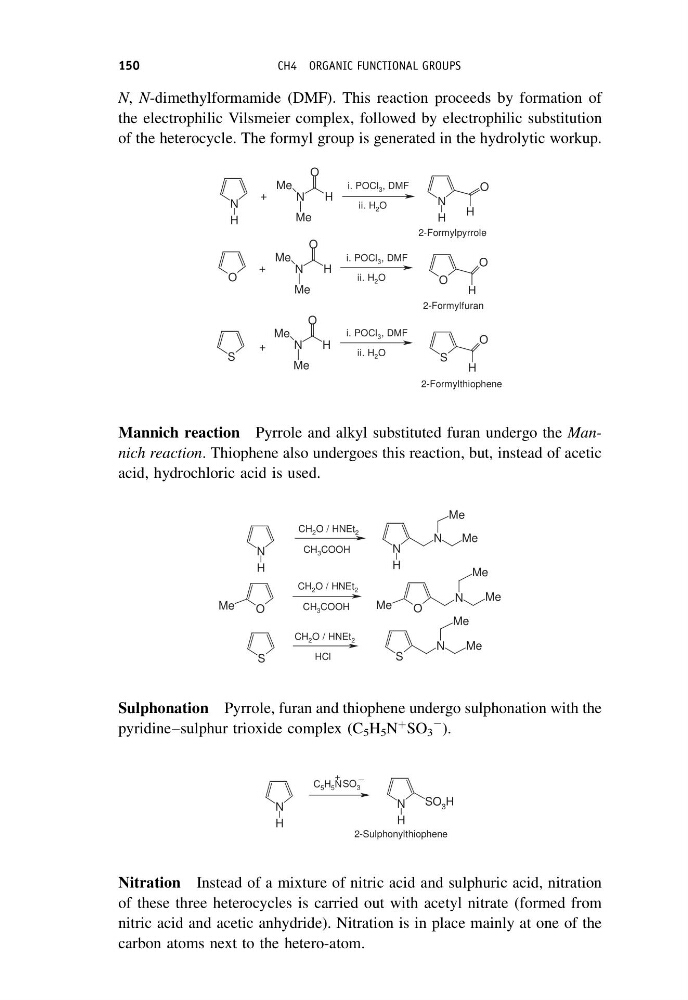
N, N-dimethylformamide (DMF). This reaction proceeds by formation of
the electrophilic Vilsmeier complex, followed by electrophilic substitution
of the heterocycle. The formyl group is generated in the hydrolytic workup.
O
Me
N
Me
H
O
O
O
H
S
Me
N
Me
H
O
S
O
H
N
H
N
H
H
O
Me
N
Me
H
O
2-Formylfuran
+
2-Formylthiophene
+
i. POCl 3 , DMF
ii. H 2 O
i. POCl 3 , DMF
ii. H 2 O
2-Formylpyrrole
+
i. POCl 3 , DMF
ii. H 2 O
Mannich reaction Pyrrole and alkyl substituted furan undergo the Mannich reaction. Thiophene also undergoes this reaction, but, instead of acetic
acid, hydrochloric acid is used.
N
H
N
H
N
Me
Me
O
Me
O
N
Me
Me
Me
S
S
N
Me
Me
CH 2 O / HNEt 2
CH 3 COOH
CH 2 O / HNEt 2
CH 3 COOH
CH 2 O / HNEt 2
HCl
Sulphonation Pyrrole, furan and thiophene undergo sulphonation with the
pyridine–sulphur trioxide complex (C 5 H 5 N
þ SO 3
À ).
N
H
N
H
SO 3 H
2-Sulphonylthiophene
C 5 H 5 N
+
SO 3
_
Nitration Instead of a mixture of nitric acid and sulphuric acid, nitration
of these three heterocycles is carried out with acetyl nitrate (formed from
nitric acid and acetic anhydride). Nitration is in place mainly at one of the
carbon atoms next to the hetero-atom.
150
CH4 ORGANIC FUNCTIONAL GROUPS
the electrophilic Vilsmeier complex, followed by electrophilic substitution
of the heterocycle. The formyl group is generated in the hydrolytic workup.
O
Me
N
Me
H
O
O
O
H
S
Me
N
Me
H
O
S
O
H
N
H
N
H
H
O
Me
N
Me
H
O
2-Formylfuran
+
2-Formylthiophene
+
i. POCl 3 , DMF
ii. H 2 O
i. POCl 3 , DMF
ii. H 2 O
2-Formylpyrrole
+
i. POCl 3 , DMF
ii. H 2 O
Mannich reaction Pyrrole and alkyl substituted furan undergo the Mannich reaction. Thiophene also undergoes this reaction, but, instead of acetic
acid, hydrochloric acid is used.
N
H
N
H
N
Me
Me
O
Me
O
N
Me
Me
Me
S
S
N
Me
Me
CH 2 O / HNEt 2
CH 3 COOH
CH 2 O / HNEt 2
CH 3 COOH
CH 2 O / HNEt 2
HCl
Sulphonation Pyrrole, furan and thiophene undergo sulphonation with the
pyridine–sulphur trioxide complex (C 5 H 5 N
þ SO 3
À ).
N
H
N
H
SO 3 H
2-Sulphonylthiophene
C 5 H 5 N
+
SO 3
_
Nitration Instead of a mixture of nitric acid and sulphuric acid, nitration
of these three heterocycles is carried out with acetyl nitrate (formed from
nitric acid and acetic anhydride). Nitration is in place mainly at one of the
carbon atoms next to the hetero-atom.
150
CH4 ORGANIC FUNCTIONAL GROUPS