

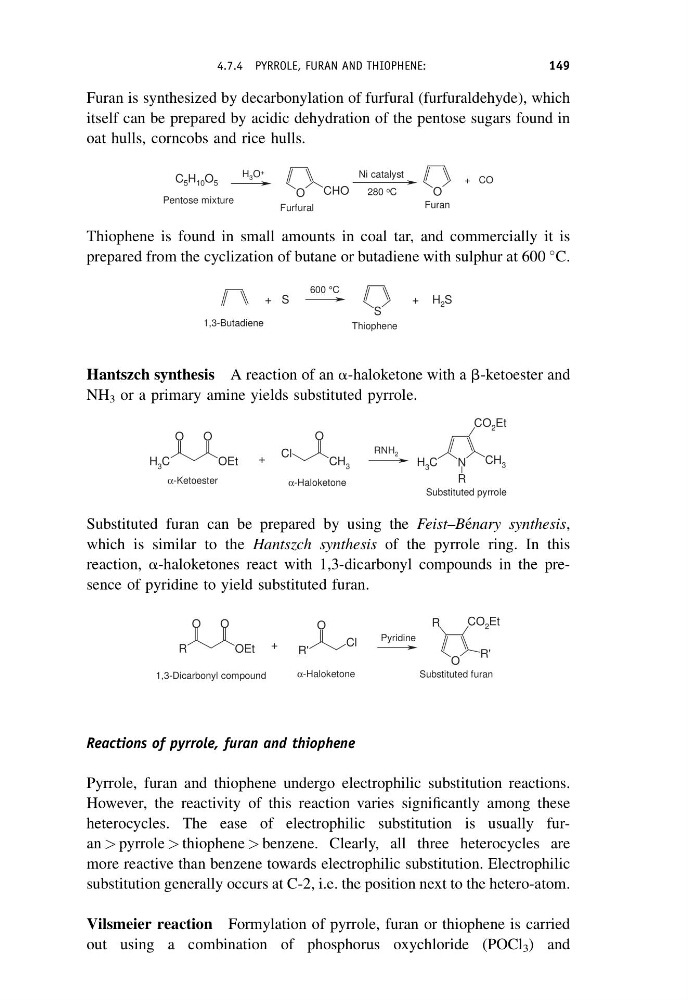
Furan is synthesized by decarbonylation of furfural (furfuraldehyde), which
itself can be prepared by acidic dehydration of the pentose sugars found in
oat hulls, corncobs and rice hulls.
O
O
CHO
Furan
C 5 H 10 O 5
Pentose mixture
H 3 O +
Ni catalyst
280 o C
+ CO
Furfural
Thiophene is found in small amounts in coal tar, and commercially it is
prepared from the cyclization of butane or butadiene with sulphur at 600
C.
S
1,3-Butadiene
+ S
600 °C
+ H 2 S
Thiophene
Hantszch synthesis A reaction of an a-haloketone with a b-ketoester and
NH 3 or a primary amine yields substituted pyrrole.
C
H 3
OEt
O
O
CH 3
Cl
O
N
C
H 3
CH 3
CO 2 Et
R
RNH 2
Substituted pyrrole
α-Ketoester
α-Haloketone
+
Substituted furan can be prepared by using the Feist–Be ´nary synthesis,
which is similar to the Hantszch synthesis of the pyrrole ring. In this
reaction, a-haloketones react with 1,3-dicarbonyl compounds in the presence of pyridine to yield substituted furan.
R'
Cl
O
R
OEt
O
O
O
R
CO 2 Et
R'
Substituted furan
1,3-Dicarbonyl compound
α-Haloketone
Pyridine
+
Reactions of pyrrole, furan and thiophene
Pyrrole, furan and thiophene undergo electrophilic substitution reactions.
However, the reactivity of this reaction varies significantly among these
heterocycles. The ease of electrophilic substitution is usually furan > pyrrole > thiophene > benzene. Clearly, all three heterocycles are
more reactive than benzene towards electrophilic substitution. Electrophilic
substitution generally occurs at C-2, i.e. the position next to the hetero-atom.
Vilsmeier reaction Formylation of pyrrole, furan or thiophene is carried
out using a combination of phosphorus oxychloride (POCl 3 ) and
4.7.4 PYRROLE, FURAN AND THIOPHENE:
149
itself can be prepared by acidic dehydration of the pentose sugars found in
oat hulls, corncobs and rice hulls.
O
O
CHO
Furan
C 5 H 10 O 5
Pentose mixture
H 3 O +
Ni catalyst
280 o C
+ CO
Furfural
Thiophene is found in small amounts in coal tar, and commercially it is
prepared from the cyclization of butane or butadiene with sulphur at 600
C.
S
1,3-Butadiene
+ S
600 °C
+ H 2 S
Thiophene
Hantszch synthesis A reaction of an a-haloketone with a b-ketoester and
NH 3 or a primary amine yields substituted pyrrole.
C
H 3
OEt
O
O
CH 3
Cl
O
N
C
H 3
CH 3
CO 2 Et
R
RNH 2
Substituted pyrrole
α-Ketoester
α-Haloketone
+
Substituted furan can be prepared by using the Feist–Be ´nary synthesis,
which is similar to the Hantszch synthesis of the pyrrole ring. In this
reaction, a-haloketones react with 1,3-dicarbonyl compounds in the presence of pyridine to yield substituted furan.
R'
Cl
O
R
OEt
O
O
O
R
CO 2 Et
R'
Substituted furan
1,3-Dicarbonyl compound
α-Haloketone
Pyridine
+
Reactions of pyrrole, furan and thiophene
Pyrrole, furan and thiophene undergo electrophilic substitution reactions.
However, the reactivity of this reaction varies significantly among these
heterocycles. The ease of electrophilic substitution is usually furan > pyrrole > thiophene > benzene. Clearly, all three heterocycles are
more reactive than benzene towards electrophilic substitution. Electrophilic
substitution generally occurs at C-2, i.e. the position next to the hetero-atom.
Vilsmeier reaction Formylation of pyrrole, furan or thiophene is carried
out using a combination of phosphorus oxychloride (POCl 3 ) and
4.7.4 PYRROLE, FURAN AND THIOPHENE:
149