

Furan and thiophene are both clear and colourless liquids at room
temperature. While furan is extremely volatile and highly flammable with
a boiling point close to room temperature (31.4
C), the b.p. of thiophene is
84
C. Thiophene possesses a mildly pleasant odour.
Preparation of pyrrole, furan and thiophene
A general way of synthesizing heterocyclic compounds is by cyclization of
a dicarbonyl or diketo compound using a nucleophilic reagent that introduces the desired hetero-atom.
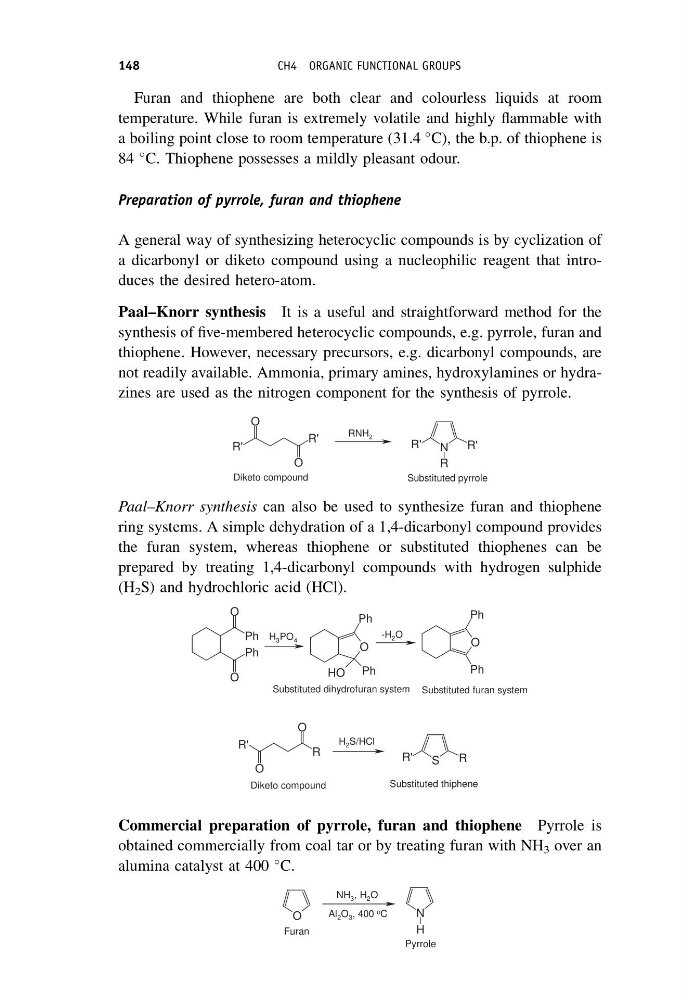
Paal–Knorr synthesis It is a useful and straightforward method for the
synthesis of five-membered heterocyclic compounds, e.g. pyrrole, furan and
thiophene. However, necessary precursors, e.g. dicarbonyl compounds, are
not readily available. Ammonia, primary amines, hydroxylamines or hydrazines are used as the nitrogen component for the synthesis of pyrrole.
R'
R'
O
O
N
R'
R'
R
RNH 2
Substituted pyrrole
Diketo compound
Paal–Knorr synthesis can also be used to synthesize furan and thiophene
ring systems. A simple dehydration of a 1,4-dicarbonyl compound provides
the furan system, whereas thiophene or substituted thiophenes can be
prepared by treating 1,4-dicarbonyl compounds with hydrogen sulphide
(H 2 S) and hydrochloric acid (HCl).
O
O
Ph
Ph
O
O
H
Ph
Ph
O
Ph
Ph
H 3 PO 4
-H 2 O
Substituted furan system
Substituted dihydrofuran system
R'
O
O
R
S
R'
R
H 2 S/HCl
Substituted thiphene
Diketo compound
Commercial preparation of pyrrole, furan and thiophene Pyrrole is
obtained commercially from coal tar or by treating furan with NH 3 over an
alumina catalyst at 400
C.
O
N
H
NH 3 , H 2 O
Al 2 O 3 , 400 o C
Furan
Pyrrole
148
CH4 ORGANIC FUNCTIONAL GROUPS
temperature. While furan is extremely volatile and highly flammable with
a boiling point close to room temperature (31.4
C), the b.p. of thiophene is
84
C. Thiophene possesses a mildly pleasant odour.
Preparation of pyrrole, furan and thiophene
A general way of synthesizing heterocyclic compounds is by cyclization of
a dicarbonyl or diketo compound using a nucleophilic reagent that introduces the desired hetero-atom.
Paal–Knorr synthesis It is a useful and straightforward method for the
synthesis of five-membered heterocyclic compounds, e.g. pyrrole, furan and
thiophene. However, necessary precursors, e.g. dicarbonyl compounds, are
not readily available. Ammonia, primary amines, hydroxylamines or hydrazines are used as the nitrogen component for the synthesis of pyrrole.
R'
R'
O
O
N
R'
R'
R
RNH 2
Substituted pyrrole
Diketo compound
Paal–Knorr synthesis can also be used to synthesize furan and thiophene
ring systems. A simple dehydration of a 1,4-dicarbonyl compound provides
the furan system, whereas thiophene or substituted thiophenes can be
prepared by treating 1,4-dicarbonyl compounds with hydrogen sulphide
(H 2 S) and hydrochloric acid (HCl).
O
O
Ph
Ph
O
O
H
Ph
Ph
O
Ph
Ph
H 3 PO 4
-H 2 O
Substituted furan system
Substituted dihydrofuran system
R'
O
O
R
S
R'
R
H 2 S/HCl
Substituted thiphene
Diketo compound
Commercial preparation of pyrrole, furan and thiophene Pyrrole is
obtained commercially from coal tar or by treating furan with NH 3 over an
alumina catalyst at 400
C.
O
N
H
NH 3 , H 2 O
Al 2 O 3 , 400 o C
Furan
Pyrrole
148
CH4 ORGANIC FUNCTIONAL GROUPS