

NH 2
O
R
R'
R''
O
X
N
O
O
R''
R
R'
H
O
N
R''
R'
R
+
Base
− H 2 O
Amide
Substituted oxazole
Cyclocondensation
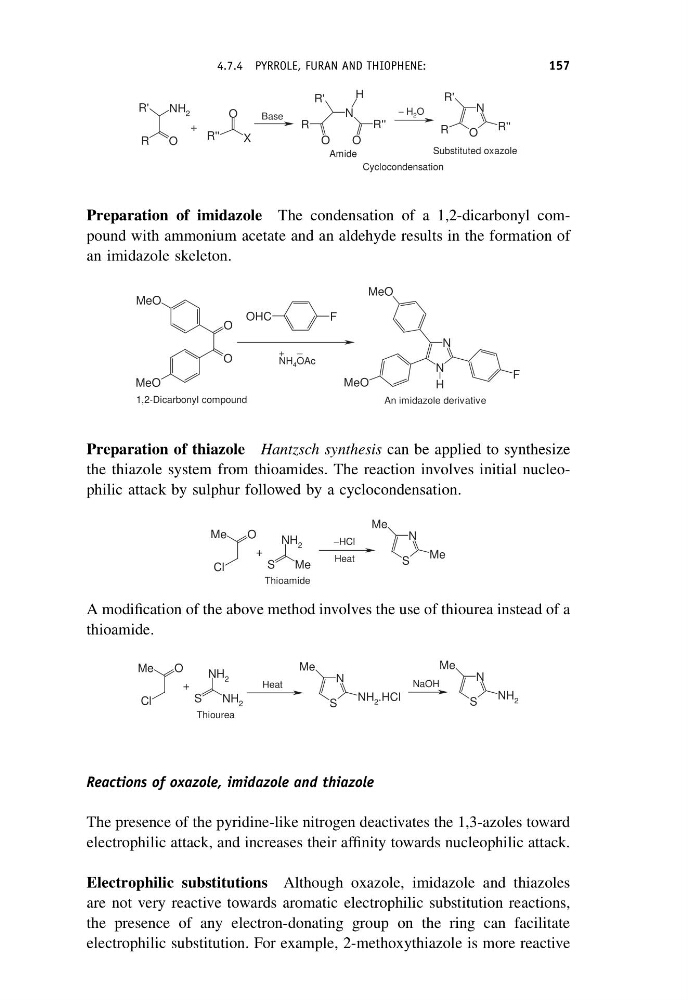
Preparation of imidazole The condensation of a 1,2-dicarbonyl compound with ammonium acetate and an aldehyde results in the formation of
an imidazole skeleton.
O
O
MeO
MeO
F
OHC
N
N
H
F
MeO
MeO
1,2-Dicarbonyl compound
NH 4 OAc
+
An imidazole derivative
_
Preparation of thiazole Hantzsch synthesis can be applied to synthesize
the thiazole system from thioamides. The reaction involves initial nucleophilic attack by sulphur followed by a cyclocondensation.
Me
Cl
O
NH 2
S
Me
S
N
Me
Me
+
−HCl
Heat
Thioamide
A modification of the above method involves the use of thiourea instead of a
thioamide.
Me
Cl
O
NH 2
S
NH 2
S
N
Me
NH 2 .HCl
S
N
Me
NH 2
+
Heat
NaOH
Thiourea
Reactions of oxazole, imidazole and thiazole
The presence of the pyridine-like nitrogen deactivates the 1,3-azoles toward
electrophilic attack, and increases their affinity towards nucleophilic attack.
Electrophilic substitutions Although oxazole, imidazole and thiazoles
are not very reactive towards aromatic electrophilic substitution reactions,
the presence of any electron-donating group on the ring can facilitate
electrophilic substitution. For example, 2-methoxythiazole is more reactive
4.7.4 PYRROLE, FURAN AND THIOPHENE:
157
O
R
R'
R''
O
X
N
O
O
R''
R
R'
H
O
N
R''
R'
R
+
Base
− H 2 O
Amide
Substituted oxazole
Cyclocondensation
Preparation of imidazole The condensation of a 1,2-dicarbonyl compound with ammonium acetate and an aldehyde results in the formation of
an imidazole skeleton.
O
O
MeO
MeO
F
OHC
N
N
H
F
MeO
MeO
1,2-Dicarbonyl compound
NH 4 OAc
+
An imidazole derivative
_
Preparation of thiazole Hantzsch synthesis can be applied to synthesize
the thiazole system from thioamides. The reaction involves initial nucleophilic attack by sulphur followed by a cyclocondensation.
Me
Cl
O
NH 2
S
Me
S
N
Me
Me
+
−HCl
Heat
Thioamide
A modification of the above method involves the use of thiourea instead of a
thioamide.
Me
Cl
O
NH 2
S
NH 2
S
N
Me
NH 2 .HCl
S
N
Me
NH 2
+
Heat
NaOH
Thiourea
Reactions of oxazole, imidazole and thiazole
The presence of the pyridine-like nitrogen deactivates the 1,3-azoles toward
electrophilic attack, and increases their affinity towards nucleophilic attack.
Electrophilic substitutions Although oxazole, imidazole and thiazoles
are not very reactive towards aromatic electrophilic substitution reactions,
the presence of any electron-donating group on the ring can facilitate
electrophilic substitution. For example, 2-methoxythiazole is more reactive
4.7.4 PYRROLE, FURAN AND THIOPHENE:
157