

O
O
O
O
O
OH
O
OH
O
+
Succinic anhydride
FC acylation
AlCl 3
β-Benzoylpropanoic acid
Zn(Hg), HCl
Clemmensen
reduction
γ-Phenylbutyric acid
Ring closure HF or
H 3 PO 4
α-Tetralone
Zn(Hg), HCl
Clemmensen
reduction
Tetralin
Aromatization
(Dehydrogenation)
Pd, ∆
Napthalene
Reactions of naphthalene
Naphthalene undergoes electrophilic substitutions on the ring, resulting in
its various derivatives. In addition to the usual electrophilic substitutions,
naphthalene can also undergo oxidation and reduction reactions under
specific conditions as outlined below.
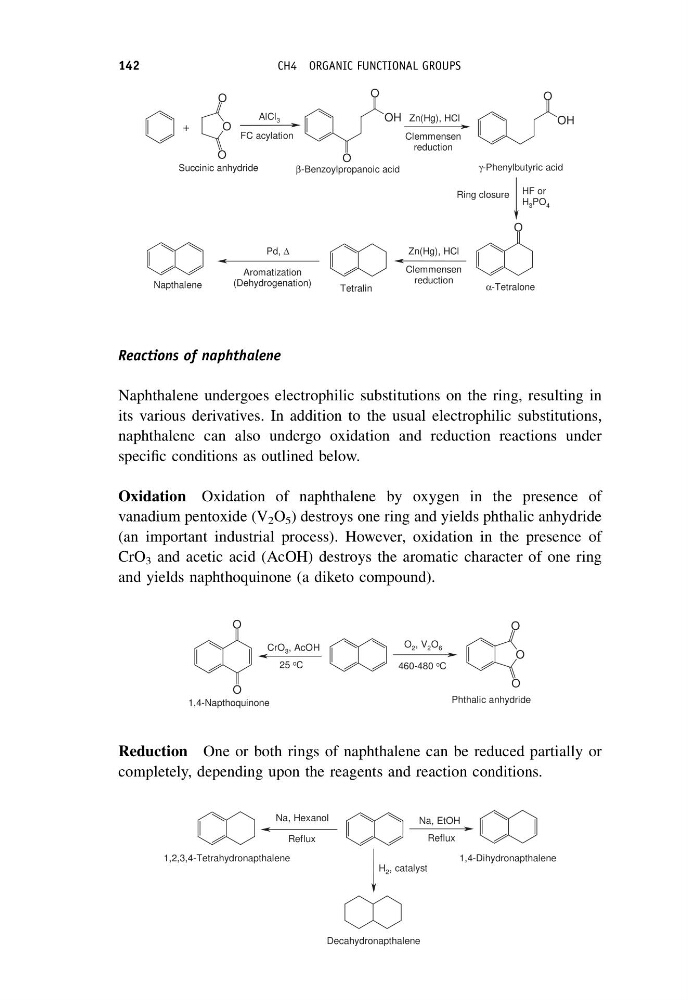
Oxidation Oxidation of naphthalene by oxygen in the presence of
vanadium pentoxide (V 2 O 5 ) destroys one ring and yields phthalic anhydride
(an important industrial process). However, oxidation in the presence of
CrO 3 and acetic acid (AcOH) destroys the aromatic character of one ring
and yields naphthoquinone (a diketo compound).
O
O
O
O
O
O 2 , V 2 O 6
460-480 o C
Phthalic anhydride
CrO 3 , AcOH
25 o C
1,4-Napthoquinone
Reduction One or both rings of naphthalene can be reduced partially or
completely, depending upon the reagents and reaction conditions.
Na, EtOH
Reflux
Decahydronapthalene
1,4-Dihydronapthalene
Na, Hexanol
Reflux
1,2,3,4-Tetrahydronapthalene
H 2 , catalyst
142
CH4 ORGANIC FUNCTIONAL GROUPS
O
O
O
O
OH
O
OH
O
+
Succinic anhydride
FC acylation
AlCl 3
β-Benzoylpropanoic acid
Zn(Hg), HCl
Clemmensen
reduction
γ-Phenylbutyric acid
Ring closure HF or
H 3 PO 4
α-Tetralone
Zn(Hg), HCl
Clemmensen
reduction
Tetralin
Aromatization
(Dehydrogenation)
Pd, ∆
Napthalene
Reactions of naphthalene
Naphthalene undergoes electrophilic substitutions on the ring, resulting in
its various derivatives. In addition to the usual electrophilic substitutions,
naphthalene can also undergo oxidation and reduction reactions under
specific conditions as outlined below.
Oxidation Oxidation of naphthalene by oxygen in the presence of
vanadium pentoxide (V 2 O 5 ) destroys one ring and yields phthalic anhydride
(an important industrial process). However, oxidation in the presence of
CrO 3 and acetic acid (AcOH) destroys the aromatic character of one ring
and yields naphthoquinone (a diketo compound).
O
O
O
O
O
O 2 , V 2 O 6
460-480 o C
Phthalic anhydride
CrO 3 , AcOH
25 o C
1,4-Napthoquinone
Reduction One or both rings of naphthalene can be reduced partially or
completely, depending upon the reagents and reaction conditions.
Na, EtOH
Reflux
Decahydronapthalene
1,4-Dihydronapthalene
Na, Hexanol
Reflux
1,2,3,4-Tetrahydronapthalene
H 2 , catalyst
142
CH4 ORGANIC FUNCTIONAL GROUPS