

4.7 Heterocyclic compounds and their derivatives
Cyclic compounds that have one or more of atoms other than carbon, e.g. N,
O or S (hetero-atoms), in their rings are called heterocyclic compounds or
heterocycles, e.g. pyridine, tetrahydrofuran, thiophene and so on.
N
O
S
Pyridine
N is the hetero-atom
Tetrahydrofuran
O is the hetero-atom
Thiophene
S is the hetero-atom
..
..
..
..
..
Among the heterocyclic compounds, there are aromatic, e.g. pyridine, as
well as nonaromatic, e.g. tetrahydrofuran, compounds. Similarly, there are
saturated (e.g. tetrahydrofuran) and unsaturated (e.g. pyridine) heterocyclic
compounds. Heterocycles also differ in their ring sizes, e.g. pyridine has a
six-membered ring, whereas tetrahydrofuran is a five-membered oxygencontaining heterocyclic compound.
4.7.1 Medicinal importance of heterocyclic compounds
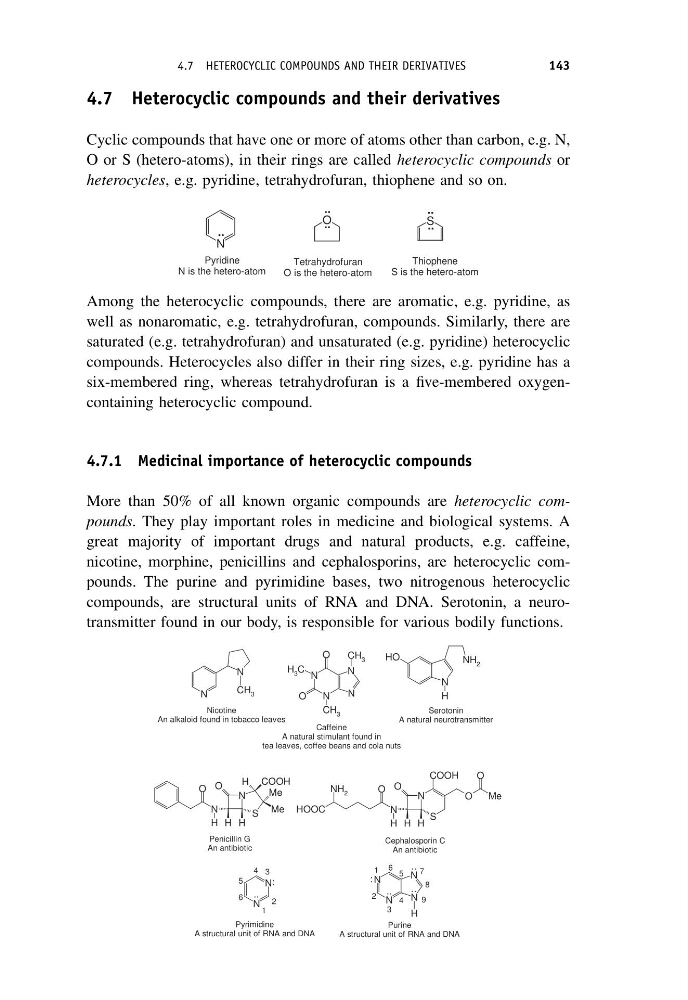
More than 50% of all known organic compounds are heterocyclic compounds. They play important roles in medicine and biological systems. A
great majority of important drugs and natural products, e.g. caffeine,
nicotine, morphine, penicillins and cephalosporins, are heterocyclic compounds. The purine and pyrimidine bases, two nitrogenous heterocyclic
compounds, are structural units of RNA and DNA. Serotonin, a neurotransmitter found in our body, is responsible for various bodily functions.
N
CH 3
N
N
N
CH 3
O
O
C
H 3
N
N
CH 3
N
H
O
H
NH 2
Caffeine
A natural stimulant found in
tea leaves, coffee beans and cola nuts
Nicotine
An alkaloid found in tobacco leaves
Serotonin
A natural neurotransmitter
N
S
O
N
H
O
H H
Me
H
Me
COOH
N
N
O
NH 2
HOOC
H H H
O
S
COOH
O
O
Me
Cephalosporin C
An antibiotic
Penicillin G
An antibiotic
N
N
N
N
N
N
H
Pyrimidine
A structural unit of RNA and DNA
1
2
3
4
5
1
6
4
5
7
8
2
6
9
3
..
..
..
:
:
..
Purine
A structural unit of RNA and DNA
4.7 HETEROCYCLIC COMPOUNDS AND THEIR DERIVATIVES
143
Cyclic compounds that have one or more of atoms other than carbon, e.g. N,
O or S (hetero-atoms), in their rings are called heterocyclic compounds or
heterocycles, e.g. pyridine, tetrahydrofuran, thiophene and so on.
N
O
S
Pyridine
N is the hetero-atom
Tetrahydrofuran
O is the hetero-atom
Thiophene
S is the hetero-atom
..
..
..
..
..
Among the heterocyclic compounds, there are aromatic, e.g. pyridine, as
well as nonaromatic, e.g. tetrahydrofuran, compounds. Similarly, there are
saturated (e.g. tetrahydrofuran) and unsaturated (e.g. pyridine) heterocyclic
compounds. Heterocycles also differ in their ring sizes, e.g. pyridine has a
six-membered ring, whereas tetrahydrofuran is a five-membered oxygencontaining heterocyclic compound.
4.7.1 Medicinal importance of heterocyclic compounds
More than 50% of all known organic compounds are heterocyclic compounds. They play important roles in medicine and biological systems. A
great majority of important drugs and natural products, e.g. caffeine,
nicotine, morphine, penicillins and cephalosporins, are heterocyclic compounds. The purine and pyrimidine bases, two nitrogenous heterocyclic
compounds, are structural units of RNA and DNA. Serotonin, a neurotransmitter found in our body, is responsible for various bodily functions.
N
CH 3
N
N
N
CH 3
O
O
C
H 3
N
N
CH 3
N
H
O
H
NH 2
Caffeine
A natural stimulant found in
tea leaves, coffee beans and cola nuts
Nicotine
An alkaloid found in tobacco leaves
Serotonin
A natural neurotransmitter
N
S
O
N
H
O
H H
Me
H
Me
COOH
N
N
O
NH 2
HOOC
H H H
O
S
COOH
O
O
Me
Cephalosporin C
An antibiotic
Penicillin G
An antibiotic
N
N
N
N
N
N
H
Pyrimidine
A structural unit of RNA and DNA
1
2
3
4
5
1
6
4
5
7
8
2
6
9
3
..
..
..
:
:
..
Purine
A structural unit of RNA and DNA
4.7 HETEROCYCLIC COMPOUNDS AND THEIR DERIVATIVES
143