

layers, aqueous and ether layers, are formed, they are separated. The lower
layer (aqueous) contains the salt of aniline, and the ether layer has the
neutral compound. Ether is evaporated from the ether layer using a rotary
evaporator to obtain purified neutral compound. To the aqueous layer,
sodium hydroxide and ether are added, and the resulting solution is shaken
in a separating funnel. Two layers are separated. The ether layer (top layer)
contains free aniline, and the aqueous layer (bottom layer) has the salt,
sodium chloride. Ether is evaporated from the ether layer using a rotary
evaporator to obtain purified aniline.
Aniline + Neutral compound
Dissolve in ether, add HCl and water
Shake in a separating funnel
Ether layer
(Contains neutral compound)
Aqueous layer
(Contains salt of aniline)
Add NaOH adn ether
Shake in a separating funnel
Ether layer
(Contains aniline)
Aqueous layer
(Contains NaCl)
Evaporation of ether
Purified neutral compound
Evaporation of ether
Purified aniline
4.6.12 Polycyclic benzenoids
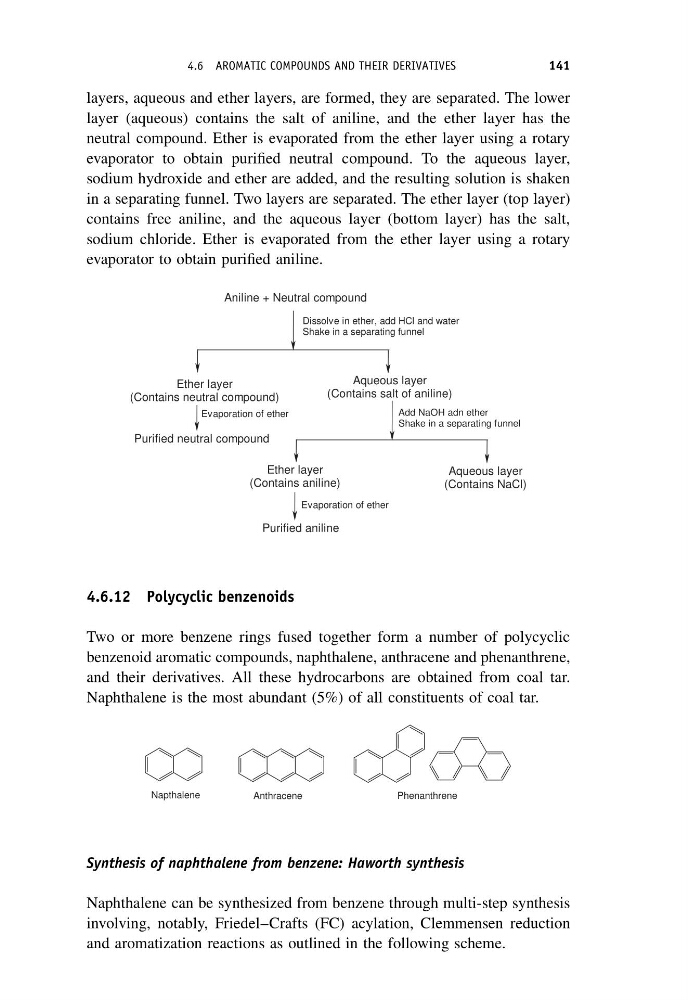
Two or more benzene rings fused together form a number of polycyclic
benzenoid aromatic compounds, naphthalene, anthracene and phenanthrene,
and their derivatives. All these hydrocarbons are obtained from coal tar.
Naphthalene is the most abundant (5%) of all constituents of coal tar.
Napthalene
Anthracene
Phenanthrene
Synthesis of naphthalene from benzene: Haworth synthesis
Naphthalene can be synthesized from benzene through multi-step synthesis
involving, notably, Friedel–Crafts (FC) acylation, Clemmensen reduction
and aromatization reactions as outlined in the following scheme.
4.6 AROMATIC COMPOUNDS AND THEIR DERIVATIVES
141
layer (aqueous) contains the salt of aniline, and the ether layer has the
neutral compound. Ether is evaporated from the ether layer using a rotary
evaporator to obtain purified neutral compound. To the aqueous layer,
sodium hydroxide and ether are added, and the resulting solution is shaken
in a separating funnel. Two layers are separated. The ether layer (top layer)
contains free aniline, and the aqueous layer (bottom layer) has the salt,
sodium chloride. Ether is evaporated from the ether layer using a rotary
evaporator to obtain purified aniline.
Aniline + Neutral compound
Dissolve in ether, add HCl and water
Shake in a separating funnel
Ether layer
(Contains neutral compound)
Aqueous layer
(Contains salt of aniline)
Add NaOH adn ether
Shake in a separating funnel
Ether layer
(Contains aniline)
Aqueous layer
(Contains NaCl)
Evaporation of ether
Purified neutral compound
Evaporation of ether
Purified aniline
4.6.12 Polycyclic benzenoids
Two or more benzene rings fused together form a number of polycyclic
benzenoid aromatic compounds, naphthalene, anthracene and phenanthrene,
and their derivatives. All these hydrocarbons are obtained from coal tar.
Naphthalene is the most abundant (5%) of all constituents of coal tar.
Napthalene
Anthracene
Phenanthrene
Synthesis of naphthalene from benzene: Haworth synthesis
Naphthalene can be synthesized from benzene through multi-step synthesis
involving, notably, Friedel–Crafts (FC) acylation, Clemmensen reduction
and aromatization reactions as outlined in the following scheme.
4.6 AROMATIC COMPOUNDS AND THEIR DERIVATIVES
141