

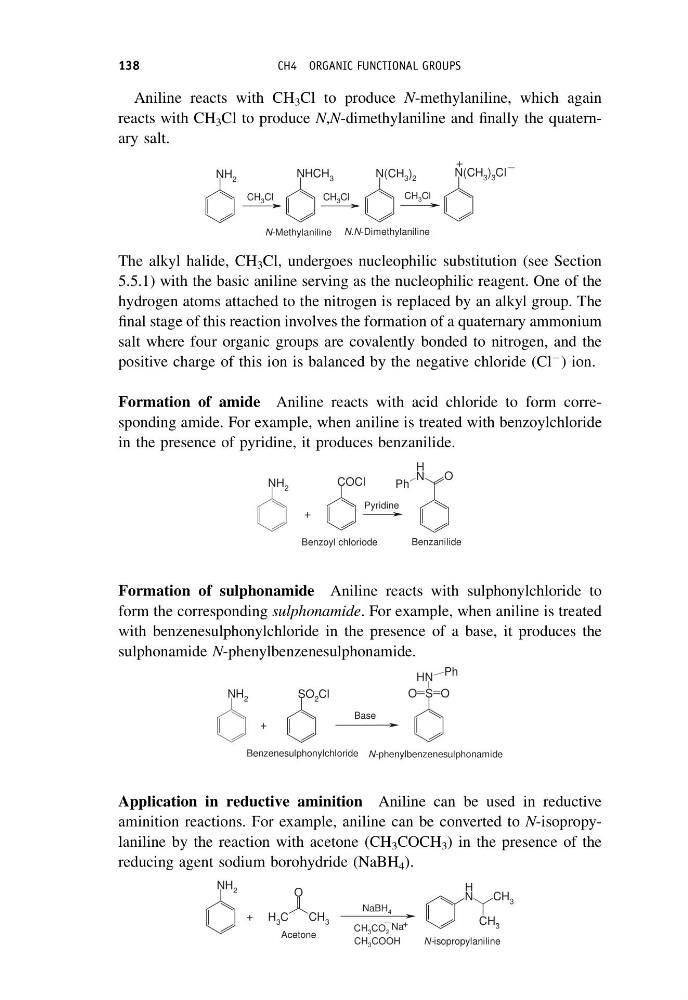
Aniline reacts with CH 3 Cl to produce N-methylaniline, which again
reacts with CH 3 Cl to produce N,N-dimethylaniline and finally the quaternary salt.
NH 2
N(CH 3 ) 3 Cl
NHCH 3
N(CH 3 ) 2
+
_
CH 3 Cl
CH 3 Cl
CH 3 Cl
N-Methylaniline N.N-Dimethylaniline
The alkyl halide, CH 3 Cl, undergoes nucleophilic substitution (see Section
5.5.1) with the basic aniline serving as the nucleophilic reagent. One of the
hydrogen atoms attached to the nitrogen is replaced by an alkyl group. The
final stage of this reaction involves the formation of a quaternary ammonium
salt where four organic groups are covalently bonded to nitrogen, and the
positive charge of this ion is balanced by the negative chloride (Cl
À ) ion.
Formation of amide Aniline reacts with acid chloride to form corresponding amide. For example, when aniline is treated with benzoylchloride
in the presence of pyridine, it produces benzanilide.
COCl
NH 2
O
N
H
Ph
Pyridine
Benzoyl chloriode
Benzanilide
+
Formation of sulphonamide Aniline reacts with sulphonylchloride to
form the corresponding sulphonamide. For example, when aniline is treated
with benzenesulphonylchloride in the presence of a base, it produces the
sulphonamide N-phenylbenzenesulphonamide.
SO 2 Cl
NH 2
S O
O
N
H
Ph
Base
Benzenesulphonylchloride N-phenylbenzenesulphonamide
+
Application in reductive aminition Aniline can be used in reductive
aminition reactions. For example, aniline can be converted to N-isopropylaniline by the reaction with acetone (CH 3 COCH 3 ) in the presence of the
reducing agent sodium borohydride (NaBH 4 ).
NH 2
C
H 3
O
CH 3
N
H
CH 3
CH 3
NaBH 4
Acetone
N-isopropylaniline
+
CH 3 CO 2
CH 3 COOH
_ +
Na
138
CH4 ORGANIC FUNCTIONAL GROUPS
reacts with CH 3 Cl to produce N,N-dimethylaniline and finally the quaternary salt.
NH 2
N(CH 3 ) 3 Cl
NHCH 3
N(CH 3 ) 2
+
_
CH 3 Cl
CH 3 Cl
CH 3 Cl
N-Methylaniline N.N-Dimethylaniline
The alkyl halide, CH 3 Cl, undergoes nucleophilic substitution (see Section
5.5.1) with the basic aniline serving as the nucleophilic reagent. One of the
hydrogen atoms attached to the nitrogen is replaced by an alkyl group. The
final stage of this reaction involves the formation of a quaternary ammonium
salt where four organic groups are covalently bonded to nitrogen, and the
positive charge of this ion is balanced by the negative chloride (Cl
À ) ion.
Formation of amide Aniline reacts with acid chloride to form corresponding amide. For example, when aniline is treated with benzoylchloride
in the presence of pyridine, it produces benzanilide.
COCl
NH 2
O
N
H
Ph
Pyridine
Benzoyl chloriode
Benzanilide
+
Formation of sulphonamide Aniline reacts with sulphonylchloride to
form the corresponding sulphonamide. For example, when aniline is treated
with benzenesulphonylchloride in the presence of a base, it produces the
sulphonamide N-phenylbenzenesulphonamide.
SO 2 Cl
NH 2
S O
O
N
H
Ph
Base
Benzenesulphonylchloride N-phenylbenzenesulphonamide
+
Application in reductive aminition Aniline can be used in reductive
aminition reactions. For example, aniline can be converted to N-isopropylaniline by the reaction with acetone (CH 3 COCH 3 ) in the presence of the
reducing agent sodium borohydride (NaBH 4 ).
NH 2
C
H 3
O
CH 3
N
H
CH 3
CH 3
NaBH 4
Acetone
N-isopropylaniline
+
CH 3 CO 2
CH 3 COOH
_ +
Na
138
CH4 ORGANIC FUNCTIONAL GROUPS