

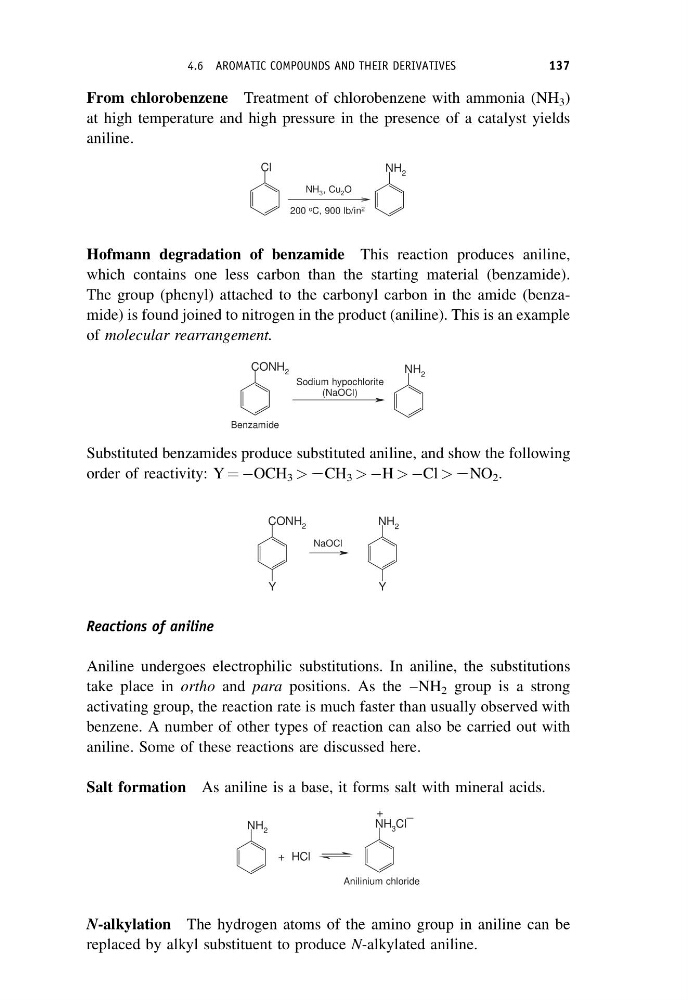
From chlorobenzene Treatment of chlorobenzene with ammonia (NH 3 )
at high temperature and high pressure in the presence of a catalyst yields
aniline.
Cl
NH 2
NH 3 , Cu 2 O
200 o C, 900 lb/in 2
Hofmann degradation of benzamide This reaction produces aniline,
which contains one less carbon than the starting material (benzamide).
The group (phenyl) attached to the carbonyl carbon in the amide (benzamide) is found joined to nitrogen in the product (aniline). This is an example
of molecular rearrangement.
CONH 2
NH 2
Benzamide
Sodium hypochlorite
(NaOCl)
Substituted benzamides produce substituted aniline, and show the following
order of reactivity: Y ¼ ÀOCH 3 > À ÀCH 3 > ÀH > ÀCl > À ÀNO 2 .
CONH 2
Y
NH 2
Y
NaOCl
Reactions of aniline
Aniline undergoes electrophilic substitutions. In aniline, the substitutions
take place in ortho and para positions. As the –NH 2 group is a strong
activating group, the reaction rate is much faster than usually observed with
benzene. A number of other types of reaction can also be carried out with
aniline. Some of these reactions are discussed here.
Salt formation As aniline is a base, it forms salt with mineral acids.
NH 2
NH 3 Cl
+ HCl
+
_
Anilinium chloride
N-alkylation The hydrogen atoms of the amino group in aniline can be
replaced by alkyl substituent to produce N-alkylated aniline.
4.6 AROMATIC COMPOUNDS AND THEIR DERIVATIVES
137
at high temperature and high pressure in the presence of a catalyst yields
aniline.
Cl
NH 2
NH 3 , Cu 2 O
200 o C, 900 lb/in 2
Hofmann degradation of benzamide This reaction produces aniline,
which contains one less carbon than the starting material (benzamide).
The group (phenyl) attached to the carbonyl carbon in the amide (benzamide) is found joined to nitrogen in the product (aniline). This is an example
of molecular rearrangement.
CONH 2
NH 2
Benzamide
Sodium hypochlorite
(NaOCl)
Substituted benzamides produce substituted aniline, and show the following
order of reactivity: Y ¼ ÀOCH 3 > À ÀCH 3 > ÀH > ÀCl > À ÀNO 2 .
CONH 2
Y
NH 2
Y
NaOCl
Reactions of aniline
Aniline undergoes electrophilic substitutions. In aniline, the substitutions
take place in ortho and para positions. As the –NH 2 group is a strong
activating group, the reaction rate is much faster than usually observed with
benzene. A number of other types of reaction can also be carried out with
aniline. Some of these reactions are discussed here.
Salt formation As aniline is a base, it forms salt with mineral acids.
NH 2
NH 3 Cl
+ HCl
+
_
Anilinium chloride
N-alkylation The hydrogen atoms of the amino group in aniline can be
replaced by alkyl substituent to produce N-alkylated aniline.
4.6 AROMATIC COMPOUNDS AND THEIR DERIVATIVES
137