

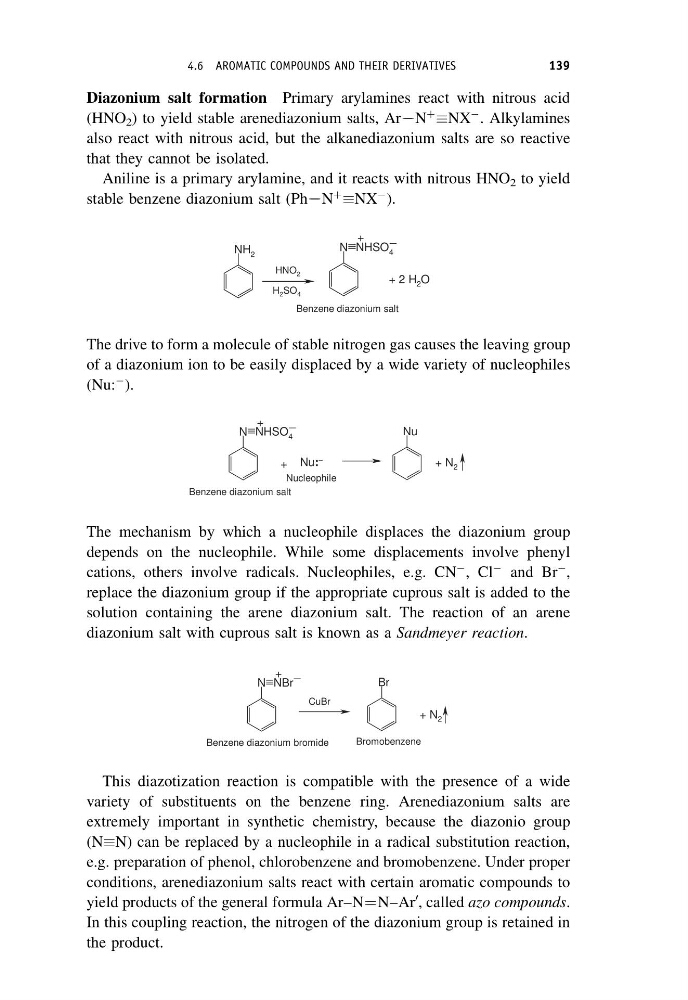
Diazonium salt formation Primary arylamines react with nitrous acid
(HNO 2 ) to yield stable arenediazonium salts, ArÀ ÀN þ NX
À . Alkylamines
also react with nitrous acid, but the alkanediazonium salts are so reactive
that they cannot be isolated.
Aniline is a primary arylamine, and it reacts with nitrous HNO 2 to yield
stable benzene diazonium salt (PhÀ ÀN þ NX
À ).
NH 2
N NHSO 4
HNO 2
Benzene diazonium salt
H 2 SO 4
+
_
+ 2 H 2 O
The drive to form a molecule of stable nitrogen gas causes the leaving group
of a diazonium ion to be easily displaced by a wide variety of nucleophiles
(Nu:
À ).
Nu
N NHSO 4
Nucleophile
Benzene diazonium salt
Nu: −
+ N 2
+
_
+
The mechanism by which a nucleophile displaces the diazonium group
depends on the nucleophile. While some displacements involve phenyl
cations, others involve radicals. Nucleophiles, e.g. CN
À , Cl
À and Br
À ,
replace the diazonium group if the appropriate cuprous salt is added to the
solution containing the arene diazonium salt. The reaction of an arene
diazonium salt with cuprous salt is known as a Sandmeyer reaction.
Br
N NBr
Benzene diazonium bromide
+ _
+ N 2
CuBr
Bromobenzene
This diazotization reaction is compatible with the presence of a wide
variety of substituents on the benzene ring. Arenediazonium salts are
extremely important in synthetic chemistry, because the diazonio group
(NN) can be replaced by a nucleophile in a radical substitution reaction,
e.g. preparation of phenol, chlorobenzene and bromobenzene. Under proper
conditions, arenediazonium salts react with certain aromatic compounds to
yield products of the general formula Ar–N À À
À À N–Ar
0 , called azo compounds.
In this coupling reaction, the nitrogen of the diazonium group is retained in
the product.
4.6 AROMATIC COMPOUNDS AND THEIR DERIVATIVES
139
(HNO 2 ) to yield stable arenediazonium salts, ArÀ ÀN þ NX
À . Alkylamines
also react with nitrous acid, but the alkanediazonium salts are so reactive
that they cannot be isolated.
Aniline is a primary arylamine, and it reacts with nitrous HNO 2 to yield
stable benzene diazonium salt (PhÀ ÀN þ NX
À ).
NH 2
N NHSO 4
HNO 2
Benzene diazonium salt
H 2 SO 4
+
_
+ 2 H 2 O
The drive to form a molecule of stable nitrogen gas causes the leaving group
of a diazonium ion to be easily displaced by a wide variety of nucleophiles
(Nu:
À ).
Nu
N NHSO 4
Nucleophile
Benzene diazonium salt
Nu: −
+ N 2
+
_
+
The mechanism by which a nucleophile displaces the diazonium group
depends on the nucleophile. While some displacements involve phenyl
cations, others involve radicals. Nucleophiles, e.g. CN
À , Cl
À and Br
À ,
replace the diazonium group if the appropriate cuprous salt is added to the
solution containing the arene diazonium salt. The reaction of an arene
diazonium salt with cuprous salt is known as a Sandmeyer reaction.
Br
N NBr
Benzene diazonium bromide
+ _
+ N 2
CuBr
Bromobenzene
This diazotization reaction is compatible with the presence of a wide
variety of substituents on the benzene ring. Arenediazonium salts are
extremely important in synthetic chemistry, because the diazonio group
(NN) can be replaced by a nucleophile in a radical substitution reaction,
e.g. preparation of phenol, chlorobenzene and bromobenzene. Under proper
conditions, arenediazonium salts react with certain aromatic compounds to
yield products of the general formula Ar–N À À
À À N–Ar
0 , called azo compounds.
In this coupling reaction, the nitrogen of the diazonium group is retained in
the product.
4.6 AROMATIC COMPOUNDS AND THEIR DERIVATIVES
139