

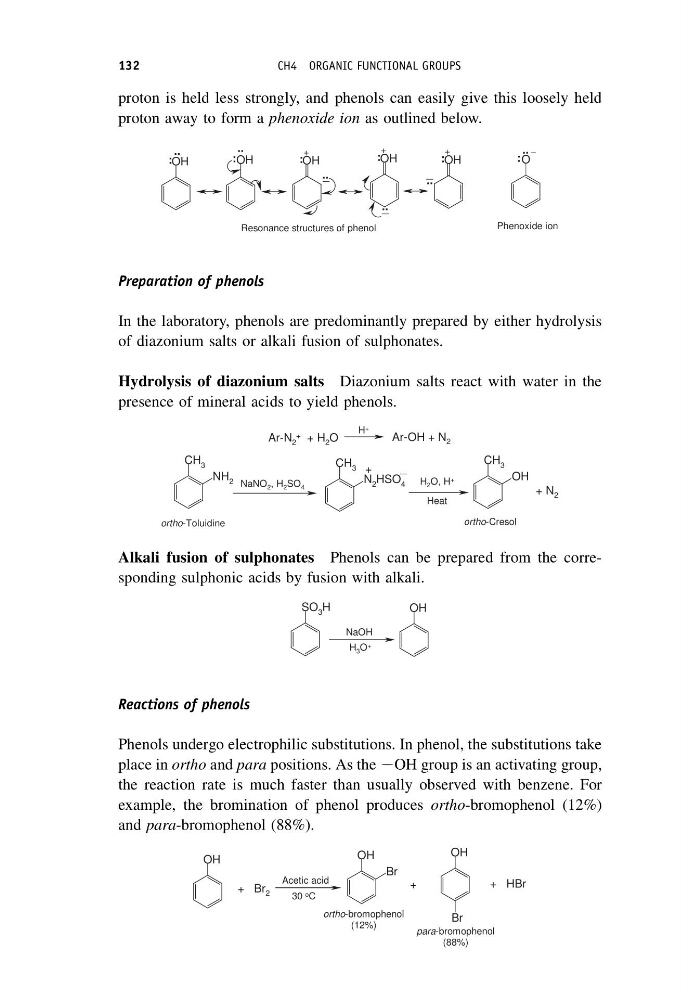
proton is held less strongly, and phenols can easily give this loosely held
proton away to form a phenoxide ion as outlined below.
OH
OH
OH
OH
OH
O
:
:
:
:
+
:
+
Resonance structures of phenol
:
..
Phenoxide ion
..
..
..
.. _
_
+
..
_
Preparation of phenols
In the laboratory, phenols are predominantly prepared by either hydrolysis
of diazonium salts or alkali fusion of sulphonates.
Hydrolysis of diazonium salts Diazonium salts react with water in the
presence of mineral acids to yield phenols.
Ar-N 2
+ + H 2 O
Ar-OH + N 2
H +
CH 3
NH 2
CH 3
N 2 HSO 4
CH 3
OH
ortho-Toluidine
NaNO 2 , H 2 SO 4
+
_
H 2 O, H +
Heat
+ N 2
ortho-Cresol
Alkali fusion of sulphonates Phenols can be prepared from the corresponding sulphonic acids by fusion with alkali.
SO 3 H
OH
NaOH
H 3 O +
Reactions of phenols
Phenols undergo electrophilic substitutions. In phenol, the substitutions take
place in ortho and para positions. As the À ÀOH group is an activating group,
the reaction rate is much faster than usually observed with benzene. For
example, the bromination of phenol produces ortho-bromophenol (12%)
and para-bromophenol (88%).
OH
OH
Br
OH
Br
Acetic acid
30 o C
+ Br 2
+
+ HBr
ortho-bromophenol
(12%)
para-bromophenol
(88%)
132
CH4 ORGANIC FUNCTIONAL GROUPS
proton away to form a phenoxide ion as outlined below.
OH
OH
OH
OH
OH
O
:
:
:
:
+
:
+
Resonance structures of phenol
:
..
Phenoxide ion
..
..
..
.. _
_
+
..
_
Preparation of phenols
In the laboratory, phenols are predominantly prepared by either hydrolysis
of diazonium salts or alkali fusion of sulphonates.
Hydrolysis of diazonium salts Diazonium salts react with water in the
presence of mineral acids to yield phenols.
Ar-N 2
+ + H 2 O
Ar-OH + N 2
H +
CH 3
NH 2
CH 3
N 2 HSO 4
CH 3
OH
ortho-Toluidine
NaNO 2 , H 2 SO 4
+
_
H 2 O, H +
Heat
+ N 2
ortho-Cresol
Alkali fusion of sulphonates Phenols can be prepared from the corresponding sulphonic acids by fusion with alkali.
SO 3 H
OH
NaOH
H 3 O +
Reactions of phenols
Phenols undergo electrophilic substitutions. In phenol, the substitutions take
place in ortho and para positions. As the À ÀOH group is an activating group,
the reaction rate is much faster than usually observed with benzene. For
example, the bromination of phenol produces ortho-bromophenol (12%)
and para-bromophenol (88%).
OH
OH
Br
OH
Br
Acetic acid
30 o C
+ Br 2
+
+ HBr
ortho-bromophenol
(12%)
para-bromophenol
(88%)
132
CH4 ORGANIC FUNCTIONAL GROUPS