

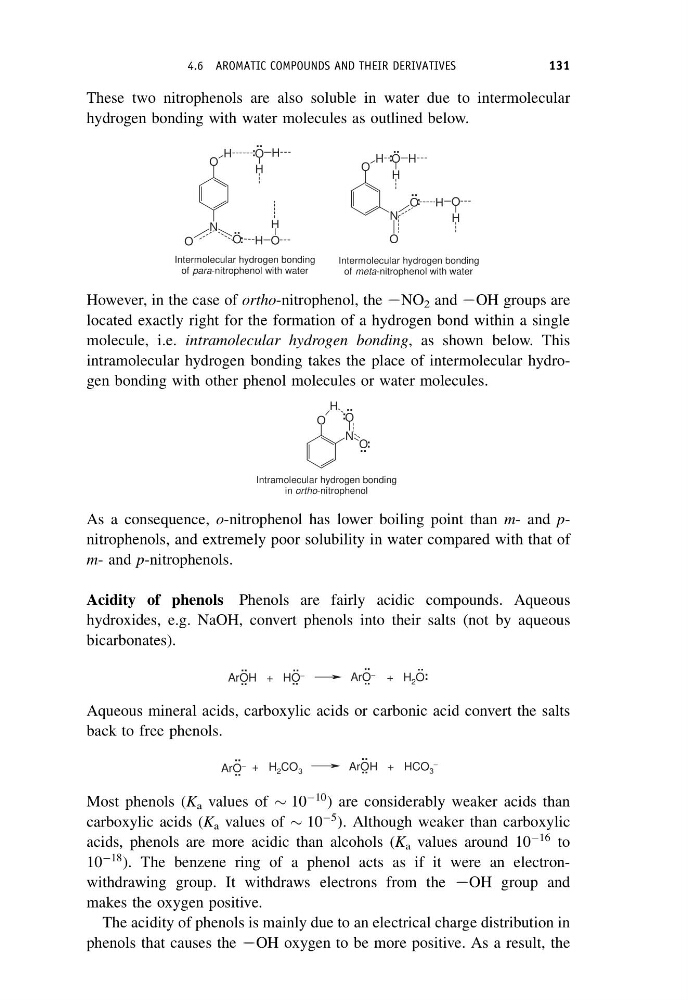
These two nitrophenols are also soluble in water due to intermolecular
hydrogen bonding with water molecules as outlined below.
H O
H
O
H
N
O
O
O H
H
O H
H
O
H
N
O
O
H O
H
Intermolecular hydrogen bonding
of para-nitrophenol with water
Intermolecular hydrogen bonding
of meta-nitrophenol with water
..
:
:
..
..
:
:
..
However, in the case of ortho-nitrophenol, the À ÀNO 2 and À ÀOH groups are
located exactly right for the formation of a hydrogen bond within a single
molecule, i.e. intramolecular hydrogen bonding, as shown below. This
intramolecular hydrogen bonding takes the place of intermolecular hydrogen bonding with other phenol molecules or water molecules.
N
O
H
O
O
Intramolecular hydrogen bonding
in ortho-nitrophenol
..
:
:
..
As a consequence, o-nitrophenol has lower boiling point than m- and pnitrophenols, and extremely poor solubility in water compared with that of
m- and p-nitrophenols.
Acidity of phenols Phenols are fairly acidic compounds. Aqueous
hydroxides, e.g. NaOH, convert phenols into their salts (not by aqueous
bicarbonates).
ArOH + HO −
ArO − + H 2 O:
..
..
..
..
..
..
..
Aqueous mineral acids, carboxylic acids or carbonic acid convert the salts
back to free phenols.
+ H 2 CO 3
ArOH + HCO 3
−
ArO −
..
..
..
..
Most phenols (K a values of $ 10
À10 ) are considerably weaker acids than
carboxylic acids (K a values of $ 10
À5 ). Although weaker than carboxylic
acids, phenols are more acidic than alcohols (K a values around 10
À16 to
10
À18 ). The benzene ring of a phenol acts as if it were an electronwithdrawing group. It withdraws electrons from the À ÀOH group and
makes the oxygen positive.
The acidity of phenols is mainly due to an electrical charge distribution in
phenols that causes the À ÀOH oxygen to be more positive. As a result, the
4.6 AROMATIC COMPOUNDS AND THEIR DERIVATIVES
131
hydrogen bonding with water molecules as outlined below.
H O
H
O
H
N
O
O
O H
H
O H
H
O
H
N
O
O
H O
H
Intermolecular hydrogen bonding
of para-nitrophenol with water
Intermolecular hydrogen bonding
of meta-nitrophenol with water
..
:
:
..
..
:
:
..
However, in the case of ortho-nitrophenol, the À ÀNO 2 and À ÀOH groups are
located exactly right for the formation of a hydrogen bond within a single
molecule, i.e. intramolecular hydrogen bonding, as shown below. This
intramolecular hydrogen bonding takes the place of intermolecular hydrogen bonding with other phenol molecules or water molecules.
N
O
H
O
O
Intramolecular hydrogen bonding
in ortho-nitrophenol
..
:
:
..
As a consequence, o-nitrophenol has lower boiling point than m- and pnitrophenols, and extremely poor solubility in water compared with that of
m- and p-nitrophenols.
Acidity of phenols Phenols are fairly acidic compounds. Aqueous
hydroxides, e.g. NaOH, convert phenols into their salts (not by aqueous
bicarbonates).
ArOH + HO −
ArO − + H 2 O:
..
..
..
..
..
..
..
Aqueous mineral acids, carboxylic acids or carbonic acid convert the salts
back to free phenols.
+ H 2 CO 3
ArOH + HCO 3
−
ArO −
..
..
..
..
Most phenols (K a values of $ 10
À10 ) are considerably weaker acids than
carboxylic acids (K a values of $ 10
À5 ). Although weaker than carboxylic
acids, phenols are more acidic than alcohols (K a values around 10
À16 to
10
À18 ). The benzene ring of a phenol acts as if it were an electronwithdrawing group. It withdraws electrons from the À ÀOH group and
makes the oxygen positive.
The acidity of phenols is mainly due to an electrical charge distribution in
phenols that causes the À ÀOH oxygen to be more positive. As a result, the
4.6 AROMATIC COMPOUNDS AND THEIR DERIVATIVES
131