

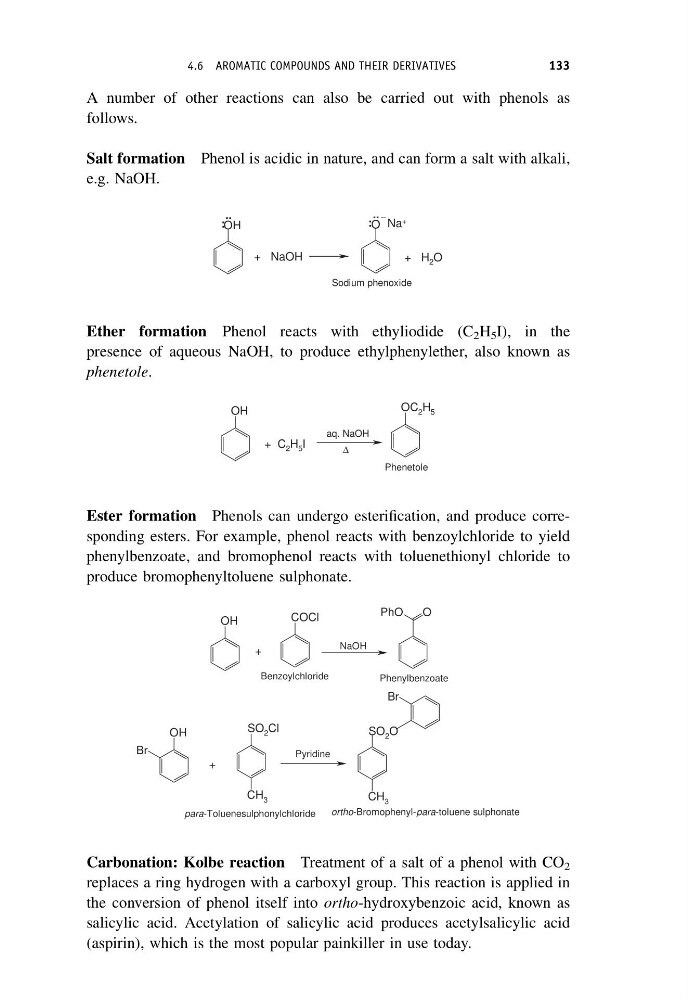
A number of other reactions can also be carried out with phenols as
follows.
Salt formation Phenol is acidic in nature, and can form a salt with alkali,
e.g. NaOH.
OH
O
+ NaOH
Sodium phenoxide
+ H 2 O
Na +
..
:
:
..
Ether formation Phenol reacts with ethyliodide (C 2 H 5 I), in the
presence of aqueous NaOH, to produce ethylphenylether, also known as
phenetole.
OH
OC 2 H 5
Phenetole
aq. NaOH
∆
+ C 2 H 5 I
Ester formation Phenols can undergo esterification, and produce corresponding esters. For example, phenol reacts with benzoylchloride to yield
phenylbenzoate, and bromophenol reacts with toluenethionyl chloride to
produce bromophenyltoluene sulphonate.
OH
COCl
PhO
O
Phenylbenzoate
NaOH
+
Benzoylchloride
OH
Br
CH 3
SO 2 O
SO 2 Cl
CH 3
Br
ortho-Bromophenyl-para-toluene sulphonate
Pyridine
+
para-Toluenesulphonylchloride
Carbonation: Kolbe reaction Treatment of a salt of a phenol with CO 2
replaces a ring hydrogen with a carboxyl group. This reaction is applied in
the conversion of phenol itself into ortho-hydroxybenzoic acid, known as
salicylic acid. Acetylation of salicylic acid produces acetylsalicylic acid
(aspirin), which is the most popular painkiller in use today.
4.6 AROMATIC COMPOUNDS AND THEIR DERIVATIVES
133
follows.
Salt formation Phenol is acidic in nature, and can form a salt with alkali,
e.g. NaOH.
OH
O
+ NaOH
Sodium phenoxide
+ H 2 O
Na +
..
:
:
..
Ether formation Phenol reacts with ethyliodide (C 2 H 5 I), in the
presence of aqueous NaOH, to produce ethylphenylether, also known as
phenetole.
OH
OC 2 H 5
Phenetole
aq. NaOH
∆
+ C 2 H 5 I
Ester formation Phenols can undergo esterification, and produce corresponding esters. For example, phenol reacts with benzoylchloride to yield
phenylbenzoate, and bromophenol reacts with toluenethionyl chloride to
produce bromophenyltoluene sulphonate.
OH
COCl
PhO
O
Phenylbenzoate
NaOH
+
Benzoylchloride
OH
Br
CH 3
SO 2 O
SO 2 Cl
CH 3
Br
ortho-Bromophenyl-para-toluene sulphonate
Pyridine
+
para-Toluenesulphonylchloride
Carbonation: Kolbe reaction Treatment of a salt of a phenol with CO 2
replaces a ring hydrogen with a carboxyl group. This reaction is applied in
the conversion of phenol itself into ortho-hydroxybenzoic acid, known as
salicylic acid. Acetylation of salicylic acid produces acetylsalicylic acid
(aspirin), which is the most popular painkiller in use today.
4.6 AROMATIC COMPOUNDS AND THEIR DERIVATIVES
133