

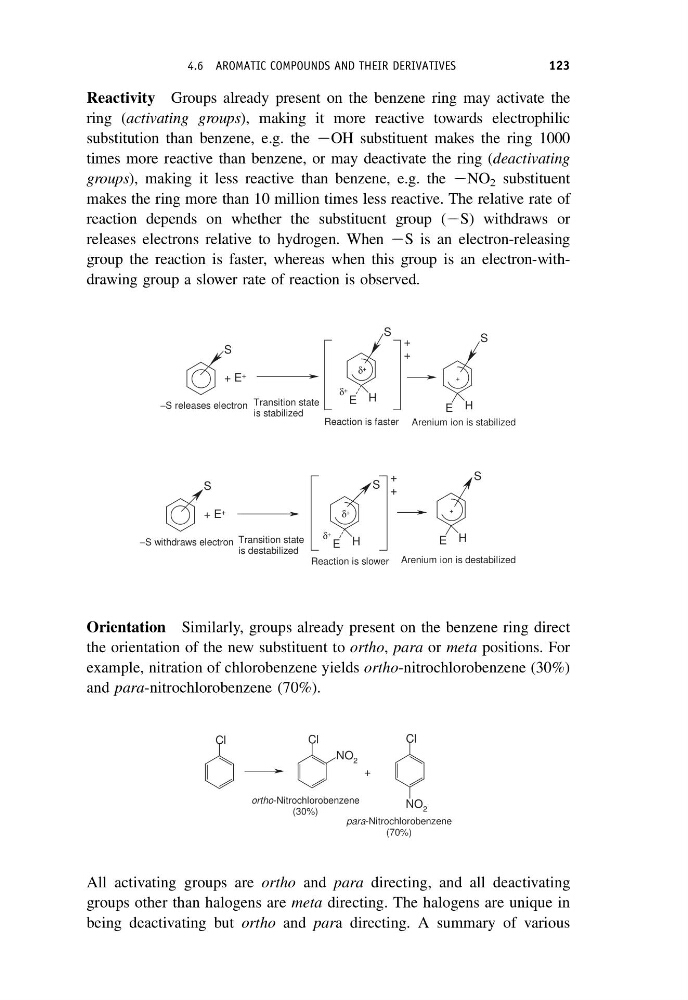
Reactivity Groups already present on the benzene ring may activate the
ring (activating groups), making it more reactive towards electrophilic
substitution than benzene, e.g. the À ÀOH substituent makes the ring 1000
times more reactive than benzene, or may deactivate the ring (deactivating
groups), making it less reactive than benzene, e.g. the À ÀNO 2 substituent
makes the ring more than 10 million times less reactive. The relative rate of
reaction depends on whether the substituent group (À ÀS) withdraws or
releases electrons relative to hydrogen. When À ÀS is an electron-releasing
group the reaction is faster, whereas when this group is an electron-withdrawing group a slower rate of reaction is observed.
H
E
H
E
+ E +
S
δ +
S
δ +
+
+
+
−S releases electron Transition state
is stabilized
Reaction is faster Arenium ion is stabilized
S
H
E
H
E
+ E +
S
δ +
S
δ +
+
+
+
−S withdraws electron Transition state
is destabilized
Reaction is slower Arenium ion is destabilized
S
Orientation Similarly, groups already present on the benzene ring direct
the orientation of the new substituent to ortho, para or meta positions. For
example, nitration of chlorobenzene yields ortho-nitrochlorobenzene (30%)
and para-nitrochlorobenzene (70%).
Cl
Cl
NO 2
Cl
NO 2
+
ortho-Nitrochlorobenzene
(30%)
para-Nitrochlorobenzene
(70%)
All activating groups are ortho and para directing, and all deactivating
groups other than halogens are meta directing. The halogens are unique in
being deactivating but ortho and para directing. A summary of various
4.6 AROMATIC COMPOUNDS AND THEIR DERIVATIVES
123
ring (activating groups), making it more reactive towards electrophilic
substitution than benzene, e.g. the À ÀOH substituent makes the ring 1000
times more reactive than benzene, or may deactivate the ring (deactivating
groups), making it less reactive than benzene, e.g. the À ÀNO 2 substituent
makes the ring more than 10 million times less reactive. The relative rate of
reaction depends on whether the substituent group (À ÀS) withdraws or
releases electrons relative to hydrogen. When À ÀS is an electron-releasing
group the reaction is faster, whereas when this group is an electron-withdrawing group a slower rate of reaction is observed.
H
E
H
E
+ E +
S
δ +
S
δ +
+
+
+
−S releases electron Transition state
is stabilized
Reaction is faster Arenium ion is stabilized
S
H
E
H
E
+ E +
S
δ +
S
δ +
+
+
+
−S withdraws electron Transition state
is destabilized
Reaction is slower Arenium ion is destabilized
S
Orientation Similarly, groups already present on the benzene ring direct
the orientation of the new substituent to ortho, para or meta positions. For
example, nitration of chlorobenzene yields ortho-nitrochlorobenzene (30%)
and para-nitrochlorobenzene (70%).
Cl
Cl
NO 2
Cl
NO 2
+
ortho-Nitrochlorobenzene
(30%)
para-Nitrochlorobenzene
(70%)
All activating groups are ortho and para directing, and all deactivating
groups other than halogens are meta directing. The halogens are unique in
being deactivating but ortho and para directing. A summary of various
4.6 AROMATIC COMPOUNDS AND THEIR DERIVATIVES
123