

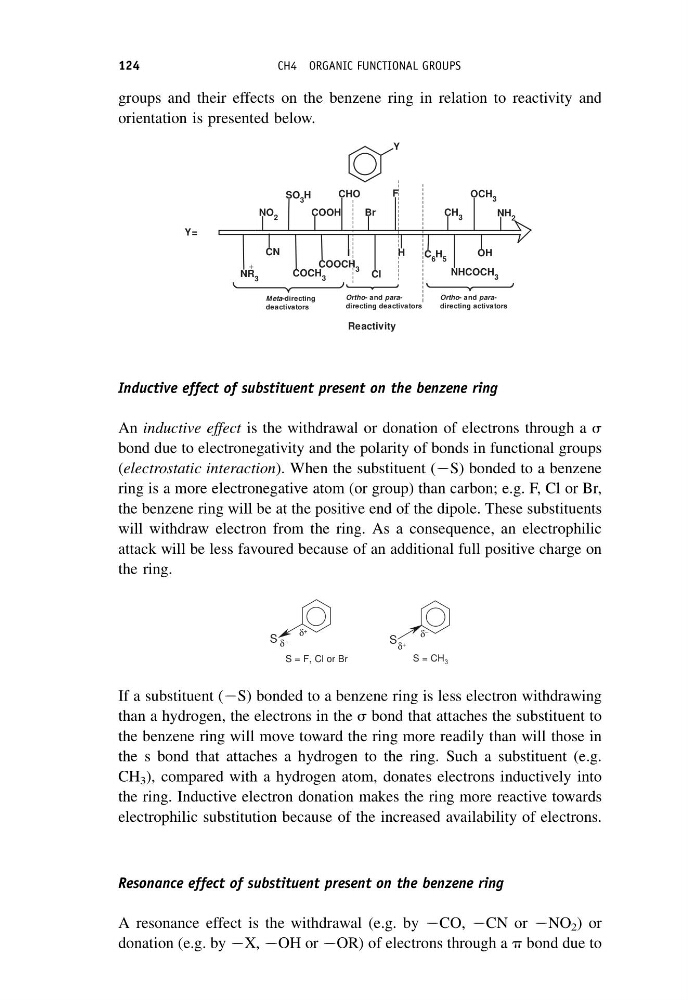
groups and their effects on the benzene ring in relation to reactivity and
orientation is presented below.
Ortho- and paradirecting activators
Ortho- and paradirecting deactivators
Meta-directing
deactivators
Reactivity
Y=
Y
C 6 H 5
NR 3
NO 2
OH
NHCOCH 3
H
Cl
I
COOCH 3
COCH 3
CN
NH 2
OCH 3
CH 3
F
Br
CHO
COOH
SO 3 H
+
Inductive effect of substituent present on the benzene ring
An inductive effect is the withdrawal or donation of electrons through a s
bond due to electronegativity and the polarity of bonds in functional groups
(electrostatic interaction). When the substituent (À ÀS) bonded to a benzene
ring is a more electronegative atom (or group) than carbon; e.g. F, Cl or Br,
the benzene ring will be at the positive end of the dipole. These substituents
will withdraw electron from the ring. As a consequence, an electrophilic
attack will be less favoured because of an additional full positive charge on
the ring.
S δ −
δ +
S = F, Cl or Br
δ −
δ +
S
S = CH 3
If a substituent (À ÀS) bonded to a benzene ring is less electron withdrawing
than a hydrogen, the electrons in the s bond that attaches the substituent to
the benzene ring will move toward the ring more readily than will those in
the s bond that attaches a hydrogen to the ring. Such a substituent (e.g.
CH 3 ), compared with a hydrogen atom, donates electrons inductively into
the ring. Inductive electron donation makes the ring more reactive towards
electrophilic substitution because of the increased availability of electrons.
Resonance effect of substituent present on the benzene ring
A resonance effect is the withdrawal (e.g. by À ÀCO, À ÀCN or À ÀNO 2 ) or
donation (e.g. by À ÀX, À ÀOH or À ÀOR) of electrons through a p bond due to
124
CH4 ORGANIC FUNCTIONAL GROUPS
orientation is presented below.
Ortho- and paradirecting activators
Ortho- and paradirecting deactivators
Meta-directing
deactivators
Reactivity
Y=
Y
C 6 H 5
NR 3
NO 2
OH
NHCOCH 3
H
Cl
I
COOCH 3
COCH 3
CN
NH 2
OCH 3
CH 3
F
Br
CHO
COOH
SO 3 H
+
Inductive effect of substituent present on the benzene ring
An inductive effect is the withdrawal or donation of electrons through a s
bond due to electronegativity and the polarity of bonds in functional groups
(electrostatic interaction). When the substituent (À ÀS) bonded to a benzene
ring is a more electronegative atom (or group) than carbon; e.g. F, Cl or Br,
the benzene ring will be at the positive end of the dipole. These substituents
will withdraw electron from the ring. As a consequence, an electrophilic
attack will be less favoured because of an additional full positive charge on
the ring.
S δ −
δ +
S = F, Cl or Br
δ −
δ +
S
S = CH 3
If a substituent (À ÀS) bonded to a benzene ring is less electron withdrawing
than a hydrogen, the electrons in the s bond that attaches the substituent to
the benzene ring will move toward the ring more readily than will those in
the s bond that attaches a hydrogen to the ring. Such a substituent (e.g.
CH 3 ), compared with a hydrogen atom, donates electrons inductively into
the ring. Inductive electron donation makes the ring more reactive towards
electrophilic substitution because of the increased availability of electrons.
Resonance effect of substituent present on the benzene ring
A resonance effect is the withdrawal (e.g. by À ÀCO, À ÀCN or À ÀNO 2 ) or
donation (e.g. by À ÀX, À ÀOH or À ÀOR) of electrons through a p bond due to
124
CH4 ORGANIC FUNCTIONAL GROUPS