

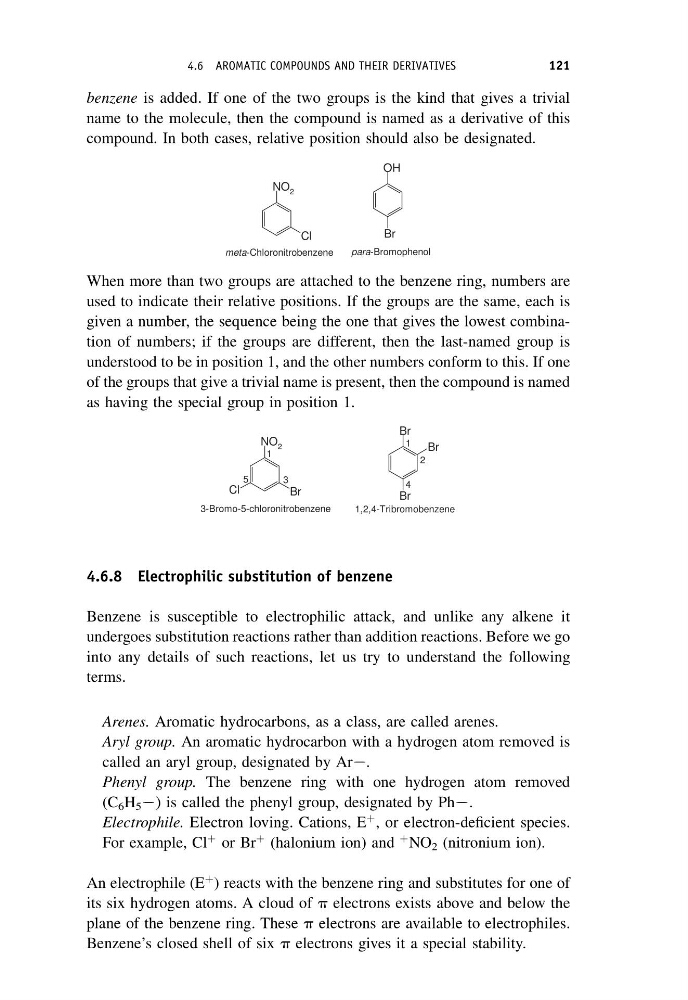
benzene is added. If one of the two groups is the kind that gives a trivial
name to the molecule, then the compound is named as a derivative of this
compound. In both cases, relative position should also be designated.
NO 2
Cl
OH
Br
meta-Chloronitrobenzene
para-Bromophenol
When more than two groups are attached to the benzene ring, numbers are
used to indicate their relative positions. If the groups are the same, each is
given a number, the sequence being the one that gives the lowest combination of numbers; if the groups are different, then the last-named group is
understood to be in position 1, and the other numbers conform to this. If one
of the groups that give a trivial name is present, then the compound is named
as having the special group in position 1.
NO 2
Br
Cl
Br
Br
Br
3-Bromo-5-chloronitrobenzene
1,2,4-Tribromobenzene
1
2
3
4
5
1
4.6.8 Electrophilic substitution of benzene
Benzene is susceptible to electrophilic attack, and unlike any alkene it
undergoes substitution reactions rather than addition reactions. Before we go
into any details of such reactions, let us try to understand the following
terms.
Arenes. Aromatic hydrocarbons, as a class, are called arenes.
Aryl group. An aromatic hydrocarbon with a hydrogen atom removed is
called an aryl group, designated by ArÀ À.
Phenyl group. The benzene ring with one hydrogen atom removed
(C 6 H 5 À À) is called the phenyl group, designated by PhÀ À.
Electrophile. Electron loving. Cations, E
þ , or electron-deficient species.
For example, Cl
þ or Br
þ (halonium ion) and
þ NO 2 (nitronium ion).
An electrophile (E
þ ) reacts with the benzene ring and substitutes for one of
its six hydrogen atoms. A cloud of p electrons exists above and below the
plane of the benzene ring. These p electrons are available to electrophiles.
Benzene’s closed shell of six p electrons gives it a special stability.
4.6 AROMATIC COMPOUNDS AND THEIR DERIVATIVES
121
name to the molecule, then the compound is named as a derivative of this
compound. In both cases, relative position should also be designated.
NO 2
Cl
OH
Br
meta-Chloronitrobenzene
para-Bromophenol
When more than two groups are attached to the benzene ring, numbers are
used to indicate their relative positions. If the groups are the same, each is
given a number, the sequence being the one that gives the lowest combination of numbers; if the groups are different, then the last-named group is
understood to be in position 1, and the other numbers conform to this. If one
of the groups that give a trivial name is present, then the compound is named
as having the special group in position 1.
NO 2
Br
Cl
Br
Br
Br
3-Bromo-5-chloronitrobenzene
1,2,4-Tribromobenzene
1
2
3
4
5
1
4.6.8 Electrophilic substitution of benzene
Benzene is susceptible to electrophilic attack, and unlike any alkene it
undergoes substitution reactions rather than addition reactions. Before we go
into any details of such reactions, let us try to understand the following
terms.
Arenes. Aromatic hydrocarbons, as a class, are called arenes.
Aryl group. An aromatic hydrocarbon with a hydrogen atom removed is
called an aryl group, designated by ArÀ À.
Phenyl group. The benzene ring with one hydrogen atom removed
(C 6 H 5 À À) is called the phenyl group, designated by PhÀ À.
Electrophile. Electron loving. Cations, E
þ , or electron-deficient species.
For example, Cl
þ or Br
þ (halonium ion) and
þ NO 2 (nitronium ion).
An electrophile (E
þ ) reacts with the benzene ring and substitutes for one of
its six hydrogen atoms. A cloud of p electrons exists above and below the
plane of the benzene ring. These p electrons are available to electrophiles.
Benzene’s closed shell of six p electrons gives it a special stability.
4.6 AROMATIC COMPOUNDS AND THEIR DERIVATIVES
121