

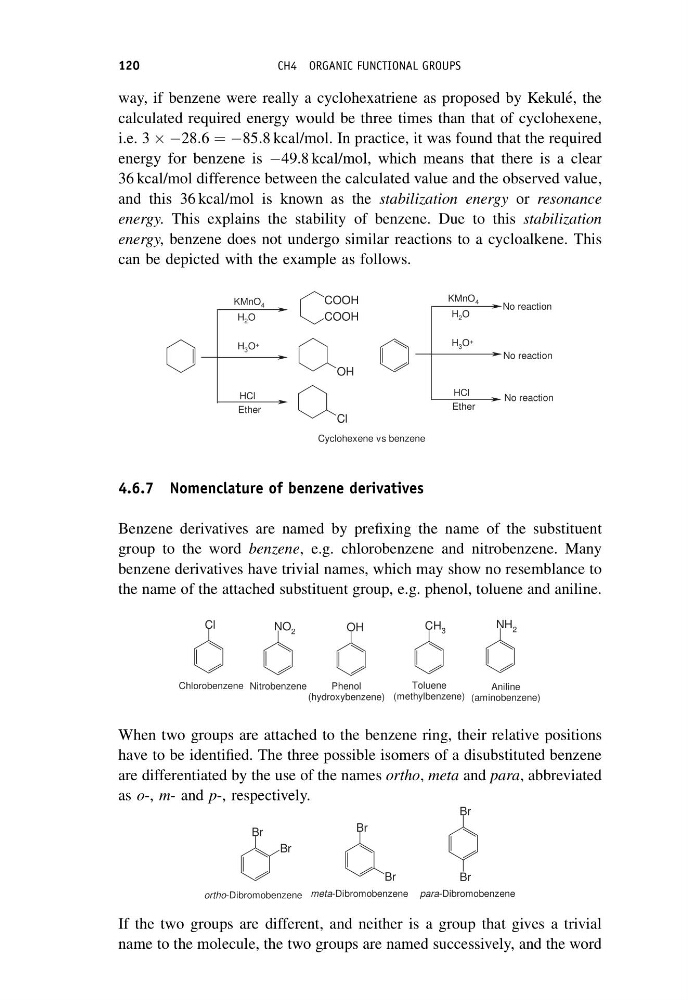
way, if benzene were really a cyclohexatriene as proposed by Kekule ´, the
calculated required energy would be three times than that of cyclohexene,
i.e. 3 Â À28:6 ¼ À85:8 kcal/mol. In practice, it was found that the required
energy for benzene is À49.8 kcal/mol, which means that there is a clear
36 kcal/mol difference between the calculated value and the observed value,
and this 36 kcal/mol is known as the stabilization energy or resonance
energy. This explains the stability of benzene. Due to this stabilization
energy, benzene does not undergo similar reactions to a cycloalkene. This
can be depicted with the example as follows.
COOH
COOH
Cl
OH
KMnO 4
H 2 O
H 3 O +
HCl
Ether
No reaction
No reaction
Cyclohexene vs benzene
No reaction
KMnO 4
H 2 O
H 3 O +
HCl
Ether
4.6.7 Nomenclature of benzene derivatives
Benzene derivatives are named by prefixing the name of the substituent
group to the word benzene, e.g. chlorobenzene and nitrobenzene. Many
benzene derivatives have trivial names, which may show no resemblance to
the name of the attached substituent group, e.g. phenol, toluene and aniline.
OH
CH 3
NH 2
Cl
NO 2
Phenol
(hydroxybenzene)
Toluene
(methylbenzene)
Aniline
(aminobenzene)
Chlorobenzene Nitrobenzene
When two groups are attached to the benzene ring, their relative positions
have to be identified. The three possible isomers of a disubstituted benzene
are differentiated by the use of the names ortho, meta and para, abbreviated
as o-, m- and p-, respectively.
Br
Br
Br
Br
Br
Br
ortho-Dibromobenzene meta-Dibromobenzene para-Dibromobenzene
If the two groups are different, and neither is a group that gives a trivial
name to the molecule, the two groups are named successively, and the word
120
CH4 ORGANIC FUNCTIONAL GROUPS
calculated required energy would be three times than that of cyclohexene,
i.e. 3 Â À28:6 ¼ À85:8 kcal/mol. In practice, it was found that the required
energy for benzene is À49.8 kcal/mol, which means that there is a clear
36 kcal/mol difference between the calculated value and the observed value,
and this 36 kcal/mol is known as the stabilization energy or resonance
energy. This explains the stability of benzene. Due to this stabilization
energy, benzene does not undergo similar reactions to a cycloalkene. This
can be depicted with the example as follows.
COOH
COOH
Cl
OH
KMnO 4
H 2 O
H 3 O +
HCl
Ether
No reaction
No reaction
Cyclohexene vs benzene
No reaction
KMnO 4
H 2 O
H 3 O +
HCl
Ether
4.6.7 Nomenclature of benzene derivatives
Benzene derivatives are named by prefixing the name of the substituent
group to the word benzene, e.g. chlorobenzene and nitrobenzene. Many
benzene derivatives have trivial names, which may show no resemblance to
the name of the attached substituent group, e.g. phenol, toluene and aniline.
OH
CH 3
NH 2
Cl
NO 2
Phenol
(hydroxybenzene)
Toluene
(methylbenzene)
Aniline
(aminobenzene)
Chlorobenzene Nitrobenzene
When two groups are attached to the benzene ring, their relative positions
have to be identified. The three possible isomers of a disubstituted benzene
are differentiated by the use of the names ortho, meta and para, abbreviated
as o-, m- and p-, respectively.
Br
Br
Br
Br
Br
Br
ortho-Dibromobenzene meta-Dibromobenzene para-Dibromobenzene
If the two groups are different, and neither is a group that gives a trivial
name to the molecule, the two groups are named successively, and the word
120
CH4 ORGANIC FUNCTIONAL GROUPS