

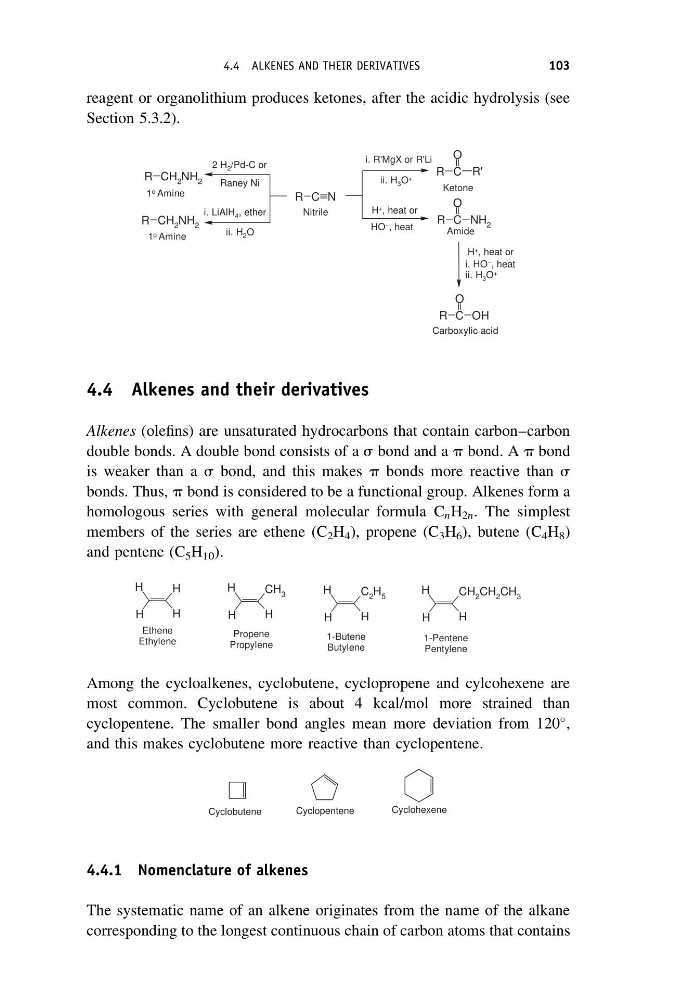
reagent or organolithium produces ketones, after the acidic hydrolysis (see
Section 5.3.2).
R C N
R C NH 2
O
R C R'
O
R CH 2 NH 2
R CH 2 NH 2
R C OH
O
Amide
Ketone
1 o Amine
2 H 2 /Pd-C or
Nitrile
i. LiAlH 4 , ether
ii. H 3 O +
1 o Amine
i. R'MgX or R'Li
ii. H 2 O
Carboxylic acid
Raney Ni
H + , heat or
i. HO − , heat
ii. H 3 O +
H + , heat or
HO − , heat
4.4 Alkenes and their derivatives
Alkenes (olefins) are unsaturated hydrocarbons that contain carbon–carbon
double bonds. A double bond consists of a s bond and a p bond. A p bond
is weaker than a s bond, and this makes p bonds more reactive than s
bonds. Thus, p bond is considered to be a functional group. Alkenes form a
homologous series with general molecular formula C n H 2n . The simplest
members of the series are ethene (C 2 H 4 ), propene (C 3 H 6 ), butene (C 4 H 8 )
and pentene (C 5 H 10 ).
H
H
H
H
CH 3
H
H
H
C 2 H 5
H
H
H
CH 2 CH 2 CH 3
H
H
H
Ethene
Ethylene
Propene
Propylene
1-Butene
Butylene
1-Pentene
Pentylene
Among the cycloalkenes, cyclobutene, cyclopropene and cylcohexene are
most common. Cyclobutene is about 4 kcal/mol more strained than
cyclopentene. The smaller bond angles mean more deviation from 120
,
and this makes cyclobutene more reactive than cyclopentene.
Cyclobutene
Cyclopentene
Cyclohexene
4.4.1 Nomenclature of alkenes
The systematic name of an alkene originates from the name of the alkane
corresponding to the longest continuous chain of carbon atoms that contains
4.4 ALKENES AND THEIR DERIVATIVES
103
Section 5.3.2).
R C N
R C NH 2
O
R C R'
O
R CH 2 NH 2
R CH 2 NH 2
R C OH
O
Amide
Ketone
1 o Amine
2 H 2 /Pd-C or
Nitrile
i. LiAlH 4 , ether
ii. H 3 O +
1 o Amine
i. R'MgX or R'Li
ii. H 2 O
Carboxylic acid
Raney Ni
H + , heat or
i. HO − , heat
ii. H 3 O +
H + , heat or
HO − , heat
4.4 Alkenes and their derivatives
Alkenes (olefins) are unsaturated hydrocarbons that contain carbon–carbon
double bonds. A double bond consists of a s bond and a p bond. A p bond
is weaker than a s bond, and this makes p bonds more reactive than s
bonds. Thus, p bond is considered to be a functional group. Alkenes form a
homologous series with general molecular formula C n H 2n . The simplest
members of the series are ethene (C 2 H 4 ), propene (C 3 H 6 ), butene (C 4 H 8 )
and pentene (C 5 H 10 ).
H
H
H
H
CH 3
H
H
H
C 2 H 5
H
H
H
CH 2 CH 2 CH 3
H
H
H
Ethene
Ethylene
Propene
Propylene
1-Butene
Butylene
1-Pentene
Pentylene
Among the cycloalkenes, cyclobutene, cyclopropene and cylcohexene are
most common. Cyclobutene is about 4 kcal/mol more strained than
cyclopentene. The smaller bond angles mean more deviation from 120
,
and this makes cyclobutene more reactive than cyclopentene.
Cyclobutene
Cyclopentene
Cyclohexene
4.4.1 Nomenclature of alkenes
The systematic name of an alkene originates from the name of the alkane
corresponding to the longest continuous chain of carbon atoms that contains
4.4 ALKENES AND THEIR DERIVATIVES
103