

group, and they are often named as cyano compounds. Nitriles are not
carbonyl compounds, but are often included with them because of the
similarities in nitrile and carbonyl chemistry. Nitriles are considered to be
acid derivatives, because they can be hydrolysed to form amides and
carboxylic acids. The nitriles related to acetic acid and benzoic acid are
called acetonitrile and benzonitrile.
C
H 3 C N
CH 3 CH 2 C N
Ethanenitrile
Acetonitrile
Propanenitrile
Nomenclature of nitriles
The IUPAC requires nitriles to be named on the basis of the name of the
alkanes, with the suffix -nitrile.
C N
C
H 3
CH CH 2 CH 2 CH 2 C N
5-Methoxyhexanenitrile
Benzonitrile
OCH 3
Preparation of nitriles
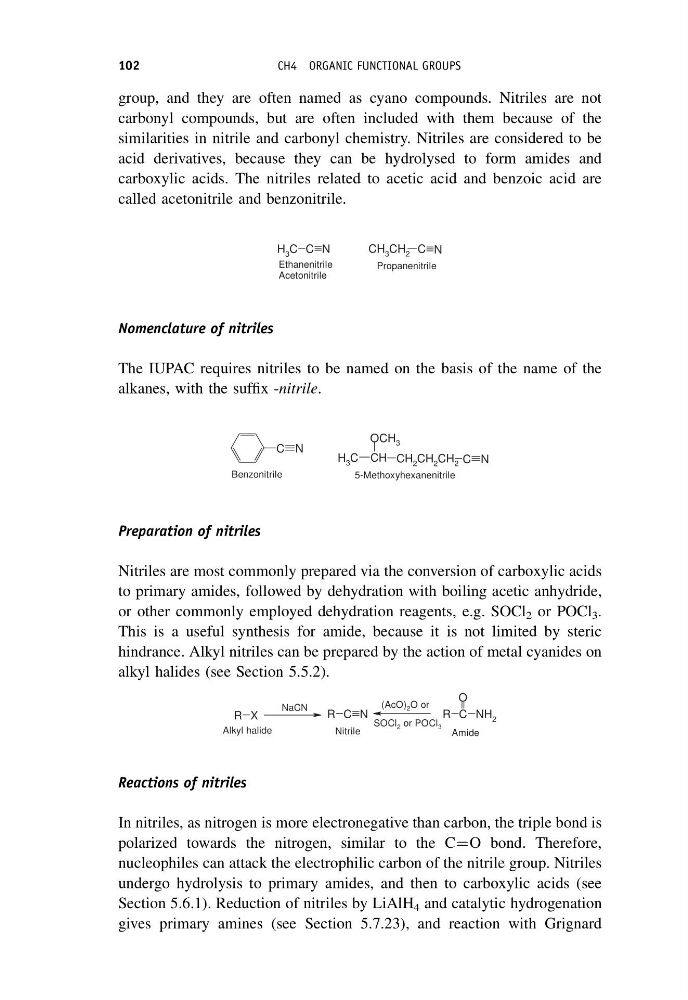
Nitriles are most commonly prepared via the conversion of carboxylic acids
to primary amides, followed by dehydration with boiling acetic anhydride,
or other commonly employed dehydration reagents, e.g. SOCl 2 or POCl 3 .
This is a useful synthesis for amide, because it is not limited by steric
hindrance. Alkyl nitriles can be prepared by the action of metal cyanides on
alkyl halides (see Section 5.5.2).
R C N
R C NH 2
O
X
R
Amide
Alkyl halide
Nitrile
NaCN
(AcO) 2 O or
SOCl 2 or POCl 3
Reactions of nitriles
In nitriles, as nitrogen is more electronegative than carbon, the triple bond is
polarized towards the nitrogen, similar to the C À À
À À O bond. Therefore,
nucleophiles can attack the electrophilic carbon of the nitrile group. Nitriles
undergo hydrolysis to primary amides, and then to carboxylic acids (see
Section 5.6.1). Reduction of nitriles by LiAlH 4 and catalytic hydrogenation
gives primary amines (see Section 5.7.23), and reaction with Grignard
102
CH4 ORGANIC FUNCTIONAL GROUPS
carbonyl compounds, but are often included with them because of the
similarities in nitrile and carbonyl chemistry. Nitriles are considered to be
acid derivatives, because they can be hydrolysed to form amides and
carboxylic acids. The nitriles related to acetic acid and benzoic acid are
called acetonitrile and benzonitrile.
C
H 3 C N
CH 3 CH 2 C N
Ethanenitrile
Acetonitrile
Propanenitrile
Nomenclature of nitriles
The IUPAC requires nitriles to be named on the basis of the name of the
alkanes, with the suffix -nitrile.
C N
C
H 3
CH CH 2 CH 2 CH 2 C N
5-Methoxyhexanenitrile
Benzonitrile
OCH 3
Preparation of nitriles
Nitriles are most commonly prepared via the conversion of carboxylic acids
to primary amides, followed by dehydration with boiling acetic anhydride,
or other commonly employed dehydration reagents, e.g. SOCl 2 or POCl 3 .
This is a useful synthesis for amide, because it is not limited by steric
hindrance. Alkyl nitriles can be prepared by the action of metal cyanides on
alkyl halides (see Section 5.5.2).
R C N
R C NH 2
O
X
R
Amide
Alkyl halide
Nitrile
NaCN
(AcO) 2 O or
SOCl 2 or POCl 3
Reactions of nitriles
In nitriles, as nitrogen is more electronegative than carbon, the triple bond is
polarized towards the nitrogen, similar to the C À À
À À O bond. Therefore,
nucleophiles can attack the electrophilic carbon of the nitrile group. Nitriles
undergo hydrolysis to primary amides, and then to carboxylic acids (see
Section 5.6.1). Reduction of nitriles by LiAlH 4 and catalytic hydrogenation
gives primary amines (see Section 5.7.23), and reaction with Grignard
102
CH4 ORGANIC FUNCTIONAL GROUPS