

respectively (see Section 5.5.5). The amides derived from sulphonic acids
are called sulphonamides. In general, sulphonamides are obtained by the
reaction of amines and sulphonyl chlorides (see Section 4.3.10).
R C
O
Cl
R C
O
NHR'
R C
O
O C
O
OR
R C
O
OR
2 o Amide
Acid chloride
Ester
Acid anhydride
Pyridine
R'NH 2
2 R'NH 2
R'NH 2
Et 3 N
Et 3 N
Lactams are produced from amino acids, where the amino and the
carboxylic acid groups of the same molecule react to form an amide
linkage. b-lactams are the active functionality in modern antibiotics, e.g.
penicillin V.
NH 2
O
OH
NH
O
Heat
+ H 3 O +
4-Aminobutanoic acid 4-Aminobutanoic
acid lactam
Reactions of amides
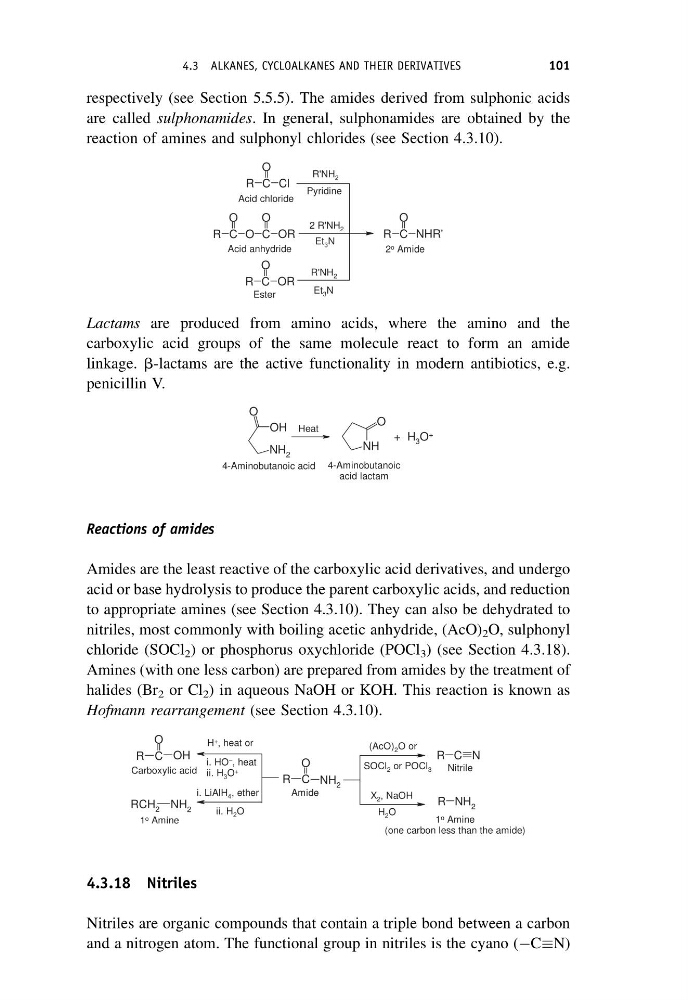
Amides are the least reactive of the carboxylic acid derivatives, and undergo
acid or base hydrolysis to produce the parent carboxylic acids, and reduction
to appropriate amines (see Section 4.3.10). They can also be dehydrated to
nitriles, most commonly with boiling acetic anhydride, (AcO) 2 O, sulphonyl
chloride (SOCl 2 ) or phosphorus oxychloride (POCl 3 ) (see Section 4.3.18).
Amines (with one less carbon) are prepared from amides by the treatment of
halides (Br 2 or Cl 2 ) in aqueous NaOH or KOH. This reaction is known as
Hofmann rearrangement (see Section 4.3.10).
R C NH 2
O
R C N
RCH 2 NH 2
R C OH
O
R NH 2
Amide
1 o Amine
Nitrile
Carboxylic acid
i. LiAlH 4 , ether
ii. H 2 O
H + , heat or
(AcO) 2 O or
SOCl 2 or POCl 3
X 2 , NaOH
H 2 O
1 o Amine
(one carbon less than the amide)
i. HO − , heat
ii. H 3 O +
4.3.18 Nitriles
Nitriles are organic compounds that contain a triple bond between a carbon
and a nitrogen atom. The functional group in nitriles is the cyano (ÀCN)
4.3 ALKANES, CYCLOALKANES AND THEIR DERIVATIVES
101
are called sulphonamides. In general, sulphonamides are obtained by the
reaction of amines and sulphonyl chlorides (see Section 4.3.10).
R C
O
Cl
R C
O
NHR'
R C
O
O C
O
OR
R C
O
OR
2 o Amide
Acid chloride
Ester
Acid anhydride
Pyridine
R'NH 2
2 R'NH 2
R'NH 2
Et 3 N
Et 3 N
Lactams are produced from amino acids, where the amino and the
carboxylic acid groups of the same molecule react to form an amide
linkage. b-lactams are the active functionality in modern antibiotics, e.g.
penicillin V.
NH 2
O
OH
NH
O
Heat
+ H 3 O +
4-Aminobutanoic acid 4-Aminobutanoic
acid lactam
Reactions of amides
Amides are the least reactive of the carboxylic acid derivatives, and undergo
acid or base hydrolysis to produce the parent carboxylic acids, and reduction
to appropriate amines (see Section 4.3.10). They can also be dehydrated to
nitriles, most commonly with boiling acetic anhydride, (AcO) 2 O, sulphonyl
chloride (SOCl 2 ) or phosphorus oxychloride (POCl 3 ) (see Section 4.3.18).
Amines (with one less carbon) are prepared from amides by the treatment of
halides (Br 2 or Cl 2 ) in aqueous NaOH or KOH. This reaction is known as
Hofmann rearrangement (see Section 4.3.10).
R C NH 2
O
R C N
RCH 2 NH 2
R C OH
O
R NH 2
Amide
1 o Amine
Nitrile
Carboxylic acid
i. LiAlH 4 , ether
ii. H 2 O
H + , heat or
(AcO) 2 O or
SOCl 2 or POCl 3
X 2 , NaOH
H 2 O
1 o Amine
(one carbon less than the amide)
i. HO − , heat
ii. H 3 O +
4.3.18 Nitriles
Nitriles are organic compounds that contain a triple bond between a carbon
and a nitrogen atom. The functional group in nitriles is the cyano (ÀCN)
4.3 ALKANES, CYCLOALKANES AND THEIR DERIVATIVES
101