

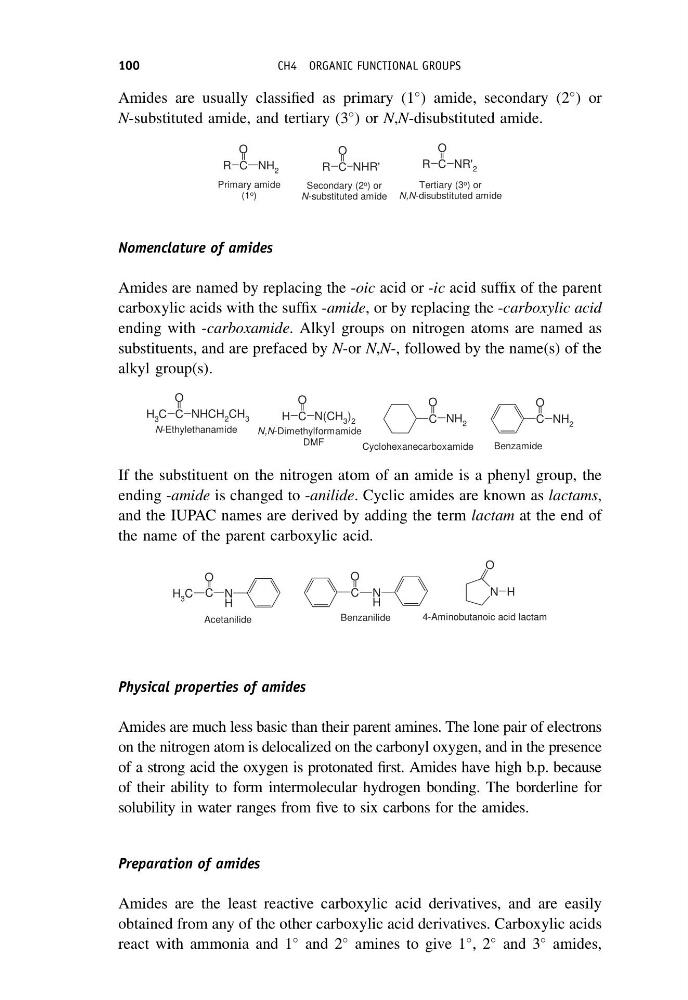
Amides are usually classified as primary (1
) amide, secondary (2
) or
N-substituted amide, and tertiary (3
) or N,N-disubstituted amide.
R C
O
NH 2
R C
O
NHR'
R C
O
NR' 2
Primary amide
(1 o )
Secondary (2 o ) or
N-substituted amide
Tertiary (3 o ) or
N,N-disubstituted amide
Nomenclature of amides
Amides are named by replacing the -oic acid or -ic acid suffix of the parent
carboxylic acids with the suffix -amide, or by replacing the -carboxylic acid
ending with -carboxamide. Alkyl groups on nitrogen atoms are named as
substituents, and are prefaced by N-or N,N-, followed by the name(s) of the
alkyl group(s).
C
H 3 C
O
NHCH 2 CH 3
H C
O
N(CH 3 ) 2
C NH 2
O
C NH 2
O
N-Ethylethanamide
N,N-Dimethylformamide
DMF
Cyclohexanecarboxamide
Benzamide
If the substituent on the nitrogen atom of an amide is a phenyl group, the
ending -amide is changed to -anilide. Cyclic amides are known as lactams,
and the IUPAC names are derived by adding the term lactam at the end of
the name of the parent carboxylic acid.
N
H
C
C
H 3
O
C N
H
O
N H
O
Acetanilide
Benzanilide
4-Aminobutanoic acid lactam
Physical properties of amides
Amides are much less basic than their parent amines. The lone pair of electrons
on the nitrogen atom is delocalized on the carbonyl oxygen, and in the presence
of a strong acid the oxygen is protonated first. Amides have high b.p. because
of their ability to form intermolecular hydrogen bonding. The borderline for
solubility in water ranges from five to six carbons for the amides.
Preparation of amides
Amides are the least reactive carboxylic acid derivatives, and are easily
obtained from any of the other carboxylic acid derivatives. Carboxylic acids
react with ammonia and 1
and 2
amines to give 1
, 2
and 3
amides,
100
CH4 ORGANIC FUNCTIONAL GROUPS
) amide, secondary (2
) or
N-substituted amide, and tertiary (3
) or N,N-disubstituted amide.
R C
O
NH 2
R C
O
NHR'
R C
O
NR' 2
Primary amide
(1 o )
Secondary (2 o ) or
N-substituted amide
Tertiary (3 o ) or
N,N-disubstituted amide
Nomenclature of amides
Amides are named by replacing the -oic acid or -ic acid suffix of the parent
carboxylic acids with the suffix -amide, or by replacing the -carboxylic acid
ending with -carboxamide. Alkyl groups on nitrogen atoms are named as
substituents, and are prefaced by N-or N,N-, followed by the name(s) of the
alkyl group(s).
C
H 3 C
O
NHCH 2 CH 3
H C
O
N(CH 3 ) 2
C NH 2
O
C NH 2
O
N-Ethylethanamide
N,N-Dimethylformamide
DMF
Cyclohexanecarboxamide
Benzamide
If the substituent on the nitrogen atom of an amide is a phenyl group, the
ending -amide is changed to -anilide. Cyclic amides are known as lactams,
and the IUPAC names are derived by adding the term lactam at the end of
the name of the parent carboxylic acid.
N
H
C
C
H 3
O
C N
H
O
N H
O
Acetanilide
Benzanilide
4-Aminobutanoic acid lactam
Physical properties of amides
Amides are much less basic than their parent amines. The lone pair of electrons
on the nitrogen atom is delocalized on the carbonyl oxygen, and in the presence
of a strong acid the oxygen is protonated first. Amides have high b.p. because
of their ability to form intermolecular hydrogen bonding. The borderline for
solubility in water ranges from five to six carbons for the amides.
Preparation of amides
Amides are the least reactive carboxylic acid derivatives, and are easily
obtained from any of the other carboxylic acid derivatives. Carboxylic acids
react with ammonia and 1
and 2
amines to give 1
, 2
and 3
amides,
100
CH4 ORGANIC FUNCTIONAL GROUPS