

Reactions of esters
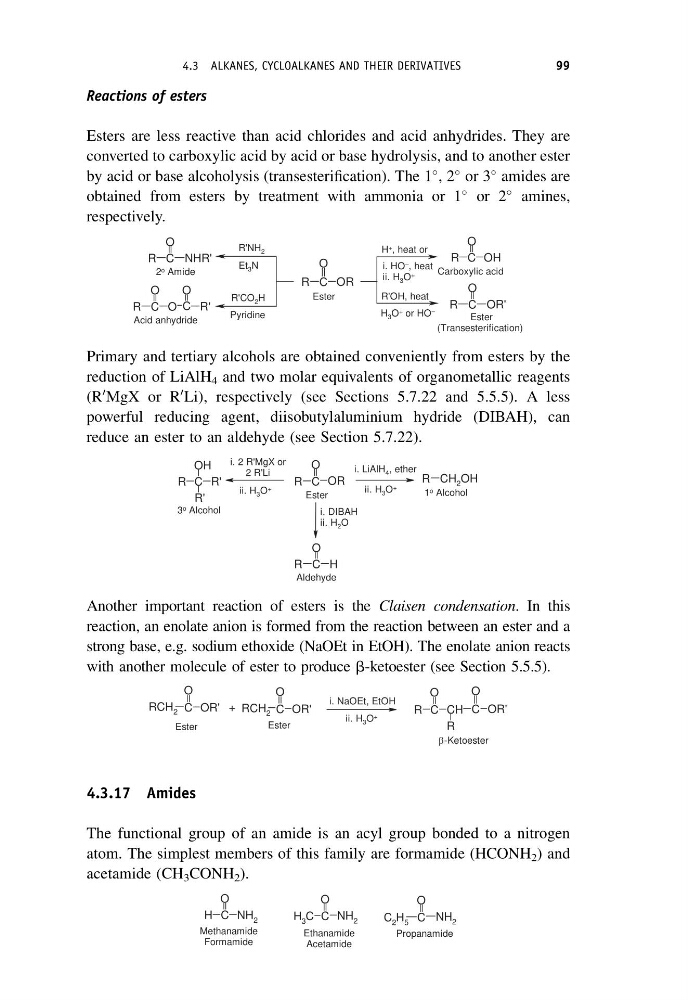
Esters are less reactive than acid chlorides and acid anhydrides. They are
converted to carboxylic acid by acid or base hydrolysis, and to another ester
by acid or base alcoholysis (transesterification). The 1
, 2
or 3
amides are
obtained from esters by treatment with ammonia or 1
or 2
amines,
respectively.
R C OR
O
R C OH
O
R C OR'
O
R C NHR'
O
R C O
O
C
O
R'
Ester
Ester
(Transesterification)
Carboxylic acid
2 o Amide
R'OH, heat
Acid anhydride
R'NH 2
R'CO 2 H
H 3 O + or HO −
H + , heat or
i. HO − , heat
ii. H 3 O +
Pyridine
Et 3 N
Primary and tertiary alcohols are obtained conveniently from esters by the
reduction of LiAlH 4 and two molar equivalents of organometallic reagents
(R
0 MgX or R
0 Li), respectively (see Sections 5.7.22 and 5.5.5). A less
powerful reducing agent, diisobutylaluminium hydride (DIBAH), can
reduce an ester to an aldehyde (see Section 5.7.22).
R C OR
O
R CH 2 OH
R C R'
OH
R'
R C H
O
Ester
1 o Alcohol
i. 2 R'MgX or
2 R'Li
ii. H 3 O +
i. LiAlH 4 , ether
ii. H 3 O +
3 o Alcohol
i. DIBAH
ii. H 2 O
Aldehyde
Another important reaction of esters is the Claisen condensation. In this
reaction, an enolate anion is formed from the reaction between an ester and a
strong base, e.g. sodium ethoxide (NaOEt in EtOH). The enolate anion reacts
with another molecule of ester to produce b-ketoester (see Section 5.5.5).
R C
O
CH
R
C
O
OR'
OR'
RCH 2 C
O
OR'
RCH 2 C
O
β-Ketoester
i. NaOEt, EtOH
ii. H 3 O +
+
Ester
Ester
4.3.17 Amides
The functional group of an amide is an acyl group bonded to a nitrogen
atom. The simplest members of this family are formamide (HCONH 2 ) and
acetamide (CH 3 CONH 2 ).
C NH 2
O
H
C
H 3 C NH 2
O
C 2 H 5 C NH 2
O
Methanamide
Formamide
Ethanamide
Acetamide
Propanamide
4.3 ALKANES, CYCLOALKANES AND THEIR DERIVATIVES
99
Esters are less reactive than acid chlorides and acid anhydrides. They are
converted to carboxylic acid by acid or base hydrolysis, and to another ester
by acid or base alcoholysis (transesterification). The 1
, 2
or 3
amides are
obtained from esters by treatment with ammonia or 1
or 2
amines,
respectively.
R C OR
O
R C OH
O
R C OR'
O
R C NHR'
O
R C O
O
C
O
R'
Ester
Ester
(Transesterification)
Carboxylic acid
2 o Amide
R'OH, heat
Acid anhydride
R'NH 2
R'CO 2 H
H 3 O + or HO −
H + , heat or
i. HO − , heat
ii. H 3 O +
Pyridine
Et 3 N
Primary and tertiary alcohols are obtained conveniently from esters by the
reduction of LiAlH 4 and two molar equivalents of organometallic reagents
(R
0 MgX or R
0 Li), respectively (see Sections 5.7.22 and 5.5.5). A less
powerful reducing agent, diisobutylaluminium hydride (DIBAH), can
reduce an ester to an aldehyde (see Section 5.7.22).
R C OR
O
R CH 2 OH
R C R'
OH
R'
R C H
O
Ester
1 o Alcohol
i. 2 R'MgX or
2 R'Li
ii. H 3 O +
i. LiAlH 4 , ether
ii. H 3 O +
3 o Alcohol
i. DIBAH
ii. H 2 O
Aldehyde
Another important reaction of esters is the Claisen condensation. In this
reaction, an enolate anion is formed from the reaction between an ester and a
strong base, e.g. sodium ethoxide (NaOEt in EtOH). The enolate anion reacts
with another molecule of ester to produce b-ketoester (see Section 5.5.5).
R C
O
CH
R
C
O
OR'
OR'
RCH 2 C
O
OR'
RCH 2 C
O
β-Ketoester
i. NaOEt, EtOH
ii. H 3 O +
+
Ester
Ester
4.3.17 Amides
The functional group of an amide is an acyl group bonded to a nitrogen
atom. The simplest members of this family are formamide (HCONH 2 ) and
acetamide (CH 3 CONH 2 ).
C NH 2
O
H
C
H 3 C NH 2
O
C 2 H 5 C NH 2
O
Methanamide
Formamide
Ethanamide
Acetamide
Propanamide
4.3 ALKANES, CYCLOALKANES AND THEIR DERIVATIVES
99