

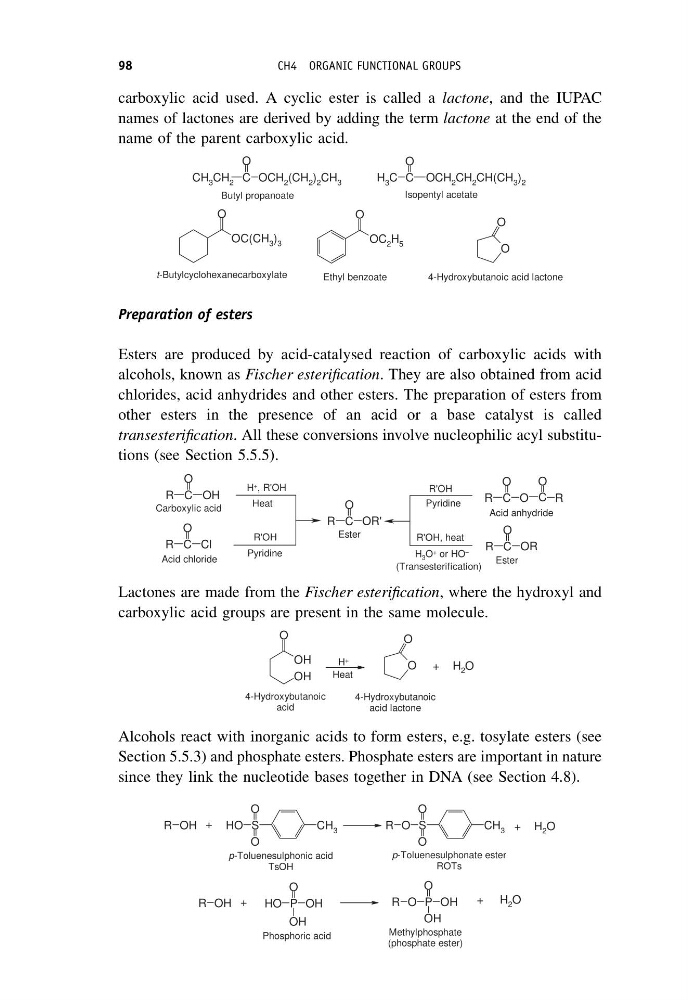
carboxylic acid used. A cyclic ester is called a lactone, and the IUPAC
names of lactones are derived by adding the term lactone at the end of the
name of the parent carboxylic acid.
C
O
C
H 3
C
O
CH 3 CH 2
OCH 2 (CH 2 ) 2 CH 3
OCH 2 CH 2 CH(CH 3 ) 2
Isopentyl acetate
Butyl propanoate
O
OC(CH 3 ) 3
O
OC 2 H 5
O
O
Ethyl benzoate
t-Butylcyclohexanecarboxylate
4-Hydroxybutanoic acid lactone
Preparation of esters
Esters are produced by acid-catalysed reaction of carboxylic acids with
alcohols, known as Fischer esterification. They are also obtained from acid
chlorides, acid anhydrides and other esters. The preparation of esters from
other esters in the presence of an acid or a base catalyst is called
transesterification. All these conversions involve nucleophilic acyl substitutions (see Section 5.5.5).
R C OH
O
R C OR'
O
R C Cl
O
R C O
O
C
O
R
R C OR
O
R'OH, heat
Acid chloride
Carboxylic acid
Ester
Heat
Pyridine
Acid anhydride
Ester
R'OH
R'OH
Pyridine
H 3 O + or HO −
H + , R'OH
(Transesterification)
Lactones are made from the Fischer esterification, where the hydroxyl and
carboxylic acid groups are present in the same molecule.
OH
OH
O
O
O
+ H 2 O
4-Hydroxybutanoic
acid
4-Hydroxybutanoic
acid lactone
H +
Heat
Alcohols react with inorganic acids to form esters, e.g. tosylate esters (see
Section 5.5.3) and phosphate esters. Phosphate esters are important in nature
since they link the nucleotide bases together in DNA (see Section 4.8).
R OH
S
CH 3
O
O
O
H
S
C H 3
O
O
O
R
+ H 2 O
p-Toluenesulphonic acid
TsOH
p-Toluenesulphonate ester
ROTs
+
OH
P
OH
O
O
H
OH
P
OH
O
O
R
R OH
+ H 2 O
Methylphosphate
(phosphate ester)
Phosphoric acid
+
98
CH4 ORGANIC FUNCTIONAL GROUPS
names of lactones are derived by adding the term lactone at the end of the
name of the parent carboxylic acid.
C
O
C
H 3
C
O
CH 3 CH 2
OCH 2 (CH 2 ) 2 CH 3
OCH 2 CH 2 CH(CH 3 ) 2
Isopentyl acetate
Butyl propanoate
O
OC(CH 3 ) 3
O
OC 2 H 5
O
O
Ethyl benzoate
t-Butylcyclohexanecarboxylate
4-Hydroxybutanoic acid lactone
Preparation of esters
Esters are produced by acid-catalysed reaction of carboxylic acids with
alcohols, known as Fischer esterification. They are also obtained from acid
chlorides, acid anhydrides and other esters. The preparation of esters from
other esters in the presence of an acid or a base catalyst is called
transesterification. All these conversions involve nucleophilic acyl substitutions (see Section 5.5.5).
R C OH
O
R C OR'
O
R C Cl
O
R C O
O
C
O
R
R C OR
O
R'OH, heat
Acid chloride
Carboxylic acid
Ester
Heat
Pyridine
Acid anhydride
Ester
R'OH
R'OH
Pyridine
H 3 O + or HO −
H + , R'OH
(Transesterification)
Lactones are made from the Fischer esterification, where the hydroxyl and
carboxylic acid groups are present in the same molecule.
OH
OH
O
O
O
+ H 2 O
4-Hydroxybutanoic
acid
4-Hydroxybutanoic
acid lactone
H +
Heat
Alcohols react with inorganic acids to form esters, e.g. tosylate esters (see
Section 5.5.3) and phosphate esters. Phosphate esters are important in nature
since they link the nucleotide bases together in DNA (see Section 4.8).
R OH
S
CH 3
O
O
O
H
S
C H 3
O
O
O
R
+ H 2 O
p-Toluenesulphonic acid
TsOH
p-Toluenesulphonate ester
ROTs
+
OH
P
OH
O
O
H
OH
P
OH
O
O
R
R OH
+ H 2 O
Methylphosphate
(phosphate ester)
Phosphoric acid
+
98
CH4 ORGANIC FUNCTIONAL GROUPS