

Preparation of acid anhydrides
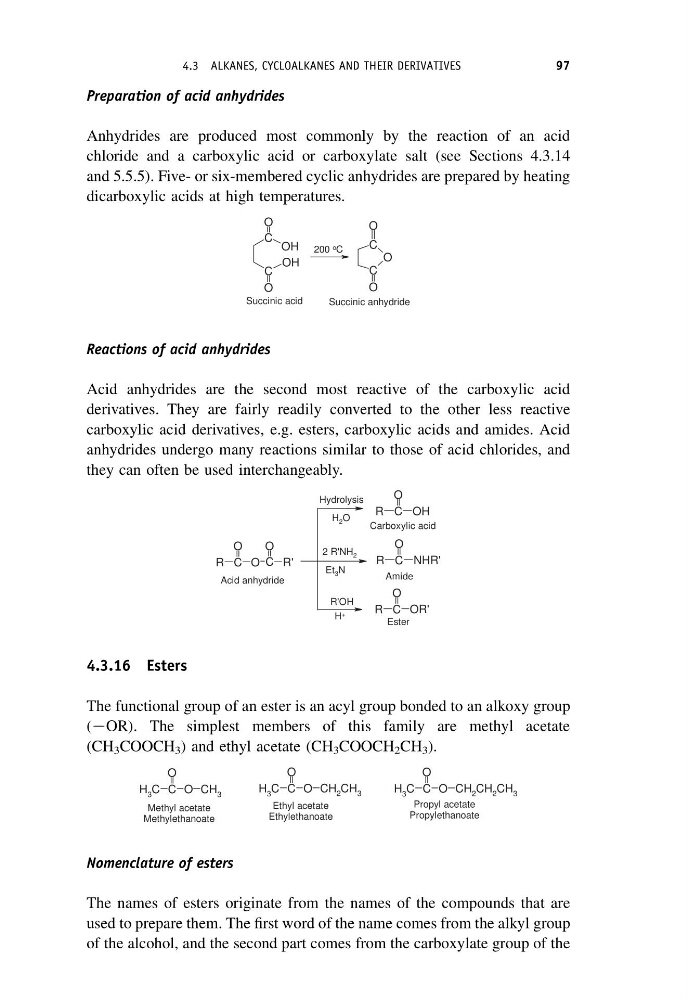
Anhydrides are produced most commonly by the reaction of an acid
chloride and a carboxylic acid or carboxylate salt (see Sections 4.3.14
and 5.5.5). Five- or six-membered cyclic anhydrides are prepared by heating
dicarboxylic acids at high temperatures.
C
OH
OH
C
O
O
C
O
C
O
O
200 o C
Succinic acid
Succinic anhydride
Reactions of acid anhydrides
Acid anhydrides are the second most reactive of the carboxylic acid
derivatives. They are fairly readily converted to the other less reactive
carboxylic acid derivatives, e.g. esters, carboxylic acids and amides. Acid
anhydrides undergo many reactions similar to those of acid chlorides, and
they can often be used interchangeably.
R C OH
O
R C OR'
O
R C O
O
C
O
R'
R C NHR'
O
Acid anhydride
Carboxylic acid
Ester
Amide
2 R'NH 2
Et 3 N
R'OH
H +
H 2 O
Hydrolysis
4.3.16 Esters
The functional group of an ester is an acyl group bonded to an alkoxy group
(À ÀOR). The simplest members of this family are methyl acetate
(CH 3 COOCH 3 ) and ethyl acetate (CH 3 COOCH 2 CH 3 ).
C
O
C
H 3
O CH 2 CH 3
C
O
C
H 3
O CH 2 CH 2 CH 3
C
O
C
H 3
O CH 3
Ethyl acetate
Ethylethanoate
Propyl acetate
Propylethanoate
Methyl acetate
Methylethanoate
Nomenclature of esters
The names of esters originate from the names of the compounds that are
used to prepare them. The first word of the name comes from the alkyl group
of the alcohol, and the second part comes from the carboxylate group of the
4.3 ALKANES, CYCLOALKANES AND THEIR DERIVATIVES
97
Anhydrides are produced most commonly by the reaction of an acid
chloride and a carboxylic acid or carboxylate salt (see Sections 4.3.14
and 5.5.5). Five- or six-membered cyclic anhydrides are prepared by heating
dicarboxylic acids at high temperatures.
C
OH
OH
C
O
O
C
O
C
O
O
200 o C
Succinic acid
Succinic anhydride
Reactions of acid anhydrides
Acid anhydrides are the second most reactive of the carboxylic acid
derivatives. They are fairly readily converted to the other less reactive
carboxylic acid derivatives, e.g. esters, carboxylic acids and amides. Acid
anhydrides undergo many reactions similar to those of acid chlorides, and
they can often be used interchangeably.
R C OH
O
R C OR'
O
R C O
O
C
O
R'
R C NHR'
O
Acid anhydride
Carboxylic acid
Ester
Amide
2 R'NH 2
Et 3 N
R'OH
H +
H 2 O
Hydrolysis
4.3.16 Esters
The functional group of an ester is an acyl group bonded to an alkoxy group
(À ÀOR). The simplest members of this family are methyl acetate
(CH 3 COOCH 3 ) and ethyl acetate (CH 3 COOCH 2 CH 3 ).
C
O
C
H 3
O CH 2 CH 3
C
O
C
H 3
O CH 2 CH 2 CH 3
C
O
C
H 3
O CH 3
Ethyl acetate
Ethylethanoate
Propyl acetate
Propylethanoate
Methyl acetate
Methylethanoate
Nomenclature of esters
The names of esters originate from the names of the compounds that are
used to prepare them. The first word of the name comes from the alkyl group
of the alcohol, and the second part comes from the carboxylate group of the
4.3 ALKANES, CYCLOALKANES AND THEIR DERIVATIVES
97