

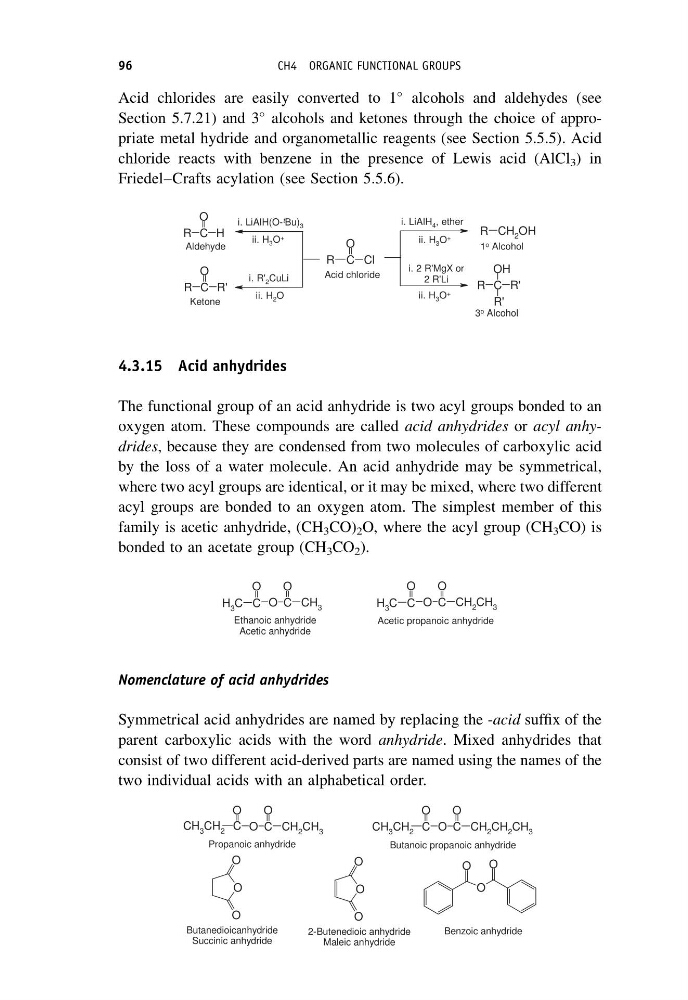
Acid chlorides are easily converted to 1
alcohols and aldehydes (see
Section 5.7.21) and 3
alcohols and ketones through the choice of appropriate metal hydride and organometallic reagents (see Section 5.5.5). Acid
chloride reacts with benzene in the presence of Lewis acid (AlCl 3 ) in
Friedel–Crafts acylation (see Section 5.5.6).
R CH 2 OH
R C R'
OH
R'
R C R'
O
R C Cl
O
R C H
O
1 o Alcohol
ii. H 3 O +
i. LiAlH 4 , ether
i. 2 R'MgX or
2 R'Li
ii. H 3 O +
3 o Alcohol
ii. H 3 O +
i. LiAlH(O- t Bu) 3
Ketone
i. R' 2 CuLi
ii. H 2 O
Acid chloride
Aldehyde
4.3.15 Acid anhydrides
The functional group of an acid anhydride is two acyl groups bonded to an
oxygen atom. These compounds are called acid anhydrides or acyl anhydrides, because they are condensed from two molecules of carboxylic acid
by the loss of a water molecule. An acid anhydride may be symmetrical,
where two acyl groups are identical, or it may be mixed, where two different
acyl groups are bonded to an oxygen atom. The simplest member of this
family is acetic anhydride, (CH 3 CO) 2 O, where the acyl group (CH 3 CO) is
bonded to an acetate group (CH 3 CO 2 ).
C
H 3
C O
O
C
O
CH 3
C
H 3
C O
O
C
O
CH 2 CH 3
Ethanoic anhydride
Acetic anhydride
Acetic propanoic anhydride
Nomenclature of acid anhydrides
Symmetrical acid anhydrides are named by replacing the -acid suffix of the
parent carboxylic acids with the word anhydride. Mixed anhydrides that
consist of two different acid-derived parts are named using the names of the
two individual acids with an alphabetical order.
CH 3 CH 2 C O
O
C
O
CH 2 CH 3
CH 3 CH 2 C O
O
C
O
CH 2 CH 2 CH 3
O
O
O
O
O
O
O
O
O
Propanoic anhydride
Butanoic propanoic anhydride
Benzoic anhydride
Butanedioicanhydride
Succinic anhydride
2-Butenedioic anhydride
Maleic anhydride
96
CH4 ORGANIC FUNCTIONAL GROUPS
alcohols and aldehydes (see
Section 5.7.21) and 3
alcohols and ketones through the choice of appropriate metal hydride and organometallic reagents (see Section 5.5.5). Acid
chloride reacts with benzene in the presence of Lewis acid (AlCl 3 ) in
Friedel–Crafts acylation (see Section 5.5.6).
R CH 2 OH
R C R'
OH
R'
R C R'
O
R C Cl
O
R C H
O
1 o Alcohol
ii. H 3 O +
i. LiAlH 4 , ether
i. 2 R'MgX or
2 R'Li
ii. H 3 O +
3 o Alcohol
ii. H 3 O +
i. LiAlH(O- t Bu) 3
Ketone
i. R' 2 CuLi
ii. H 2 O
Acid chloride
Aldehyde
4.3.15 Acid anhydrides
The functional group of an acid anhydride is two acyl groups bonded to an
oxygen atom. These compounds are called acid anhydrides or acyl anhydrides, because they are condensed from two molecules of carboxylic acid
by the loss of a water molecule. An acid anhydride may be symmetrical,
where two acyl groups are identical, or it may be mixed, where two different
acyl groups are bonded to an oxygen atom. The simplest member of this
family is acetic anhydride, (CH 3 CO) 2 O, where the acyl group (CH 3 CO) is
bonded to an acetate group (CH 3 CO 2 ).
C
H 3
C O
O
C
O
CH 3
C
H 3
C O
O
C
O
CH 2 CH 3
Ethanoic anhydride
Acetic anhydride
Acetic propanoic anhydride
Nomenclature of acid anhydrides
Symmetrical acid anhydrides are named by replacing the -acid suffix of the
parent carboxylic acids with the word anhydride. Mixed anhydrides that
consist of two different acid-derived parts are named using the names of the
two individual acids with an alphabetical order.
CH 3 CH 2 C O
O
C
O
CH 2 CH 3
CH 3 CH 2 C O
O
C
O
CH 2 CH 2 CH 3
O
O
O
O
O
O
O
O
O
Propanoic anhydride
Butanoic propanoic anhydride
Benzoic anhydride
Butanedioicanhydride
Succinic anhydride
2-Butenedioic anhydride
Maleic anhydride
96
CH4 ORGANIC FUNCTIONAL GROUPS