

4.3.14 Acid chlorides
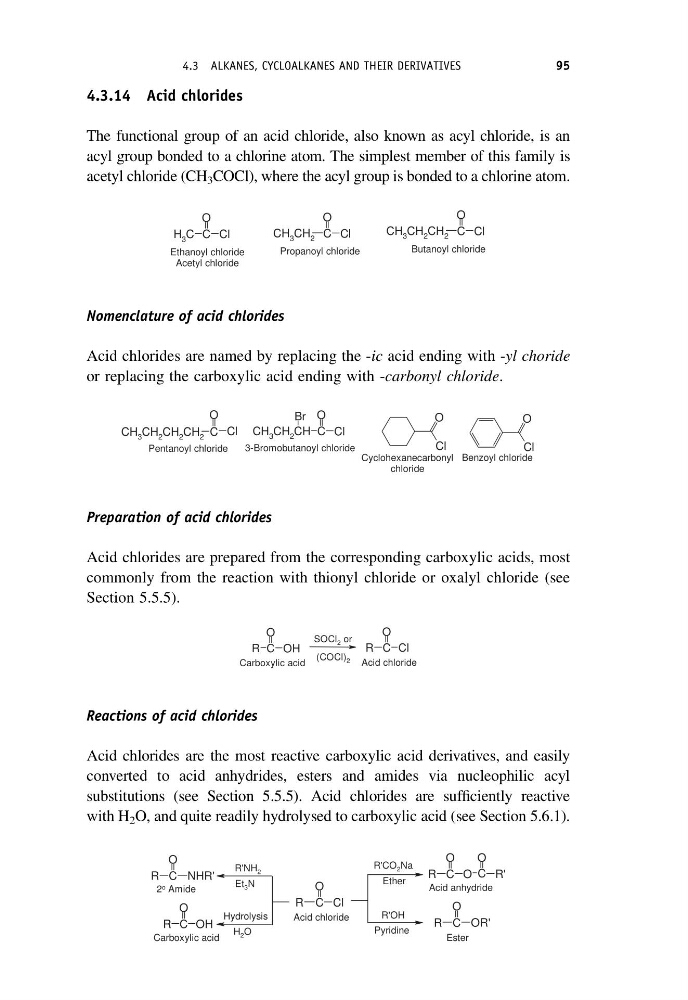
The functional group of an acid chloride, also known as acyl chloride, is an
acyl group bonded to a chlorine atom. The simplest member of this family is
acetyl chloride (CH 3 COCl), where the acyl group is bonded to a chlorine atom.
C Cl
O
C
H 3
CH 3 CH 2 C Cl
O
CH 3 CH 2 CH 2 C Cl
O
Ethanoyl chloride
Acetyl chloride
Propanoyl chloride
Butanoyl chloride
Nomenclature of acid chlorides
Acid chlorides are named by replacing the -ic acid ending with -yl choride
or replacing the carboxylic acid ending with -carbonyl chloride.
O
Cl
O
Cl
CH 3 CH 2 CH 2 CH 2 C Cl
O
CH 3 CH 2 CH C Cl
O
Br
3-Bromobutanoyl chloride
Pentanoyl chloride
Cyclohexanecarbonyl
chloride
Benzoyl chloride
Preparation of acid chlorides
Acid chlorides are prepared from the corresponding carboxylic acids, most
commonly from the reaction with thionyl chloride or oxalyl chloride (see
Section 5.5.5).
R C Cl
O
R C OH
O
(COCl) 2
SOCl 2 or
Acid chloride
Carboxylic acid
Reactions of acid chlorides
Acid chlorides are the most reactive carboxylic acid derivatives, and easily
converted to acid anhydrides, esters and amides via nucleophilic acyl
substitutions (see Section 5.5.5). Acid chlorides are sufficiently reactive
with H 2 O, and quite readily hydrolysed to carboxylic acid (see Section 5.6.1).
R C Cl
O
R C OH
O
R C OR'
O
R C NHR'
O
R C O
O
C
O
R'
Carboxylic acid
Ester
R'OH
Acid chloride
Acid anhydride
R'NH 2
R'CO 2 Na
2 o Amide
H 2 O
Hydrolysis
Pyridine
Et 3 N
Ether
4.3 ALKANES, CYCLOALKANES AND THEIR DERIVATIVES
95
The functional group of an acid chloride, also known as acyl chloride, is an
acyl group bonded to a chlorine atom. The simplest member of this family is
acetyl chloride (CH 3 COCl), where the acyl group is bonded to a chlorine atom.
C Cl
O
C
H 3
CH 3 CH 2 C Cl
O
CH 3 CH 2 CH 2 C Cl
O
Ethanoyl chloride
Acetyl chloride
Propanoyl chloride
Butanoyl chloride
Nomenclature of acid chlorides
Acid chlorides are named by replacing the -ic acid ending with -yl choride
or replacing the carboxylic acid ending with -carbonyl chloride.
O
Cl
O
Cl
CH 3 CH 2 CH 2 CH 2 C Cl
O
CH 3 CH 2 CH C Cl
O
Br
3-Bromobutanoyl chloride
Pentanoyl chloride
Cyclohexanecarbonyl
chloride
Benzoyl chloride
Preparation of acid chlorides
Acid chlorides are prepared from the corresponding carboxylic acids, most
commonly from the reaction with thionyl chloride or oxalyl chloride (see
Section 5.5.5).
R C Cl
O
R C OH
O
(COCl) 2
SOCl 2 or
Acid chloride
Carboxylic acid
Reactions of acid chlorides
Acid chlorides are the most reactive carboxylic acid derivatives, and easily
converted to acid anhydrides, esters and amides via nucleophilic acyl
substitutions (see Section 5.5.5). Acid chlorides are sufficiently reactive
with H 2 O, and quite readily hydrolysed to carboxylic acid (see Section 5.6.1).
R C Cl
O
R C OH
O
R C OR'
O
R C NHR'
O
R C O
O
C
O
R'
Carboxylic acid
Ester
R'OH
Acid chloride
Acid anhydride
R'NH 2
R'CO 2 Na
2 o Amide
H 2 O
Hydrolysis
Pyridine
Et 3 N
Ether
4.3 ALKANES, CYCLOALKANES AND THEIR DERIVATIVES
95