

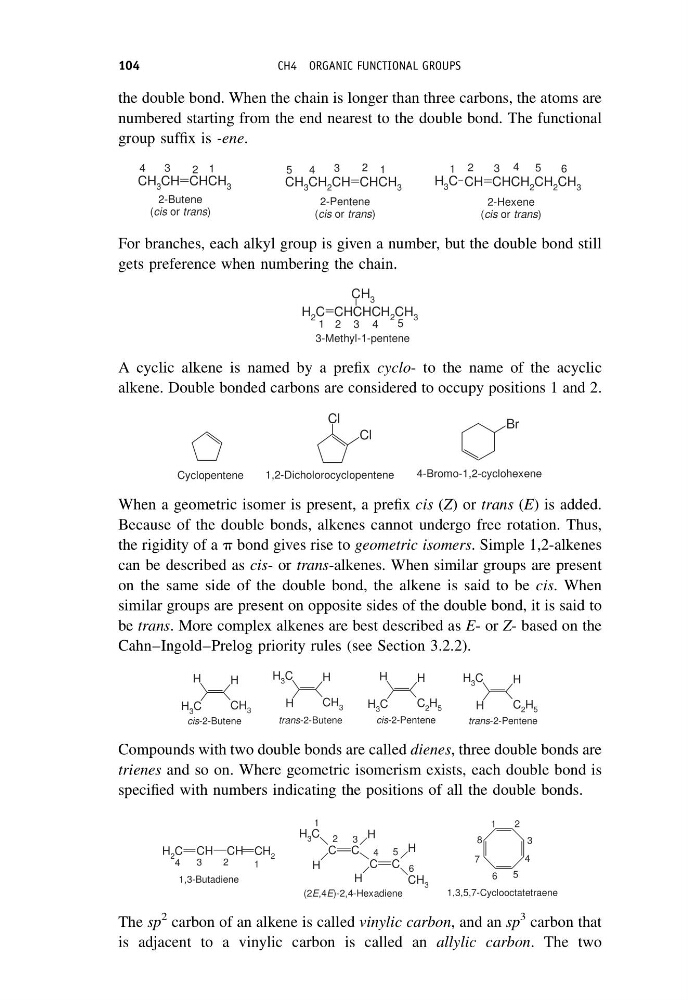
the double bond. When the chain is longer than three carbons, the atoms are
numbered starting from the end nearest to the double bond. The functional
group suffix is -ene.
CH 3 CH 2 CH CHCH 3
CH 3 CH CHCH 3
CH CHCH 2 CH 2 CH 3
C
H 3
2-Pentene
(cis or trans)
1
2
3
4
5
2-Hexene
(cis or trans)
2-Butene
(cis or trans)
1
2
3
4
6
3
1 2
4 5
For branches, each alkyl group is given a number, but the double bond still
gets preference when numbering the chain.
C
H 2 CHCHCH 2 CH 3
CH 3
3-Methyl-1-pentene
1 2
4
3
5
A cyclic alkene is named by a prefix cyclo- to the name of the acyclic
alkene. Double bonded carbons are considered to occupy positions 1 and 2.
Br
Cl
Cl
Cyclopentene
4-Bromo-1,2-cyclohexene
1,2-Dicholorocyclopentene
When a geometric isomer is present, a prefix cis (Z) or trans (E) is added.
Because of the double bonds, alkenes cannot undergo free rotation. Thus,
the rigidity of a p bond gives rise to geometric isomers. Simple 1,2-alkenes
can be described as cis- or trans-alkenes. When similar groups are present
on the same side of the double bond, the alkene is said to be cis. When
similar groups are present on opposite sides of the double bond, it is said to
be trans. More complex alkenes are best described as E- or Z- based on the
Cahn–Ingold–Prelog priority rules (see Section 3.2.2).
H
CH 3
H
C
H 3
H
CH 3
C
H 3
H
H
C 2 H 5
H
C
H 3
H
C 2 H 5
C
H 3
H
cis-2-Butene
trans-2-Butene
cis-2-Pentene
trans-2-Pentene
Compounds with two double bonds are called dienes, three double bonds are
trienes and so on. Where geometric isomerism exists, each double bond is
specified with numbers indicating the positions of all the double bonds.
CH
CH
C
H
CH 3
C
C
H
C
H
C
H 3
H
C
H 2
CH 2
1,3-Butadiene
1,3,5,7-Cyclooctatetraene
3
1
2
3
1
2
4
5
8
6
7
4
(2E,4E)-2,4-Hexadiene
3
1
2
4 5
6
The sp
2 carbon of an alkene is called vinylic carbon, and an sp
3 carbon that
is adjacent to a vinylic carbon is called an allylic carbon. The two
104
CH4 ORGANIC FUNCTIONAL GROUPS
numbered starting from the end nearest to the double bond. The functional
group suffix is -ene.
CH 3 CH 2 CH CHCH 3
CH 3 CH CHCH 3
CH CHCH 2 CH 2 CH 3
C
H 3
2-Pentene
(cis or trans)
1
2
3
4
5
2-Hexene
(cis or trans)
2-Butene
(cis or trans)
1
2
3
4
6
3
1 2
4 5
For branches, each alkyl group is given a number, but the double bond still
gets preference when numbering the chain.
C
H 2 CHCHCH 2 CH 3
CH 3
3-Methyl-1-pentene
1 2
4
3
5
A cyclic alkene is named by a prefix cyclo- to the name of the acyclic
alkene. Double bonded carbons are considered to occupy positions 1 and 2.
Br
Cl
Cl
Cyclopentene
4-Bromo-1,2-cyclohexene
1,2-Dicholorocyclopentene
When a geometric isomer is present, a prefix cis (Z) or trans (E) is added.
Because of the double bonds, alkenes cannot undergo free rotation. Thus,
the rigidity of a p bond gives rise to geometric isomers. Simple 1,2-alkenes
can be described as cis- or trans-alkenes. When similar groups are present
on the same side of the double bond, the alkene is said to be cis. When
similar groups are present on opposite sides of the double bond, it is said to
be trans. More complex alkenes are best described as E- or Z- based on the
Cahn–Ingold–Prelog priority rules (see Section 3.2.2).
H
CH 3
H
C
H 3
H
CH 3
C
H 3
H
H
C 2 H 5
H
C
H 3
H
C 2 H 5
C
H 3
H
cis-2-Butene
trans-2-Butene
cis-2-Pentene
trans-2-Pentene
Compounds with two double bonds are called dienes, three double bonds are
trienes and so on. Where geometric isomerism exists, each double bond is
specified with numbers indicating the positions of all the double bonds.
CH
CH
C
H
CH 3
C
C
H
C
H
C
H 3
H
C
H 2
CH 2
1,3-Butadiene
1,3,5,7-Cyclooctatetraene
3
1
2
3
1
2
4
5
8
6
7
4
(2E,4E)-2,4-Hexadiene
3
1
2
4 5
6
The sp
2 carbon of an alkene is called vinylic carbon, and an sp
3 carbon that
is adjacent to a vinylic carbon is called an allylic carbon. The two
104
CH4 ORGANIC FUNCTIONAL GROUPS