

R CH 2 OH
R'
R C
O
R'
R C
O
Cl
N
Ketone
2 o Alcohol
KMnO 4 or K 2 Cr 2 O 7
or PCC orPDC
Any oxidizing agent
i.R' 2 CuLi , ether
Acid chloride
i. R'MgBr, ether
ii. H 3 O +
RC
Nitrile
ii. H 2 O
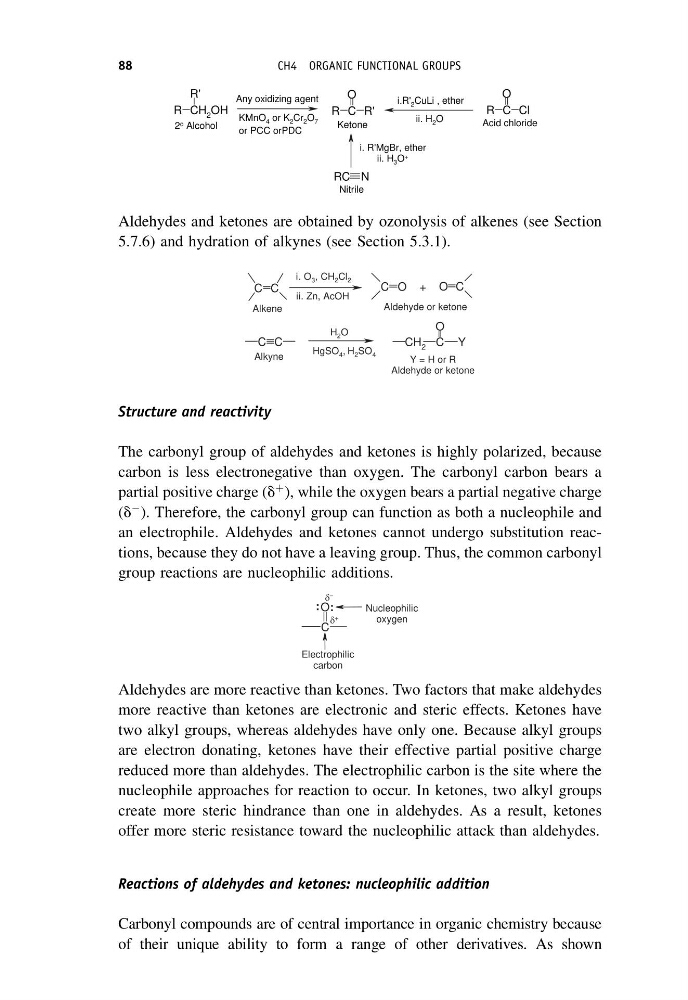
Aldehydes and ketones are obtained by ozonolysis of alkenes (see Section
5.7.6) and hydration of alkynes (see Section 5.3.1).
C O
O C
C Y
O
CH 2
C C
C C
Alkene
i. O 3 , CH 2 Cl 2
ii. Zn, AcOH
Aldehyde or ketone
+
Alkyne
Y = H or R
Aldehyde or ketone
HgSO 4 , H 2 SO 4
H 2 O
Structure and reactivity
The carbonyl group of aldehydes and ketones is highly polarized, because
carbon is less electronegative than oxygen. The carbonyl carbon bears a
partial positive charge (d
þ ), while the oxygen bears a partial negative charge
(d
À ). Therefore, the carbonyl group can function as both a nucleophile and
an electrophile. Aldehydes and ketones cannot undergo substitution reactions, because they do not have a leaving group. Thus, the common carbonyl
group reactions are nucleophilic additions.
C
O
δ +
δ −
:
Electrophilic
carbon
Nucleophilic
oxygen
:
Aldehydes are more reactive than ketones. Two factors that make aldehydes
more reactive than ketones are electronic and steric effects. Ketones have
two alkyl groups, whereas aldehydes have only one. Because alkyl groups
are electron donating, ketones have their effective partial positive charge
reduced more than aldehydes. The electrophilic carbon is the site where the
nucleophile approaches for reaction to occur. In ketones, two alkyl groups
create more steric hindrance than one in aldehydes. As a result, ketones
offer more steric resistance toward the nucleophilic attack than aldehydes.
Reactions of aldehydes and ketones: nucleophilic addition
Carbonyl compounds are of central importance in organic chemistry because
of their unique ability to form a range of other derivatives. As shown
88
CH4 ORGANIC FUNCTIONAL GROUPS
R'
R C
O
R'
R C
O
Cl
N
Ketone
2 o Alcohol
KMnO 4 or K 2 Cr 2 O 7
or PCC orPDC
Any oxidizing agent
i.R' 2 CuLi , ether
Acid chloride
i. R'MgBr, ether
ii. H 3 O +
RC
Nitrile
ii. H 2 O
Aldehydes and ketones are obtained by ozonolysis of alkenes (see Section
5.7.6) and hydration of alkynes (see Section 5.3.1).
C O
O C
C Y
O
CH 2
C C
C C
Alkene
i. O 3 , CH 2 Cl 2
ii. Zn, AcOH
Aldehyde or ketone
+
Alkyne
Y = H or R
Aldehyde or ketone
HgSO 4 , H 2 SO 4
H 2 O
Structure and reactivity
The carbonyl group of aldehydes and ketones is highly polarized, because
carbon is less electronegative than oxygen. The carbonyl carbon bears a
partial positive charge (d
þ ), while the oxygen bears a partial negative charge
(d
À ). Therefore, the carbonyl group can function as both a nucleophile and
an electrophile. Aldehydes and ketones cannot undergo substitution reactions, because they do not have a leaving group. Thus, the common carbonyl
group reactions are nucleophilic additions.
C
O
δ +
δ −
:
Electrophilic
carbon
Nucleophilic
oxygen
:
Aldehydes are more reactive than ketones. Two factors that make aldehydes
more reactive than ketones are electronic and steric effects. Ketones have
two alkyl groups, whereas aldehydes have only one. Because alkyl groups
are electron donating, ketones have their effective partial positive charge
reduced more than aldehydes. The electrophilic carbon is the site where the
nucleophile approaches for reaction to occur. In ketones, two alkyl groups
create more steric hindrance than one in aldehydes. As a result, ketones
offer more steric resistance toward the nucleophilic attack than aldehydes.
Reactions of aldehydes and ketones: nucleophilic addition
Carbonyl compounds are of central importance in organic chemistry because
of their unique ability to form a range of other derivatives. As shown
88
CH4 ORGANIC FUNCTIONAL GROUPS