

COH
O
CH
O
C
O
CH 3
C
O
C 2 H 5 C
O
CH 2 C
O
H
C
H 3 C
O
CH 2 C
O
OH
C
H 3 C
O
CH 2 CH 2 OH
2-Formylbenzoic acid
Acetophenone
Benzophenone
3-Oxopentanal
3-Oxobutanoic acid
4-Hydroxy-2-butanone
Physical properties of aldehydes and ketones
The carbonyl oxygen atom is a Lewis base (see Sections 1.2.3 and 1.2.4),
and can be readily protonated in the presence of an acid. The polar nature of
the C À À
À À O group is due to the electronegativity difference of the carbon and
oxygen atoms. The C À À
À À O group cannot form intermolecular hydrogen
bonding, but it can accept hydrogen from hydrogen bond donors, e.g.
water, alcohols and amines. Therefore, aldehydes and ketones have higher
melting and boiling points compared with analogous alkanes, and much
lower boiling points than analogous alcohols. They are much more soluble
than alkanes but less soluble than analogous alcohols in aqueous media; e.g.,
acetone and acetaldehyde are miscible with water.
Preparation of aldehydes and ketones
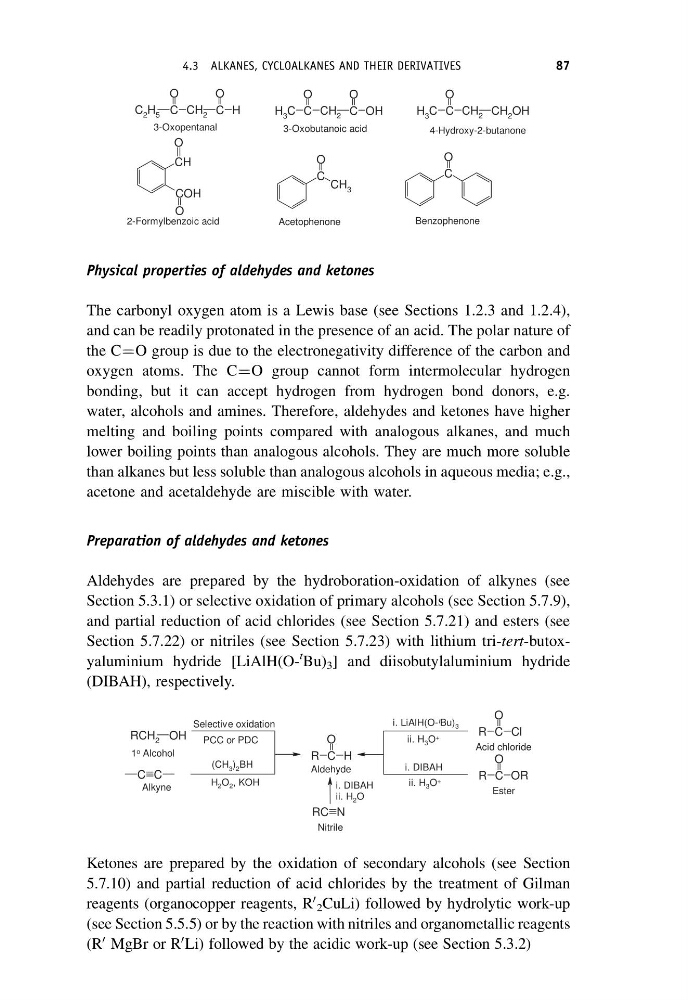
Aldehydes are prepared by the hydroboration-oxidation of alkynes (see
Section 5.3.1) or selective oxidation of primary alcohols (see Section 5.7.9),
and partial reduction of acid chlorides (see Section 5.7.21) and esters (see
Section 5.7.22) or nitriles (see Section 5.7.23) with lithium tri-tert-butoxyaluminium hydride [LiAlH(Ot Bu) 3 ] and diisobutylaluminium hydride
(DIBAH), respectively.
(CH 3 ) 2 BH
RCH 2 OH
RC N
C C
R C
O
Cl
R C
O
H
R C
O
OR
Alkyne
Aldehyde
Acid chloride
i. LiAlH(O- t Bu) 3
H 2 O 2 , KOH
PCC or PDC
1 o Alcohol
Selective oxidation
ii. H 3 O +
i. DIBAH
Nitrile
Ester
i. DIBAH
ii. H 2 O
ii. H 3 O +
Ketones are prepared by the oxidation of secondary alcohols (see Section
5.7.10) and partial reduction of acid chlorides by the treatment of Gilman
reagents (organocopper reagents, R
0
2 CuLi) followed by hydrolytic work-up
(see Section 5.5.5) or by the reaction with nitriles and organometallic reagents
(R
0 MgBr or R
0 Li) followed by the acidic work-up (see Section 5.3.2)
4.3 ALKANES, CYCLOALKANES AND THEIR DERIVATIVES
87
O
CH
O
C
O
CH 3
C
O
C 2 H 5 C
O
CH 2 C
O
H
C
H 3 C
O
CH 2 C
O
OH
C
H 3 C
O
CH 2 CH 2 OH
2-Formylbenzoic acid
Acetophenone
Benzophenone
3-Oxopentanal
3-Oxobutanoic acid
4-Hydroxy-2-butanone
Physical properties of aldehydes and ketones
The carbonyl oxygen atom is a Lewis base (see Sections 1.2.3 and 1.2.4),
and can be readily protonated in the presence of an acid. The polar nature of
the C À À
À À O group is due to the electronegativity difference of the carbon and
oxygen atoms. The C À À
À À O group cannot form intermolecular hydrogen
bonding, but it can accept hydrogen from hydrogen bond donors, e.g.
water, alcohols and amines. Therefore, aldehydes and ketones have higher
melting and boiling points compared with analogous alkanes, and much
lower boiling points than analogous alcohols. They are much more soluble
than alkanes but less soluble than analogous alcohols in aqueous media; e.g.,
acetone and acetaldehyde are miscible with water.
Preparation of aldehydes and ketones
Aldehydes are prepared by the hydroboration-oxidation of alkynes (see
Section 5.3.1) or selective oxidation of primary alcohols (see Section 5.7.9),
and partial reduction of acid chlorides (see Section 5.7.21) and esters (see
Section 5.7.22) or nitriles (see Section 5.7.23) with lithium tri-tert-butoxyaluminium hydride [LiAlH(Ot Bu) 3 ] and diisobutylaluminium hydride
(DIBAH), respectively.
(CH 3 ) 2 BH
RCH 2 OH
RC N
C C
R C
O
Cl
R C
O
H
R C
O
OR
Alkyne
Aldehyde
Acid chloride
i. LiAlH(O- t Bu) 3
H 2 O 2 , KOH
PCC or PDC
1 o Alcohol
Selective oxidation
ii. H 3 O +
i. DIBAH
Nitrile
Ester
i. DIBAH
ii. H 2 O
ii. H 3 O +
Ketones are prepared by the oxidation of secondary alcohols (see Section
5.7.10) and partial reduction of acid chlorides by the treatment of Gilman
reagents (organocopper reagents, R
0
2 CuLi) followed by hydrolytic work-up
(see Section 5.5.5) or by the reaction with nitriles and organometallic reagents
(R
0 MgBr or R
0 Li) followed by the acidic work-up (see Section 5.3.2)
4.3 ALKANES, CYCLOALKANES AND THEIR DERIVATIVES
87