

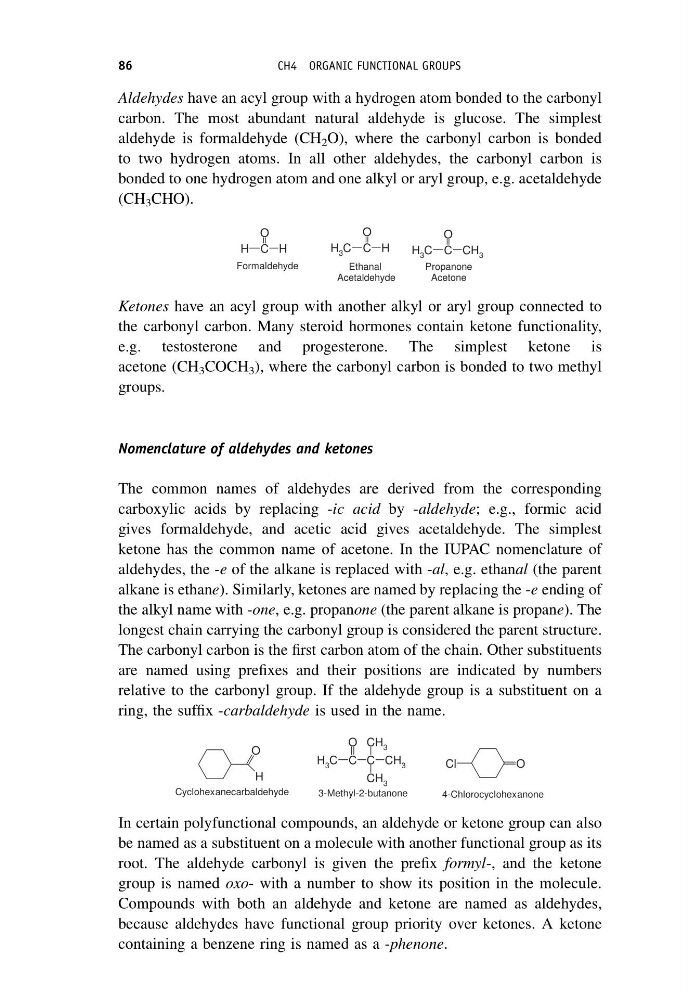
Aldehydes have an acyl group with a hydrogen atom bonded to the carbonyl
carbon. The most abundant natural aldehyde is glucose. The simplest
aldehyde is formaldehyde (CH 2 O), where the carbonyl carbon is bonded
to two hydrogen atoms. In all other aldehydes, the carbonyl carbon is
bonded to one hydrogen atom and one alkyl or aryl group, e.g. acetaldehyde
(CH 3 CHO).
C
O
H
H
C
O
C
H 3
H
C
O
C
H 3
CH 3
Formaldehyde
Ethanal
Acetaldehyde
Propanone
Acetone
Ketones have an acyl group with another alkyl or aryl group connected to
the carbonyl carbon. Many steroid hormones contain ketone functionality,
e.g. testosterone and progesterone. The simplest ketone is
acetone (CH 3 COCH 3 ), where the carbonyl carbon is bonded to two methyl
groups.
Nomenclature of aldehydes and ketones
The common names of aldehydes are derived from the corresponding
carboxylic acids by replacing -ic acid by -aldehyde; e.g., formic acid
gives formaldehyde, and acetic acid gives acetaldehyde. The simplest
ketone has the common name of acetone. In the IUPAC nomenclature of
aldehydes, the -e of the alkane is replaced with -al, e.g. ethanal (the parent
alkane is ethane). Similarly, ketones are named by replacing the -e ending of
the alkyl name with -one, e.g. propanone (the parent alkane is propane). The
longest chain carrying the carbonyl group is considered the parent structure.
The carbonyl carbon is the first carbon atom of the chain. Other substituents
are named using prefixes and their positions are indicated by numbers
relative to the carbonyl group. If the aldehyde group is a substituent on a
ring, the suffix -carbaldehyde is used in the name.
H
O
O
Cl
C
C
H 3
C
O
CH 3
CH 3
CH 3
Cyclohexanecarbaldehyde
4-Chlorocyclohexanone
3-Methyl-2-butanone
In certain polyfunctional compounds, an aldehyde or ketone group can also
be named as a substituent on a molecule with another functional group as its
root. The aldehyde carbonyl is given the prefix formyl-, and the ketone
group is named oxo- with a number to show its position in the molecule.
Compounds with both an aldehyde and ketone are named as aldehydes,
because aldehydes have functional group priority over ketones. A ketone
containing a benzene ring is named as a -phenone.
86
CH4 ORGANIC FUNCTIONAL GROUPS
carbon. The most abundant natural aldehyde is glucose. The simplest
aldehyde is formaldehyde (CH 2 O), where the carbonyl carbon is bonded
to two hydrogen atoms. In all other aldehydes, the carbonyl carbon is
bonded to one hydrogen atom and one alkyl or aryl group, e.g. acetaldehyde
(CH 3 CHO).
C
O
H
H
C
O
C
H 3
H
C
O
C
H 3
CH 3
Formaldehyde
Ethanal
Acetaldehyde
Propanone
Acetone
Ketones have an acyl group with another alkyl or aryl group connected to
the carbonyl carbon. Many steroid hormones contain ketone functionality,
e.g. testosterone and progesterone. The simplest ketone is
acetone (CH 3 COCH 3 ), where the carbonyl carbon is bonded to two methyl
groups.
Nomenclature of aldehydes and ketones
The common names of aldehydes are derived from the corresponding
carboxylic acids by replacing -ic acid by -aldehyde; e.g., formic acid
gives formaldehyde, and acetic acid gives acetaldehyde. The simplest
ketone has the common name of acetone. In the IUPAC nomenclature of
aldehydes, the -e of the alkane is replaced with -al, e.g. ethanal (the parent
alkane is ethane). Similarly, ketones are named by replacing the -e ending of
the alkyl name with -one, e.g. propanone (the parent alkane is propane). The
longest chain carrying the carbonyl group is considered the parent structure.
The carbonyl carbon is the first carbon atom of the chain. Other substituents
are named using prefixes and their positions are indicated by numbers
relative to the carbonyl group. If the aldehyde group is a substituent on a
ring, the suffix -carbaldehyde is used in the name.
H
O
O
Cl
C
C
H 3
C
O
CH 3
CH 3
CH 3
Cyclohexanecarbaldehyde
4-Chlorocyclohexanone
3-Methyl-2-butanone
In certain polyfunctional compounds, an aldehyde or ketone group can also
be named as a substituent on a molecule with another functional group as its
root. The aldehyde carbonyl is given the prefix formyl-, and the ketone
group is named oxo- with a number to show its position in the molecule.
Compounds with both an aldehyde and ketone are named as aldehydes,
because aldehydes have functional group priority over ketones. A ketone
containing a benzene ring is named as a -phenone.
86
CH4 ORGANIC FUNCTIONAL GROUPS