

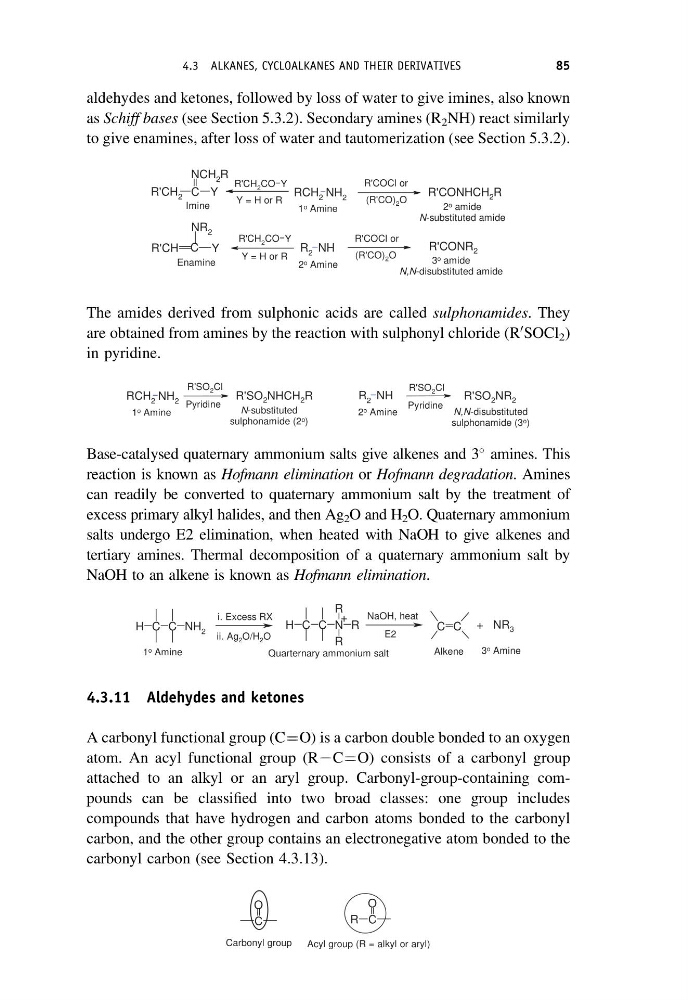
aldehydes and ketones, followed by loss of water to give imines, also known
as Schiff bases (see Section 5.3.2). Secondary amines (R 2 NH) react similarly
to give enamines, after loss of water and tautomerization (see Section 5.3.2).
RCH 2 NH 2
C
NCH 2 R
Y
R'CH 2
R'CH 2 CO Y
R'CH
Y
NR 2
R 2 NH
R'CH 2 CO Y
1 o Amine
R'COCl or
(R'CO) 2 O
R'CONHCH 2 R
2 o amide
N-substituted amide
Imine
Y = H or R
2 o Amine
C
R'COCl or
(R'CO) 2 O
R'CONR 2
Enamine
Y = H or R
3 o amide
N,N-disubstituted amide
The amides derived from sulphonic acids are called sulphonamides. They
are obtained from amines by the reaction with sulphonyl chloride (R
0 SOCl 2 )
in pyridine.
RCH 2 NH 2
R 2 NH
1 o Amine
R'SO 2 Cl
R'SO 2 NHCH 2 R
N-substituted
sulphonamide (2 o )
2 o Amine
R'SO 2 NR 2
N,N-disubstituted
sulphonamide (3 o )
R'SO 2 Cl
Pyridine
Pyridine
Base-catalysed quaternary ammonium salts give alkenes and 3
amines. This
reaction is known as Hofmann elimination or Hofmann degradation. Amines
can readily be converted to quaternary ammonium salt by the treatment of
excess primary alkyl halides, and then Ag 2 O and H 2 O. Quaternary ammonium
salts undergo E2 elimination, when heated with NaOH to give alkenes and
tertiary amines. Thermal decomposition of a quaternary ammonium salt by
NaOH to an alkene is known as Hofmann elimination.
C NH 2
C
H
C N
C
H
R
R
R
C C
i. Excess RX
ii. Ag 2 O/H 2 O
1 o Amine
Quarternary ammonium salt
+
NaOH, heat
E2
+ NR 3
Alkene
3 o Amine
4.3.11 Aldehydes and ketones
A carbonyl functional group (C À À
À À O) is a carbon double bonded to an oxygen
atom. An acyl functional group (RÀ ÀCÀ À
À À O) consists of a carbonyl group
attached to an alkyl or an aryl group. Carbonyl-group-containing compounds can be classified into two broad classes: one group includes
compounds that have hydrogen and carbon atoms bonded to the carbonyl
carbon, and the other group contains an electronegative atom bonded to the
carbonyl carbon (see Section 4.3.13).
C
O
C
R
O
Acyl group (R = alkyl or aryl)
Carbonyl group
4.3 ALKANES, CYCLOALKANES AND THEIR DERIVATIVES
85
as Schiff bases (see Section 5.3.2). Secondary amines (R 2 NH) react similarly
to give enamines, after loss of water and tautomerization (see Section 5.3.2).
RCH 2 NH 2
C
NCH 2 R
Y
R'CH 2
R'CH 2 CO Y
R'CH
Y
NR 2
R 2 NH
R'CH 2 CO Y
1 o Amine
R'COCl or
(R'CO) 2 O
R'CONHCH 2 R
2 o amide
N-substituted amide
Imine
Y = H or R
2 o Amine
C
R'COCl or
(R'CO) 2 O
R'CONR 2
Enamine
Y = H or R
3 o amide
N,N-disubstituted amide
The amides derived from sulphonic acids are called sulphonamides. They
are obtained from amines by the reaction with sulphonyl chloride (R
0 SOCl 2 )
in pyridine.
RCH 2 NH 2
R 2 NH
1 o Amine
R'SO 2 Cl
R'SO 2 NHCH 2 R
N-substituted
sulphonamide (2 o )
2 o Amine
R'SO 2 NR 2
N,N-disubstituted
sulphonamide (3 o )
R'SO 2 Cl
Pyridine
Pyridine
Base-catalysed quaternary ammonium salts give alkenes and 3
amines. This
reaction is known as Hofmann elimination or Hofmann degradation. Amines
can readily be converted to quaternary ammonium salt by the treatment of
excess primary alkyl halides, and then Ag 2 O and H 2 O. Quaternary ammonium
salts undergo E2 elimination, when heated with NaOH to give alkenes and
tertiary amines. Thermal decomposition of a quaternary ammonium salt by
NaOH to an alkene is known as Hofmann elimination.
C NH 2
C
H
C N
C
H
R
R
R
C C
i. Excess RX
ii. Ag 2 O/H 2 O
1 o Amine
Quarternary ammonium salt
+
NaOH, heat
E2
+ NR 3
Alkene
3 o Amine
4.3.11 Aldehydes and ketones
A carbonyl functional group (C À À
À À O) is a carbon double bonded to an oxygen
atom. An acyl functional group (RÀ ÀCÀ À
À À O) consists of a carbonyl group
attached to an alkyl or an aryl group. Carbonyl-group-containing compounds can be classified into two broad classes: one group includes
compounds that have hydrogen and carbon atoms bonded to the carbonyl
carbon, and the other group contains an electronegative atom bonded to the
carbonyl carbon (see Section 4.3.13).
C
O
C
R
O
Acyl group (R = alkyl or aryl)
Carbonyl group
4.3 ALKANES, CYCLOALKANES AND THEIR DERIVATIVES
85