

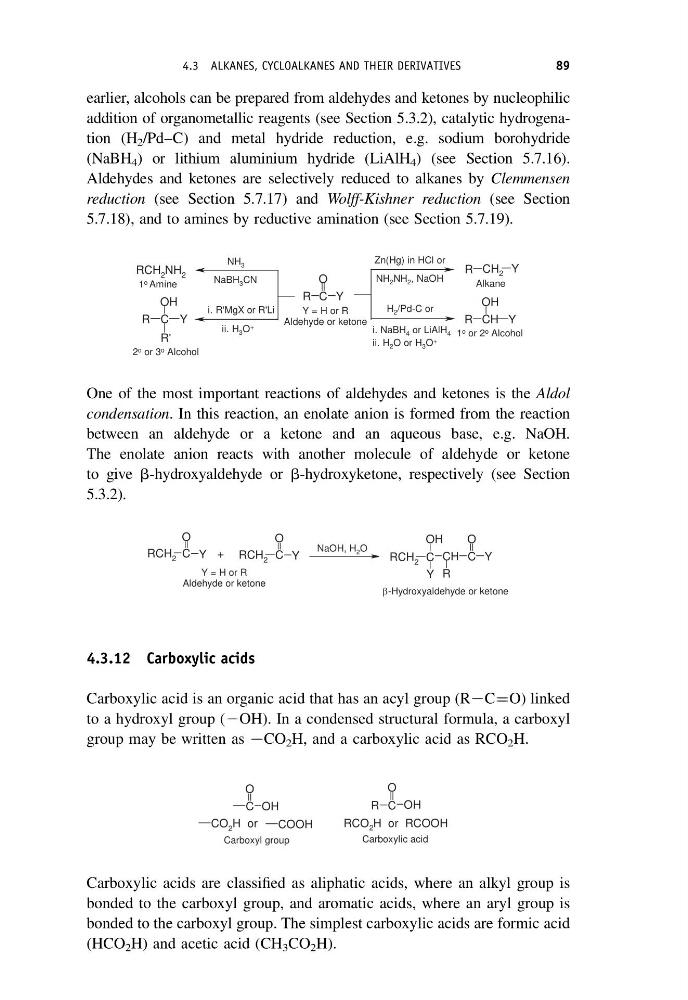
earlier, alcohols can be prepared from aldehydes and ketones by nucleophilic
addition of organometallic reagents (see Section 5.3.2), catalytic hydrogenation (H 2 /Pd–C) and metal hydride reduction, e.g. sodium borohydride
(NaBH 4 ) or lithium aluminium hydride (LiAlH 4 ) (see Section 5.7.16).
Aldehydes and ketones are selectively reduced to alkanes by Clemmensen
reduction (see Section 5.7.17) and Wolff-Kishner reduction (see Section
5.7.18), and to amines by reductive amination (see Section 5.7.19).
CH
OH
R
C Y
OH
R
R'
R C Y
O
Y
R
Y
RCH 2 NH 2
H 2 /Pd-C or
i. R'MgX or R'Li
1 o or 2 o Alcohol
2 o or 3 o Alcohol
Y = H or R
Aldehyde or ketone
Zn(Hg) in HCl or
NH 2 NH 2 , NaOH
Alkane
CH 2
i. NaBH 4 or LiAlH 4
ii. H 2 O or H 3 O +
NaBH 3 CN
1 o Amine
NH 3
ii. H 3 O +
One of the most important reactions of aldehydes and ketones is the Aldol
condensation. In this reaction, an enolate anion is formed from the reaction
between an aldehyde or a ketone and an aqueous base, e.g. NaOH.
The enolate anion reacts with another molecule of aldehyde or ketone
to give b-hydroxyaldehyde or b-hydroxyketone, respectively (see Section
5.3.2).
RCH 2 C
O
Y
C Y
O
RCH 2 C
O
Y
CH
R
RCH 2 C
OH
Y
β-Hydroxyaldehyde or ketone
Y = H or R
Aldehyde or ketone
NaOH, H 2 O
+
4.3.12 Carboxylic acids
Carboxylic acid is an organic acid that has an acyl group (RÀ ÀCÀ À
À À O) linked
to a hydroxyl group (À ÀOH). In a condensed structural formula, a carboxyl
group may be written as À ÀCO 2 H, and a carboxylic acid as RCO 2 H.
CO 2 H or
COOH
C
O
OH
R C
O
OH
RCO 2 H or RCOOH
Carboxylic acid
Carboxyl group
Carboxylic acids are classified as aliphatic acids, where an alkyl group is
bonded to the carboxyl group, and aromatic acids, where an aryl group is
bonded to the carboxyl group. The simplest carboxylic acids are formic acid
(HCO 2 H) and acetic acid (CH 3 CO 2 H).
4.3 ALKANES, CYCLOALKANES AND THEIR DERIVATIVES
89
addition of organometallic reagents (see Section 5.3.2), catalytic hydrogenation (H 2 /Pd–C) and metal hydride reduction, e.g. sodium borohydride
(NaBH 4 ) or lithium aluminium hydride (LiAlH 4 ) (see Section 5.7.16).
Aldehydes and ketones are selectively reduced to alkanes by Clemmensen
reduction (see Section 5.7.17) and Wolff-Kishner reduction (see Section
5.7.18), and to amines by reductive amination (see Section 5.7.19).
CH
OH
R
C Y
OH
R
R'
R C Y
O
Y
R
Y
RCH 2 NH 2
H 2 /Pd-C or
i. R'MgX or R'Li
1 o or 2 o Alcohol
2 o or 3 o Alcohol
Y = H or R
Aldehyde or ketone
Zn(Hg) in HCl or
NH 2 NH 2 , NaOH
Alkane
CH 2
i. NaBH 4 or LiAlH 4
ii. H 2 O or H 3 O +
NaBH 3 CN
1 o Amine
NH 3
ii. H 3 O +
One of the most important reactions of aldehydes and ketones is the Aldol
condensation. In this reaction, an enolate anion is formed from the reaction
between an aldehyde or a ketone and an aqueous base, e.g. NaOH.
The enolate anion reacts with another molecule of aldehyde or ketone
to give b-hydroxyaldehyde or b-hydroxyketone, respectively (see Section
5.3.2).
RCH 2 C
O
Y
C Y
O
RCH 2 C
O
Y
CH
R
RCH 2 C
OH
Y
β-Hydroxyaldehyde or ketone
Y = H or R
Aldehyde or ketone
NaOH, H 2 O
+
4.3.12 Carboxylic acids
Carboxylic acid is an organic acid that has an acyl group (RÀ ÀCÀ À
À À O) linked
to a hydroxyl group (À ÀOH). In a condensed structural formula, a carboxyl
group may be written as À ÀCO 2 H, and a carboxylic acid as RCO 2 H.
CO 2 H or
COOH
C
O
OH
R C
O
OH
RCO 2 H or RCOOH
Carboxylic acid
Carboxyl group
Carboxylic acids are classified as aliphatic acids, where an alkyl group is
bonded to the carboxyl group, and aromatic acids, where an aryl group is
bonded to the carboxyl group. The simplest carboxylic acids are formic acid
(HCO 2 H) and acetic acid (CH 3 CO 2 H).
4.3 ALKANES, CYCLOALKANES AND THEIR DERIVATIVES
89