

92
Density and Buoyancy
PROBLEM:
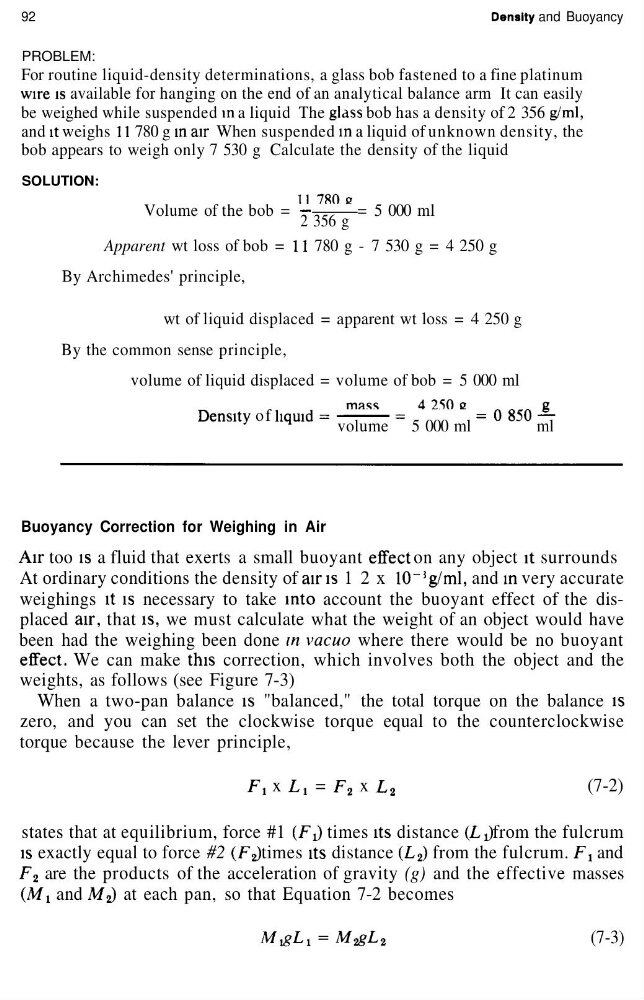
For routine liquid-density determinations, a glass bob fastened to a fine platinum
wire is available for hanging on the end of an analytical balance arm It can easily
be weighed while suspended in a liquid The glass bob has a density of 2 356 g/ml,
and it weighs 11 780 g in air When suspended in a liquid of unknown density, the
bob appears to weigh only 7 530 g Calculate the density of the liquid
SOLUTION:
Volume of the bob = -
= 5 000 ml
2 356 g
Apparent wt loss of bob = 1 1 780 g - 7 530 g = 4 250 g
By Archimedes' principle,
wt of liquid displaced = apparent wt loss = 4 250 g
By the common sense principle,
volume of liquid displaced = volume of bob = 5 000 ml
Density of liquid = -
- =
= 0 850
volume 5 000 ml
ml
Buoyancy Correction for Weighing in Air
Air too is a fluid that exerts a small buoyant effect on any object it surrounds
At ordinary conditions the density of air is 1 2 x 10~
! g/ml, and in very accurate
weighings it is necessary to take into account the buoyant effect of the displaced air, that is, we must calculate what the weight of an object would have
been had the weighing been done in vacua where there would be no buoyant
effect. We can make this correction, which involves both the object and the
weights, as follows (see Figure 7-3)
When a two-pan balance is "balanced," the total torque on the balance is
zero, and you can set the clockwise torque equal to the counterclockwise
torque because the lever principle,
FI x LI = F 2 x L 2
(7-2)
states that at equilibrium, force #1 (F x ) times its distance (LJ from the fulcrum
is exactly equal to force #2 (F^ times its distance (L 2 ) from the fulcrum. F t and
F 2 are the products of the acceleration of gravity (g) and the effective masses
(M, and MZ) at each pan, so that Equation 7-2 becomes
(7-3)
Density and Buoyancy
PROBLEM:
For routine liquid-density determinations, a glass bob fastened to a fine platinum
wire is available for hanging on the end of an analytical balance arm It can easily
be weighed while suspended in a liquid The glass bob has a density of 2 356 g/ml,
and it weighs 11 780 g in air When suspended in a liquid of unknown density, the
bob appears to weigh only 7 530 g Calculate the density of the liquid
SOLUTION:
Volume of the bob = -
= 5 000 ml
2 356 g
Apparent wt loss of bob = 1 1 780 g - 7 530 g = 4 250 g
By Archimedes' principle,
wt of liquid displaced = apparent wt loss = 4 250 g
By the common sense principle,
volume of liquid displaced = volume of bob = 5 000 ml
Density of liquid = -
- =
= 0 850
volume 5 000 ml
ml
Buoyancy Correction for Weighing in Air
Air too is a fluid that exerts a small buoyant effect on any object it surrounds
At ordinary conditions the density of air is 1 2 x 10~
! g/ml, and in very accurate
weighings it is necessary to take into account the buoyant effect of the displaced air, that is, we must calculate what the weight of an object would have
been had the weighing been done in vacua where there would be no buoyant
effect. We can make this correction, which involves both the object and the
weights, as follows (see Figure 7-3)
When a two-pan balance is "balanced," the total torque on the balance is
zero, and you can set the clockwise torque equal to the counterclockwise
torque because the lever principle,
FI x LI = F 2 x L 2
(7-2)
states that at equilibrium, force #1 (F x ) times its distance (LJ from the fulcrum
is exactly equal to force #2 (F^ times its distance (L 2 ) from the fulcrum. F t and
F 2 are the products of the acceleration of gravity (g) and the effective masses
(M, and MZ) at each pan, so that Equation 7-2 becomes
(7-3)