

91
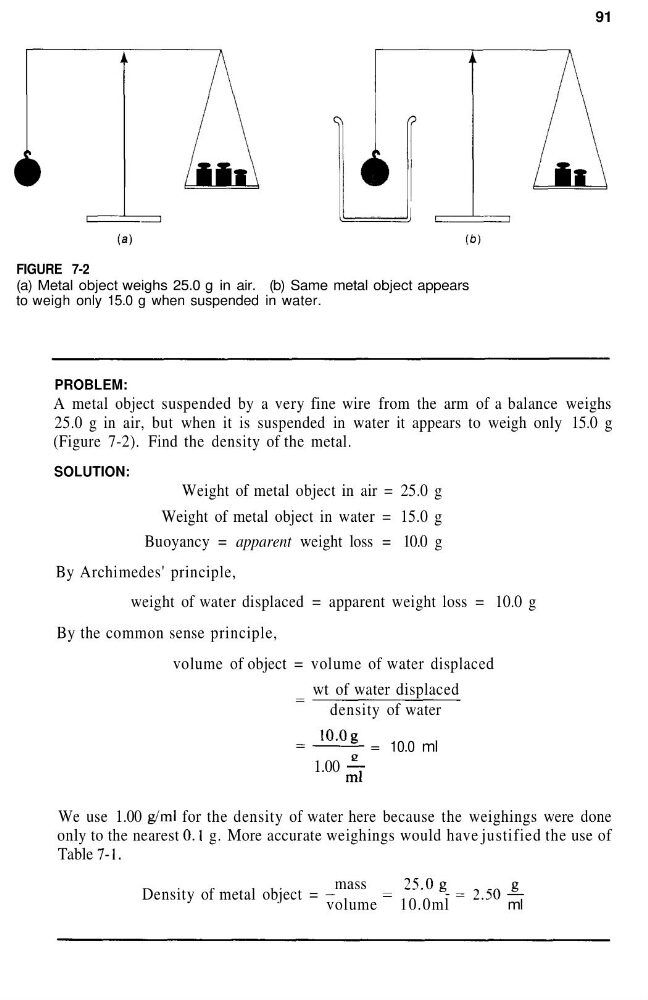
FIGURE 7-2
(a) Metal object weighs 25.0 g in air. (b) Same metal object appears
to weigh only 15.0 g when suspended in water.
PROBLEM:
A metal object suspended by a very fine wire from the arm of a balance weighs
25.0 g in air, but when it is suspended in water it appears to weigh only 15.0 g
(Figure 7-2). Find the density of the metal.
SOLUTION:
Weight of metal object in air = 25.0 g
Weight of metal object in water = 15.0 g
Buoyancy = apparent weight loss = 10.0 g
By Archimedes' principle,
weight of water displaced = apparent weight loss = 10.0 g
By the common sense principle,
volume of object = volume of water displaced
wt of water displaced
density of water
10.0 g
= 10.0 ml
1.00 • •
ml
We use 1.00 g/ml for the density of water here because the weighings were done
only to the nearest 0.1 g. More accurate weighings would have justified the use of
Table 7-1.
Density of metal object =
mass = 25. Og
volume 10.0ml
ml
FIGURE 7-2
(a) Metal object weighs 25.0 g in air. (b) Same metal object appears
to weigh only 15.0 g when suspended in water.
PROBLEM:
A metal object suspended by a very fine wire from the arm of a balance weighs
25.0 g in air, but when it is suspended in water it appears to weigh only 15.0 g
(Figure 7-2). Find the density of the metal.
SOLUTION:
Weight of metal object in air = 25.0 g
Weight of metal object in water = 15.0 g
Buoyancy = apparent weight loss = 10.0 g
By Archimedes' principle,
weight of water displaced = apparent weight loss = 10.0 g
By the common sense principle,
volume of object = volume of water displaced
wt of water displaced
density of water
10.0 g
= 10.0 ml
1.00 • •
ml
We use 1.00 g/ml for the density of water here because the weighings were done
only to the nearest 0.1 g. More accurate weighings would have justified the use of
Table 7-1.
Density of metal object =
mass = 25. Og
volume 10.0ml
ml