

90
Density and Buoyancy
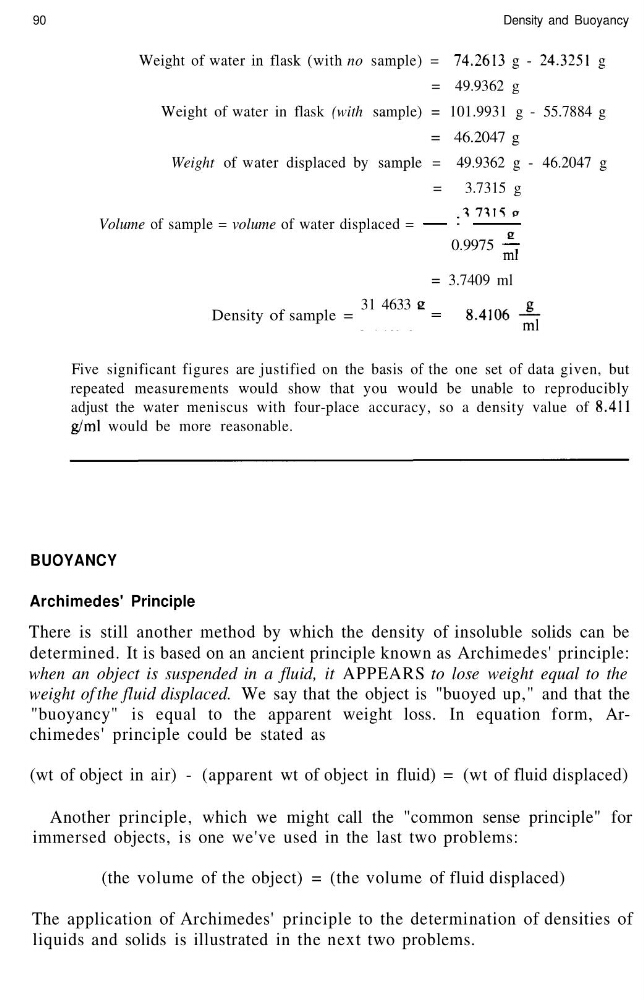
Weight of water in flask (with no sample) = 74.2613 g - 24.3251 g
= 49.9362 g
Weight of water in flask (with sample) = 101.9931 g - 55.7884 g
= 46.2047 g
Weight of water displaced by sample = 49.9362 g - 46.2047 g
= 3.7315 g
Volume of sample = volume of water displaced = -
: -
0.9975 —,
ml
= 3.7409 ml
31 4633 e
s.
Density of sample =
=
8.4,06^
Five significant figures are justified on the basis of the one set of data given, but
repeated measurements would show that you would be unable to reproducibly
adjust the water meniscus with four-place accuracy, so a density value of 8.411
g/ml would be more reasonable.
BUOYANCY
Archimedes' Principle
There is still another method by which the density of insoluble solids can be
determined. It is based on an ancient principle known as Archimedes' principle:
when an object is suspended in a fluid, it APPEARS to lose weight equal to the
weight of the fluid displaced. We say that the object is "buoyed up," and that the
"buoyancy" is equal to the apparent weight loss. In equation form, Archimedes' principle could be stated as
(wt of object in air) - (apparent wt of object in fluid) = (wt of fluid displaced)
Another principle, which we might call the "common sense principle" for
immersed objects, is one we've used in the last two problems:
(the volume of the object) = (the volume of fluid displaced)
The application of Archimedes' principle to the determination of densities of
liquids and solids is illustrated in the next two problems.
Density and Buoyancy
Weight of water in flask (with no sample) = 74.2613 g - 24.3251 g
= 49.9362 g
Weight of water in flask (with sample) = 101.9931 g - 55.7884 g
= 46.2047 g
Weight of water displaced by sample = 49.9362 g - 46.2047 g
= 3.7315 g
Volume of sample = volume of water displaced = -
: -
0.9975 —,
ml
= 3.7409 ml
31 4633 e
s.
Density of sample =
=
8.4,06^
Five significant figures are justified on the basis of the one set of data given, but
repeated measurements would show that you would be unable to reproducibly
adjust the water meniscus with four-place accuracy, so a density value of 8.411
g/ml would be more reasonable.
BUOYANCY
Archimedes' Principle
There is still another method by which the density of insoluble solids can be
determined. It is based on an ancient principle known as Archimedes' principle:
when an object is suspended in a fluid, it APPEARS to lose weight equal to the
weight of the fluid displaced. We say that the object is "buoyed up," and that the
"buoyancy" is equal to the apparent weight loss. In equation form, Archimedes' principle could be stated as
(wt of object in air) - (apparent wt of object in fluid) = (wt of fluid displaced)
Another principle, which we might call the "common sense principle" for
immersed objects, is one we've used in the last two problems:
(the volume of the object) = (the volume of fluid displaced)
The application of Archimedes' principle to the determination of densities of
liquids and solids is illustrated in the next two problems.