

Density of a Solid
89
the volume of the liquid it displaces, taking care that air bubbles don't cling to
the solid's surface and also displace liquid. The method will work only if the
solid is insoluble in the liquid used. An approximate value, using a graduated
cylinder, may be found as follows.
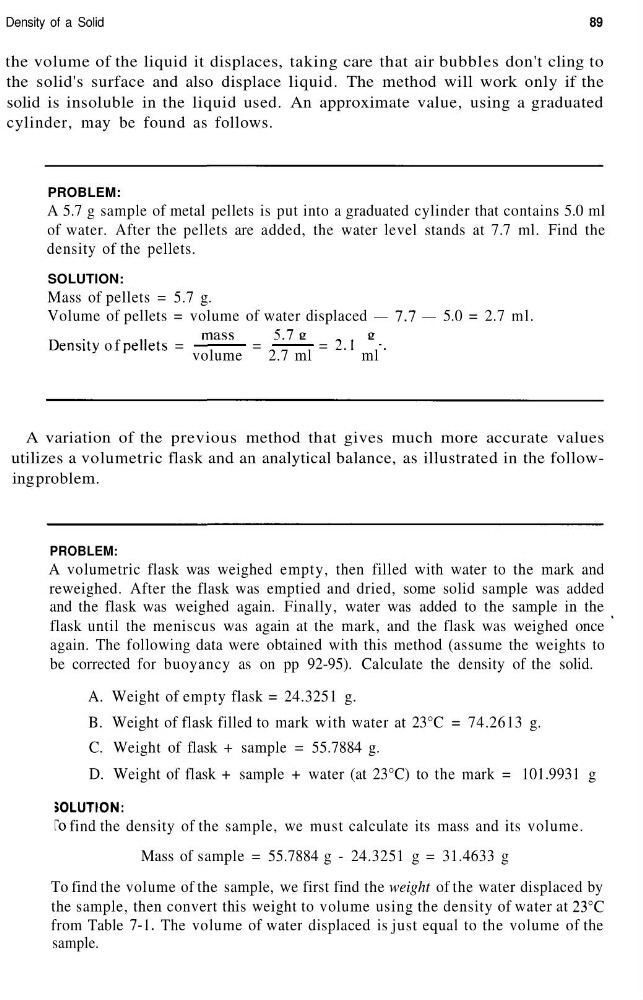
PROBLEM:
A 5.7 g sample of metal pellets is put into a graduated cylinder that contains 5.0 ml
of water. After the pellets are added, the water level stands at 7.7 ml. Find the
density of the pellets.
SOLUTION:
Mass of pellets = 5.7 g.
Volume of pellets = volume of water displaced — 1.1 — 5.0 = 2.7 ml.
Density of pellets = - - = - - = 2.1 -.
volume
2.7 ml
ml
A variation of the previous method that gives much more accurate values
utilizes a volumetric flask and an analytical balance, as illustrated in the following problem.
PROBLEM:
A volumetric flask was weighed empty, then filled with water to the mark and
reweighed. After the flask was emptied and dried, some solid sample was added
and the flask was weighed again. Finally, water was added to the sample in the
flask until the meniscus was again at the mark, and the flask was weighed once
again. The following data were obtained with this method (assume the weights to
be corrected for buoyancy as on pp 92-95). Calculate the density of the solid.
A. Weight of empty flask = 24.3251 g.
B. Weight of flask filled to mark with water at 23°C = 74.2613 g.
C. Weight of flask + sample = 55.7884 g.
D. Weight of flask + sample + water (at 23°C) to the mark = 101.9931 g
SOLUTION:
To find the density of the sample, we must calculate its mass and its volume.
Mass of sample = 55.7884 g - 24.3251 g = 31.4633 g
To find the volume of the sample, we first find the weight of the water displaced by
the sample, then convert this weight to volume using the density of water at 23°C
from Table 7-1. The volume of water displaced is just equal to the volume of the
sample.
89
the volume of the liquid it displaces, taking care that air bubbles don't cling to
the solid's surface and also displace liquid. The method will work only if the
solid is insoluble in the liquid used. An approximate value, using a graduated
cylinder, may be found as follows.
PROBLEM:
A 5.7 g sample of metal pellets is put into a graduated cylinder that contains 5.0 ml
of water. After the pellets are added, the water level stands at 7.7 ml. Find the
density of the pellets.
SOLUTION:
Mass of pellets = 5.7 g.
Volume of pellets = volume of water displaced — 1.1 — 5.0 = 2.7 ml.
Density of pellets = - - = - - = 2.1 -.
volume
2.7 ml
ml
A variation of the previous method that gives much more accurate values
utilizes a volumetric flask and an analytical balance, as illustrated in the following problem.
PROBLEM:
A volumetric flask was weighed empty, then filled with water to the mark and
reweighed. After the flask was emptied and dried, some solid sample was added
and the flask was weighed again. Finally, water was added to the sample in the
flask until the meniscus was again at the mark, and the flask was weighed once
again. The following data were obtained with this method (assume the weights to
be corrected for buoyancy as on pp 92-95). Calculate the density of the solid.
A. Weight of empty flask = 24.3251 g.
B. Weight of flask filled to mark with water at 23°C = 74.2613 g.
C. Weight of flask + sample = 55.7884 g.
D. Weight of flask + sample + water (at 23°C) to the mark = 101.9931 g
SOLUTION:
To find the density of the sample, we must calculate its mass and its volume.
Mass of sample = 55.7884 g - 24.3251 g = 31.4633 g
To find the volume of the sample, we first find the weight of the water displaced by
the sample, then convert this weight to volume using the density of water at 23°C
from Table 7-1. The volume of water displaced is just equal to the volume of the
sample.