

88
Density and Buoyancy
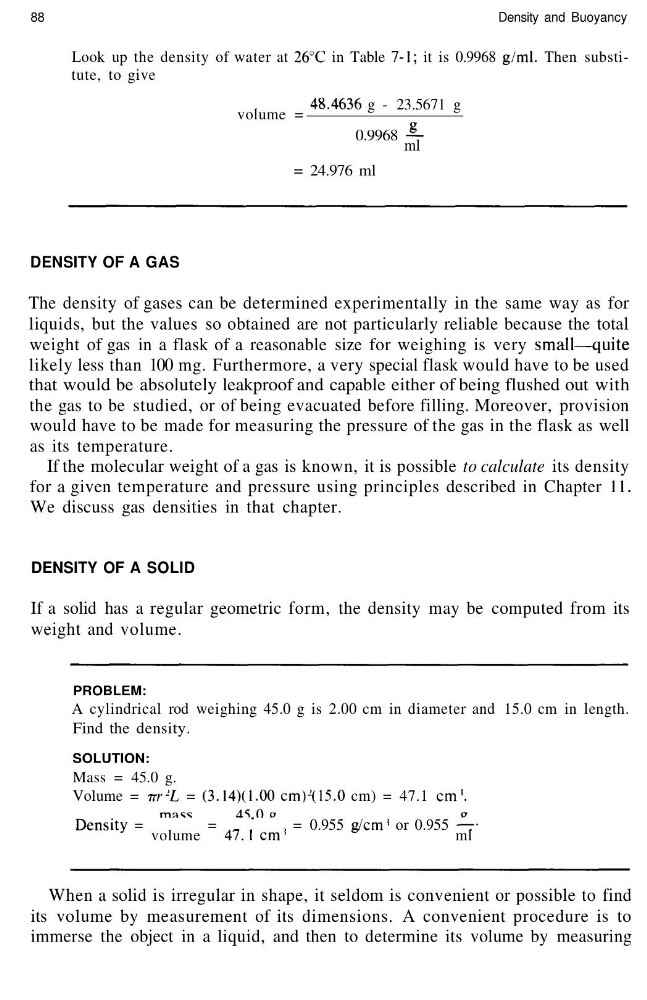
Look up the density of water at 26°C in Table 7-1; it is 0.9968 g/ml. Then substitute, to give
48.4636 g - 23.5671 g
volume =
0.9968 -§ml
= 24.976 ml
DENSITY OF A GAS
The density of gases can be determined experimentally in the same way as for
liquids, but the values so obtained are not particularly reliable because the total
weight of gas in a flask of a reasonable size for weighing is very small—quite
likely less than 100 mg. Furthermore, a very special flask would have to be used
that would be absolutely leakproof and capable either of being flushed out with
the gas to be studied, or of being evacuated before filling. Moreover, provision
would have to be made for measuring the pressure of the gas in the flask as well
as its temperature.
If the molecular weight of a gas is known, it is possible to calculate its density
for a given temperature and pressure using principles described in Chapter 11.
We discuss gas densities in that chapter.
DENSITY OF A SOLID
If a solid has a regular geometric form, the density may be computed from its
weight and volume.
PROBLEM:
A cylindrical rod weighing 45.0 g is 2.00 cm in diameter and 15.0 cm in length.
Find the density.
SOLUTION:
Mass = 45.0 g.
Volume = 77r
J L = (3.14)(1.00 cm)
J (15.0 cm) = 47.1 cm
1 .
Density =
=
'
, = 0.955 g/cm ' or 0.955 -rvolume
47. 1 cm
1
ml
When a solid is irregular in shape, it seldom is convenient or possible to find
its volume by measurement of its dimensions. A convenient procedure is to
immerse the object in a liquid, and then to determine its volume by measuring
Density and Buoyancy
Look up the density of water at 26°C in Table 7-1; it is 0.9968 g/ml. Then substitute, to give
48.4636 g - 23.5671 g
volume =
0.9968 -§ml
= 24.976 ml
DENSITY OF A GAS
The density of gases can be determined experimentally in the same way as for
liquids, but the values so obtained are not particularly reliable because the total
weight of gas in a flask of a reasonable size for weighing is very small—quite
likely less than 100 mg. Furthermore, a very special flask would have to be used
that would be absolutely leakproof and capable either of being flushed out with
the gas to be studied, or of being evacuated before filling. Moreover, provision
would have to be made for measuring the pressure of the gas in the flask as well
as its temperature.
If the molecular weight of a gas is known, it is possible to calculate its density
for a given temperature and pressure using principles described in Chapter 11.
We discuss gas densities in that chapter.
DENSITY OF A SOLID
If a solid has a regular geometric form, the density may be computed from its
weight and volume.
PROBLEM:
A cylindrical rod weighing 45.0 g is 2.00 cm in diameter and 15.0 cm in length.
Find the density.
SOLUTION:
Mass = 45.0 g.
Volume = 77r
J L = (3.14)(1.00 cm)
J (15.0 cm) = 47.1 cm
1 .
Density =
=
'
, = 0.955 g/cm ' or 0.955 -rvolume
47. 1 cm
1
ml
When a solid is irregular in shape, it seldom is convenient or possible to find
its volume by measurement of its dimensions. A convenient procedure is to
immerse the object in a liquid, and then to determine its volume by measuring