

87
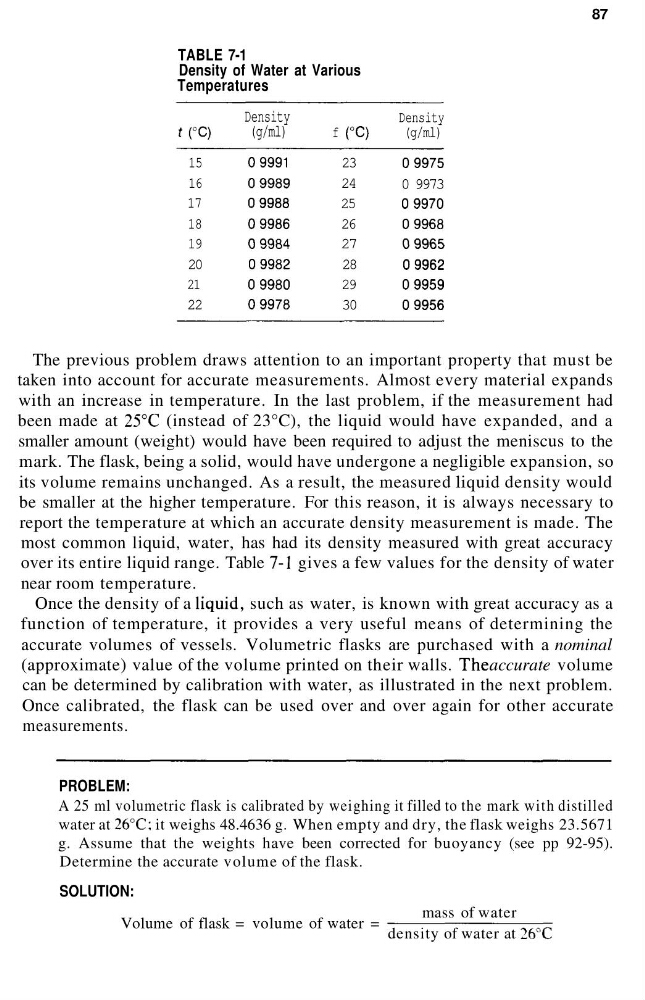
TABLE 7-1
Density of Water at Various
Temperatures
M°C)
15
16
17
18
19
20
21
22
Density
(g/ml)
09991
09989
09988
09986
09984
09982
09980
09978
f (°C)
23
24
25
26
27
28
29
30
Density
(g/ml)
09975
0 9973
09970
09968
09965
09962
09959
09956
The previous problem draws attention to an important property that must be
taken into account for accurate measurements. Almost every material expands
with an increase in temperature. In the last problem, if the measurement had
been made at 25°C (instead of 23°C), the liquid would have expanded, and a
smaller amount (weight) would have been required to adjust the meniscus to the
mark. The flask, being a solid, would have undergone a negligible expansion, so
its volume remains unchanged. As a result, the measured liquid density would
be smaller at the higher temperature. For this reason, it is always necessary to
report the temperature at which an accurate density measurement is made. The
most common liquid, water, has had its density measured with great accuracy
over its entire liquid range. Table 7-1 gives a few values for the density of water
near room temperature.
Once the density of a liquid, such as water, is known with great accuracy as a
function of temperature, it provides a very useful means of determining the
accurate volumes of vessels. Volumetric flasks are purchased with a nominal
(approximate) value of the volume printed on their walls. The accurate volume
can be determined by calibration with water, as illustrated in the next problem.
Once calibrated, the flask can be used over and over again for other accurate
measurements.
PROBLEM:
A 25 ml volumetric flask is calibrated by weighing it filled to the mark with distilled
water at 26°C; it weighs 48.4636 g. When empty and dry, the flask weighs 23.5671
g. Assume that the weights have been corrected for buoyancy (see pp 92-95).
Determine the accurate volume of the flask.
SOLUTION:
mass of water
Volume of flask = volume of water = density of water at 26°C
TABLE 7-1
Density of Water at Various
Temperatures
M°C)
15
16
17
18
19
20
21
22
Density
(g/ml)
09991
09989
09988
09986
09984
09982
09980
09978
f (°C)
23
24
25
26
27
28
29
30
Density
(g/ml)
09975
0 9973
09970
09968
09965
09962
09959
09956
The previous problem draws attention to an important property that must be
taken into account for accurate measurements. Almost every material expands
with an increase in temperature. In the last problem, if the measurement had
been made at 25°C (instead of 23°C), the liquid would have expanded, and a
smaller amount (weight) would have been required to adjust the meniscus to the
mark. The flask, being a solid, would have undergone a negligible expansion, so
its volume remains unchanged. As a result, the measured liquid density would
be smaller at the higher temperature. For this reason, it is always necessary to
report the temperature at which an accurate density measurement is made. The
most common liquid, water, has had its density measured with great accuracy
over its entire liquid range. Table 7-1 gives a few values for the density of water
near room temperature.
Once the density of a liquid, such as water, is known with great accuracy as a
function of temperature, it provides a very useful means of determining the
accurate volumes of vessels. Volumetric flasks are purchased with a nominal
(approximate) value of the volume printed on their walls. The accurate volume
can be determined by calibration with water, as illustrated in the next problem.
Once calibrated, the flask can be used over and over again for other accurate
measurements.
PROBLEM:
A 25 ml volumetric flask is calibrated by weighing it filled to the mark with distilled
water at 26°C; it weighs 48.4636 g. When empty and dry, the flask weighs 23.5671
g. Assume that the weights have been corrected for buoyancy (see pp 92-95).
Determine the accurate volume of the flask.
SOLUTION:
mass of water
Volume of flask = volume of water = density of water at 26°C