

93
(a)
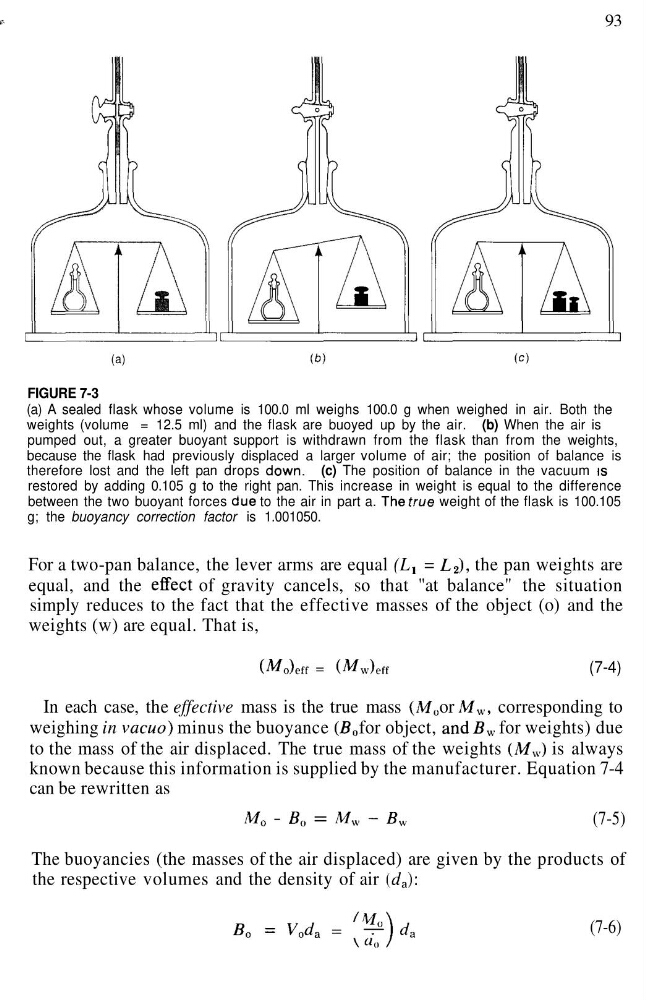
FIGURE 7-3
(a) A sealed flask whose volume is 100.0 ml weighs 100.0 g when weighed in air. Both the
weights (volume = 12.5 ml) and the flask are buoyed up by the air. (b) When the air is
pumped out, a greater buoyant support is withdrawn from the flask than from the weights,
because the flask had previously displaced a larger volume of air; the position of balance is
therefore lost and the left pan drops down, (c) The position of balance in the vacuum is
restored by adding 0.105 g to the right pan. This increase in weight is equal to the difference
between the two buoyant forces due to the air in part a. Thefrue weight of the flask is 100.105
g; the buoyancy correction factor is 1.001050.
For a two-pan balance, the lever arms are equal (L j = L 2 ), the pan weights are
equal, and the effect of gravity cancels, so that "at balance" the situation
simply reduces to the fact that the effective masses of the object (o) and the
weights (w) are equal. That is,
(M 0 )eff = (Af w ) eft
(7-4)
In each case, the effective mass is the true mass (M 0 or M w , corresponding to
weighing in vacuo) minus the buoyance (B 0 for object, and5 w for weights) due
to the mass of the air displaced. The true mass of the weights (A/ w ) is always
known because this information is supplied by the manufacturer. Equation 7-4
can be rewritten as
M 0 - B 0 =
(7-5)
The buoyancies (the masses of the air displaced) are given by the products of
the respective volumes and the density of air (d a ):
(7-6)
B 0 = V 0 d a = -T*
(a)
FIGURE 7-3
(a) A sealed flask whose volume is 100.0 ml weighs 100.0 g when weighed in air. Both the
weights (volume = 12.5 ml) and the flask are buoyed up by the air. (b) When the air is
pumped out, a greater buoyant support is withdrawn from the flask than from the weights,
because the flask had previously displaced a larger volume of air; the position of balance is
therefore lost and the left pan drops down, (c) The position of balance in the vacuum is
restored by adding 0.105 g to the right pan. This increase in weight is equal to the difference
between the two buoyant forces due to the air in part a. Thefrue weight of the flask is 100.105
g; the buoyancy correction factor is 1.001050.
For a two-pan balance, the lever arms are equal (L j = L 2 ), the pan weights are
equal, and the effect of gravity cancels, so that "at balance" the situation
simply reduces to the fact that the effective masses of the object (o) and the
weights (w) are equal. That is,
(M 0 )eff = (Af w ) eft
(7-4)
In each case, the effective mass is the true mass (M 0 or M w , corresponding to
weighing in vacuo) minus the buoyance (B 0 for object, and5 w for weights) due
to the mass of the air displaced. The true mass of the weights (A/ w ) is always
known because this information is supplied by the manufacturer. Equation 7-4
can be rewritten as
M 0 - B 0 =
(7-5)
The buoyancies (the masses of the air displaced) are given by the products of
the respective volumes and the density of air (d a ):
(7-6)
B 0 = V 0 d a = -T*