

94
Density and Buoyancy
a
(7-7)
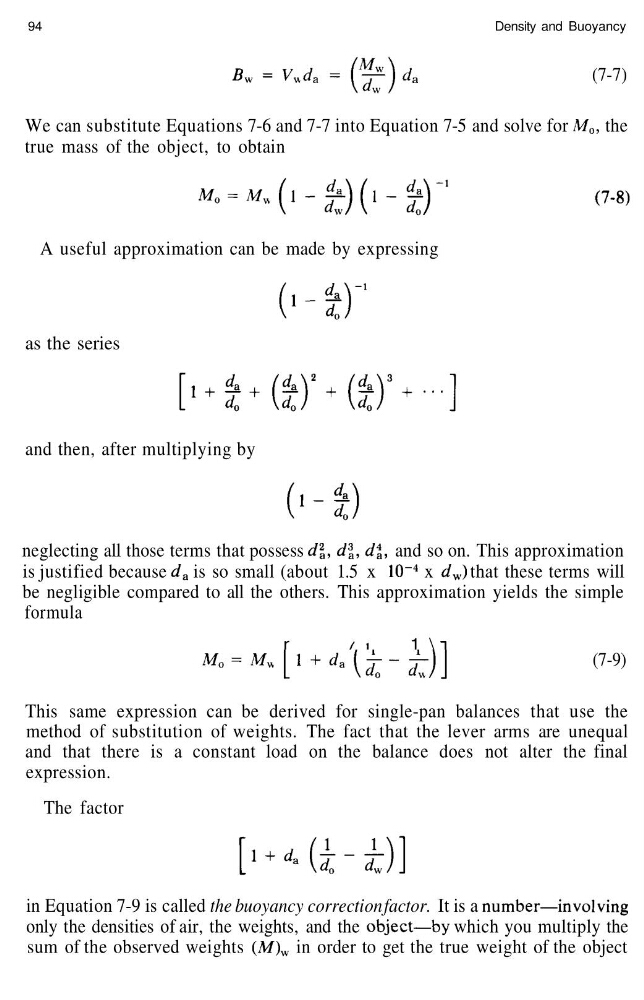
We can substitute Equations 7-6 and 7-7 into Equation 7-5 and solve for M 0 , the
true mass of the object, to obtain
<7
-
8)
A useful approximation can be made by expressing
as the series
and then, after multiplying by
neglecting all those terms that possess d\, d\, d\, and so on. This approximation
is justified because d a is so small (about 1.5 x 10~
4 x d v ) that these terms will
be negligible compared to all the others. This approximation yields the simple
formula
r
/ i
1 \ n
(7-9)
This same expression can be derived for single-pan balances that use the
method of substitution of weights. The fact that the lever arms are unequal
and that there is a constant load on the balance does not alter the final
expression.
The factor
in Equation 7-9 is called the buoyancy correction factor. It is a number—involving
only the densities of air, the weights, and the object—by which you multiply the
sum of the observed weights (M) w in order to get the true weight of the object
Density and Buoyancy
a
(7-7)
We can substitute Equations 7-6 and 7-7 into Equation 7-5 and solve for M 0 , the
true mass of the object, to obtain
<7
-
8)
A useful approximation can be made by expressing
as the series
and then, after multiplying by
neglecting all those terms that possess d\, d\, d\, and so on. This approximation
is justified because d a is so small (about 1.5 x 10~
4 x d v ) that these terms will
be negligible compared to all the others. This approximation yields the simple
formula
r
/ i
1 \ n
(7-9)
This same expression can be derived for single-pan balances that use the
method of substitution of weights. The fact that the lever arms are unequal
and that there is a constant load on the balance does not alter the final
expression.
The factor
in Equation 7-9 is called the buoyancy correction factor. It is a number—involving
only the densities of air, the weights, and the object—by which you multiply the
sum of the observed weights (M) w in order to get the true weight of the object