

Rate of Nuclear Disintegration
405
The half-lives of a few selected radioactive isotopes are given in Table 26-1,
along with the particles that are emitted in each case.
PROBLEM:
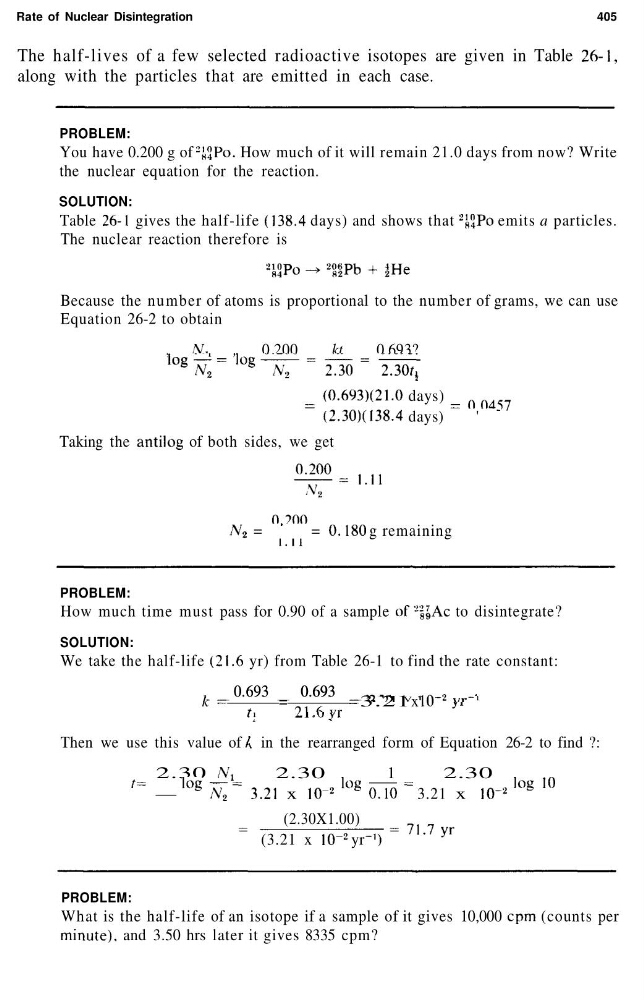
You have 0.200 g of
2 J!JPo. How much of it will remain 21.0 days from now? Write
the nuclear equation for the reaction.
SOLUTION:
Table 26-1 gives the half-life (138.4 days) and shows that
2 8°Po emits a particles.
The nuclear reaction therefore is
Because the number of atoms is proportional to the number of grams, we can use
Equation 26-2 to obtain
, N t
,
0.200
kt
0.693?
108
^
= 10g -^T
= 2^
= T3^
= (0-693X21.0 days) =
(2.30)(138.4 days)
' "
Taking the antilog of both sides, we get
N 2 = '
= 0. 180 g remaining
PROBLEM:
How much time must pass for 0.90 of a sample of'-|£Ac to disintegrate?
SOLUTION:
We take the half-life (21.6 yr) from Table 26-1 to find the rate constant:
0.693
0.693
, ..
,„ ,
.
/- —
—
— ^ Tl V \f\ — t \ir~>
0.693
0.693
, ..
,„ ,
k =
=
= 3.21 x 10~
2
r,
21.6 yr
11
— i ,u y i
Then we use this value of A in the rearranged form of Equation 26-2 to find ?:
2.30 /V,
2.30
.
1
2.30
. ,.
'
= — '°
g W t
= 3.2! x 102 l08 Olo
= 3.21 x 1Q-* '°
8 10
(2.30X1.00)
(3.21 x 10² yr
PROBLEM:
What is the half-life of an isotope if a sample of it gives 10,000 cpm (counts per
minute), and 3.50 hrs later it gives 8335 cpm?
405
The half-lives of a few selected radioactive isotopes are given in Table 26-1,
along with the particles that are emitted in each case.
PROBLEM:
You have 0.200 g of
2 J!JPo. How much of it will remain 21.0 days from now? Write
the nuclear equation for the reaction.
SOLUTION:
Table 26-1 gives the half-life (138.4 days) and shows that
2 8°Po emits a particles.
The nuclear reaction therefore is
Because the number of atoms is proportional to the number of grams, we can use
Equation 26-2 to obtain
, N t
,
0.200
kt
0.693?
108
^
= 10g -^T
= 2^
= T3^
= (0-693X21.0 days) =
(2.30)(138.4 days)
' "
Taking the antilog of both sides, we get
N 2 = '
= 0. 180 g remaining
PROBLEM:
How much time must pass for 0.90 of a sample of'-|£Ac to disintegrate?
SOLUTION:
We take the half-life (21.6 yr) from Table 26-1 to find the rate constant:
0.693
0.693
, ..
,„ ,
.
/- —
—
— ^ Tl V \f\ — t \ir~>
0.693
0.693
, ..
,„ ,
k =
=
= 3.21 x 10~
2
r,
21.6 yr
11
— i ,u y i
Then we use this value of A in the rearranged form of Equation 26-2 to find ?:
2.30 /V,
2.30
.
1
2.30
. ,.
'
= — '°
g W t
= 3.2! x 102 l08 Olo
= 3.21 x 1Q-* '°
8 10
(2.30X1.00)
(3.21 x 10² yr
PROBLEM:
What is the half-life of an isotope if a sample of it gives 10,000 cpm (counts per
minute), and 3.50 hrs later it gives 8335 cpm?