

404
Nuclear Chemistry
is a first-order process with a rate solely proportional to the number of atoms
(N) of the isotope present at any given instant.
(26-1)
The proportionality constant (the rate constant, A) is different for each isotope, and has the units of reciprocal time (sec""
1 , min"
1 , yr"
1 , etc.). In Chapter
15, we show that the relationship between the number of atoms (NJ at the
outset (t = 0), and the number of atoms (N 2 ) remaining at time t is given by
N may be expressed in any convenient units because whatever is used
cancels out in the ratio NJN^. A common unit is "counts per minute" (cpm)
because, through Equation 26-1, the observed cpm are a direct measure of the
number of radioactive atoms present.
Equation 26-2 often is written in the form
log N 2 = -
t + log
(26-3)
because a plot of log (cpm) 2 versus t will yield a straight line whose slope
(-A./2.30) will enable the evaluation of the rate constant k. This procedure is
illustrated on p. 234.
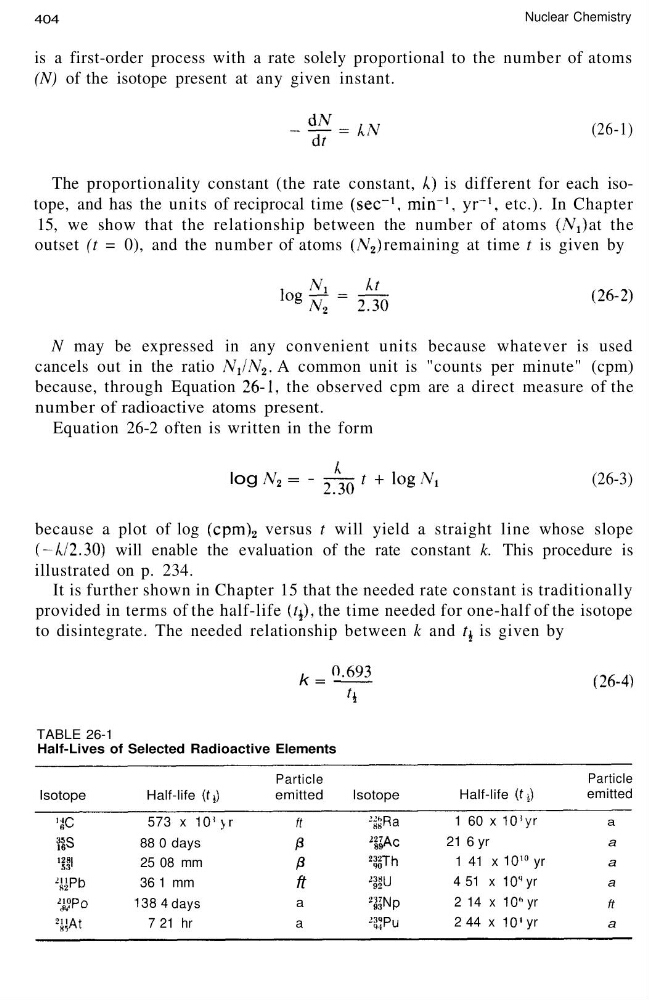
It is further shown in Chapter 15 that the needed rate constant is traditionally
provided in terms of the half-life (/j), the time needed for one-half of the isotope
to disintegrate. The needed relationship between k and ^ is given by
k = -
(26 . 4)
TABLE 26-1
Half-Lives of Selected Radioactive Elements
Isotope
'3C
BS
'ill
2
JlPb
"°P°
2'lAt
Half-life (fj)
573 x 10' >r
88 0 days
25 08 mm
36 1 mm
1384 days
7 21 hr
Particle
emitted
Isotope
ft
-ggRa
y8
'IJAc
0
2 ?§Th
ft
-iiu
a
2
iJNp
a
2
igPu
Half-life (fj)
1 60 x 10' yr
21 6 yr
1 41 x 10'° yr
4 51 x 10" yr
2 14 x 10" yr
2 44 x 10' yr
Particle
emitted
a
a
a
a
ft
a
Nuclear Chemistry
is a first-order process with a rate solely proportional to the number of atoms
(N) of the isotope present at any given instant.
(26-1)
The proportionality constant (the rate constant, A) is different for each isotope, and has the units of reciprocal time (sec""
1 , min"
1 , yr"
1 , etc.). In Chapter
15, we show that the relationship between the number of atoms (NJ at the
outset (t = 0), and the number of atoms (N 2 ) remaining at time t is given by
N may be expressed in any convenient units because whatever is used
cancels out in the ratio NJN^. A common unit is "counts per minute" (cpm)
because, through Equation 26-1, the observed cpm are a direct measure of the
number of radioactive atoms present.
Equation 26-2 often is written in the form
log N 2 = -
t + log
(26-3)
because a plot of log (cpm) 2 versus t will yield a straight line whose slope
(-A./2.30) will enable the evaluation of the rate constant k. This procedure is
illustrated on p. 234.
It is further shown in Chapter 15 that the needed rate constant is traditionally
provided in terms of the half-life (/j), the time needed for one-half of the isotope
to disintegrate. The needed relationship between k and ^ is given by
k = -
(26 . 4)
TABLE 26-1
Half-Lives of Selected Radioactive Elements
Isotope
'3C
BS
'ill
2
JlPb
"°P°
2'lAt
Half-life (fj)
573 x 10' >r
88 0 days
25 08 mm
36 1 mm
1384 days
7 21 hr
Particle
emitted
Isotope
ft
-ggRa
y8
'IJAc
0
2 ?§Th
ft
-iiu
a
2
iJNp
a
2
igPu
Half-life (fj)
1 60 x 10' yr
21 6 yr
1 41 x 10'° yr
4 51 x 10" yr
2 14 x 10" yr
2 44 x 10' yr
Particle
emitted
a
a
a
a
ft
a