

406
Nuclear Chemistry
SOLUTION:
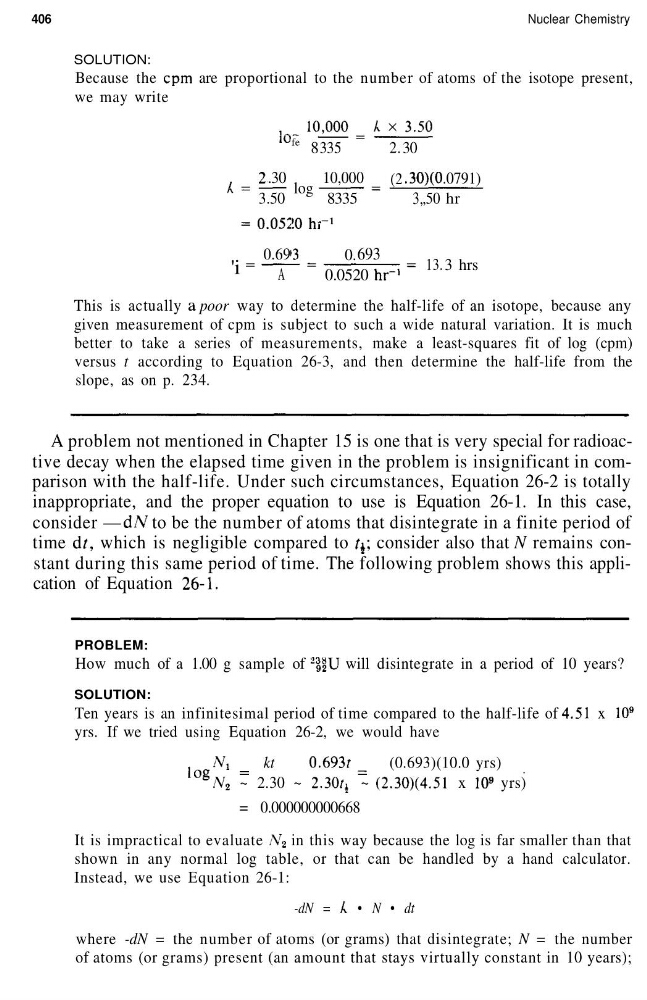
Because the cpm are proportional to the number of atoms of the isotope present,
we may write
/
'i
2
IU
.30
3.50
0.05^
0.69
A
fe 8
log
!0hi
'3
335
10,000
8335
--i
0.693
2.
(2
30
.30)(0
3,
0.0520 hr~'
,50
13.
.0791)
hr
3 hrs
This is actually a poor way to determine the half-life of an isotope, because any
given measurement of cpm is subject to such a wide natural variation. It is much
better to take a series of measurements, make a least-squares fit of log (cpm)
versus t according to Equation 26-3, and then determine the half-life from the
slope, as on p. 234.
A problem not mentioned in Chapter 15 is one that is very special for radioactive decay when the elapsed time given in the problem is insignificant in comparison with the half-life. Under such circumstances, Equation 26-2 is totally
inappropriate, and the proper equation to use is Equation 26-1. In this case,
consider — d/V to be the number of atoms that disintegrate in a finite period of
time dt, which is negligible compared to /j; consider also that N remains constant during this same period of time. The following problem shows this application of Equation 26-1.
PROBLEM:
How much of a 1.00 g sample of -$U will disintegrate in a period of 10 years?
SOLUTION:
Ten years is an infinitesimal period of time compared to the half-life of 4.51 x 10
9
yrs. If we tried using Equation 26-2, we would have
N! = kt
0.693f =
(0.693)(10.0 yrs)
°
B N 2 ~ 2.30 ~ 2.30r 4 ~ (2.30)(4.51 x 10" yrs)
= 0.000000000668
It is impractical to evaluate ;V 2 in this way because the log is far smaller than that
shown in any normal log table, or that can be handled by a hand calculator.
Instead, we use Equation 26-1:
-dN = L • N • dt
where -dN = the number of atoms (or grams) that disintegrate; N = the number
of atoms (or grams) present (an amount that stays virtually constant in 10 years);
Nuclear Chemistry
SOLUTION:
Because the cpm are proportional to the number of atoms of the isotope present,
we may write
/
'i
2
IU
.30
3.50
0.05^
0.69
A
fe 8
log
!0hi
'3
335
10,000
8335
--i
0.693
2.
(2
30
.30)(0
3,
0.0520 hr~'
,50
13.
.0791)
hr
3 hrs
This is actually a poor way to determine the half-life of an isotope, because any
given measurement of cpm is subject to such a wide natural variation. It is much
better to take a series of measurements, make a least-squares fit of log (cpm)
versus t according to Equation 26-3, and then determine the half-life from the
slope, as on p. 234.
A problem not mentioned in Chapter 15 is one that is very special for radioactive decay when the elapsed time given in the problem is insignificant in comparison with the half-life. Under such circumstances, Equation 26-2 is totally
inappropriate, and the proper equation to use is Equation 26-1. In this case,
consider — d/V to be the number of atoms that disintegrate in a finite period of
time dt, which is negligible compared to /j; consider also that N remains constant during this same period of time. The following problem shows this application of Equation 26-1.
PROBLEM:
How much of a 1.00 g sample of -$U will disintegrate in a period of 10 years?
SOLUTION:
Ten years is an infinitesimal period of time compared to the half-life of 4.51 x 10
9
yrs. If we tried using Equation 26-2, we would have
N! = kt
0.693f =
(0.693)(10.0 yrs)
°
B N 2 ~ 2.30 ~ 2.30r 4 ~ (2.30)(4.51 x 10" yrs)
= 0.000000000668
It is impractical to evaluate ;V 2 in this way because the log is far smaller than that
shown in any normal log table, or that can be handled by a hand calculator.
Instead, we use Equation 26-1:
-dN = L • N • dt
where -dN = the number of atoms (or grams) that disintegrate; N = the number
of atoms (or grams) present (an amount that stays virtually constant in 10 years);