

Control of Precipitation
395
Wt of Pb(OH) 2 that dissolves = (o.0385 jf^\ (0.250 liter) ( 241.2 mole/
= 2.32 g in 250 ml
CONTROL OF PRECIPITATION
The insoluble salts of metals that are able to form complex ions often can be
dissolved by adding an excess of ligand, just as the insoluble salts of weak
acids can be dissolved by adding an excess of strong acid. The high ligand
concentration uses up the metal ions to form complex ions, causing the
solubility equilibrium to shift to the right. The following problems illustrate
this effect.
PROBLEM:
What weight of AgCl will dissolve in one liter of 1.00 M NH 3 ?
SOLUTION:
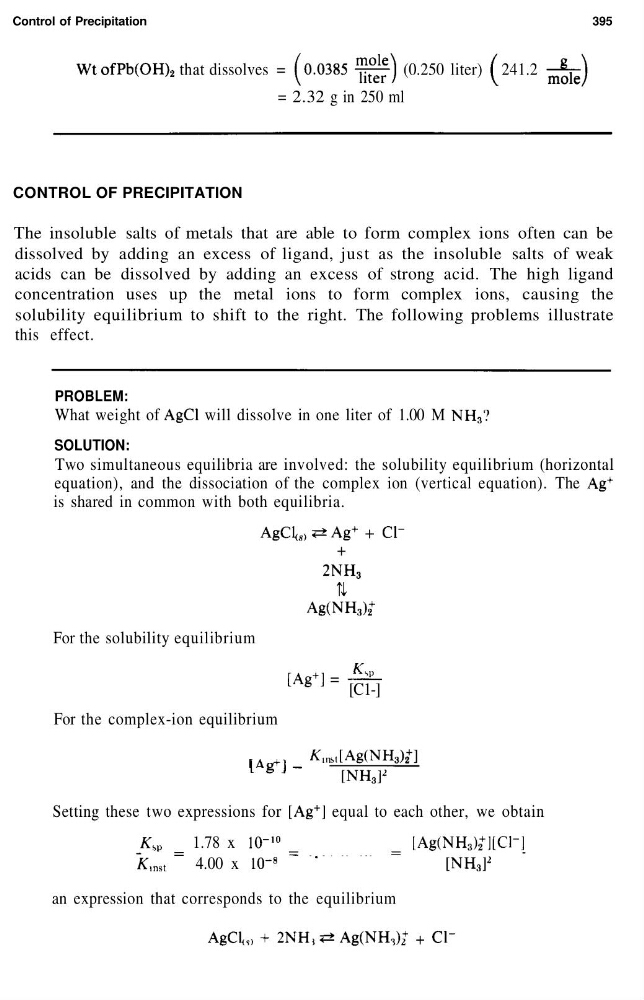
Two simultaneous equilibria are involved: the solubility equilibrium (horizontal
equation), and the dissociation of the complex ion (vertical equation). The Ag
+
is shared in common with both equilibria.
AgQ., ?± Ag
+ + Cl+
2NH 3
Tl
Ag(NH 3 ) 2 +
For the solubility equilibrium
K
[Ag
+ ] = [C1-]
For the complex-ion equilibrium
rA + . £. n
1 g J ~
Setting these two expressions for [Ag
+ ] equal to each other, we obtain
K w = 1.78 x 10-° =
= [Ag(NH 3 ) 2
+ ][Cl-]
K tnst
4.00 x 10⁸
'
[NH 3 ]^
an expression that corresponds to the equilibrium
=* Ag(NH 3 ) 2
+ + Cl-
395
Wt of Pb(OH) 2 that dissolves = (o.0385 jf^\ (0.250 liter) ( 241.2 mole/
= 2.32 g in 250 ml
CONTROL OF PRECIPITATION
The insoluble salts of metals that are able to form complex ions often can be
dissolved by adding an excess of ligand, just as the insoluble salts of weak
acids can be dissolved by adding an excess of strong acid. The high ligand
concentration uses up the metal ions to form complex ions, causing the
solubility equilibrium to shift to the right. The following problems illustrate
this effect.
PROBLEM:
What weight of AgCl will dissolve in one liter of 1.00 M NH 3 ?
SOLUTION:
Two simultaneous equilibria are involved: the solubility equilibrium (horizontal
equation), and the dissociation of the complex ion (vertical equation). The Ag
+
is shared in common with both equilibria.
AgQ., ?± Ag
+ + Cl+
2NH 3
Tl
Ag(NH 3 ) 2 +
For the solubility equilibrium
K
[Ag
+ ] = [C1-]
For the complex-ion equilibrium
rA + . £. n
1 g J ~
Setting these two expressions for [Ag
+ ] equal to each other, we obtain
K w = 1.78 x 10-° =
= [Ag(NH 3 ) 2
+ ][Cl-]
K tnst
4.00 x 10⁸
'
[NH 3 ]^
an expression that corresponds to the equilibrium
=* Ag(NH 3 ) 2
+ + Cl-