

394
Complex Ions
AMPHOTERISM (HYDROXO COMPLEXES)
Some insoluble hydroxides dissolve not only in acid but also in excess of
strong base. Those that do so are said to be amphoteric. We illustrate this by
A1(OH) 3 :
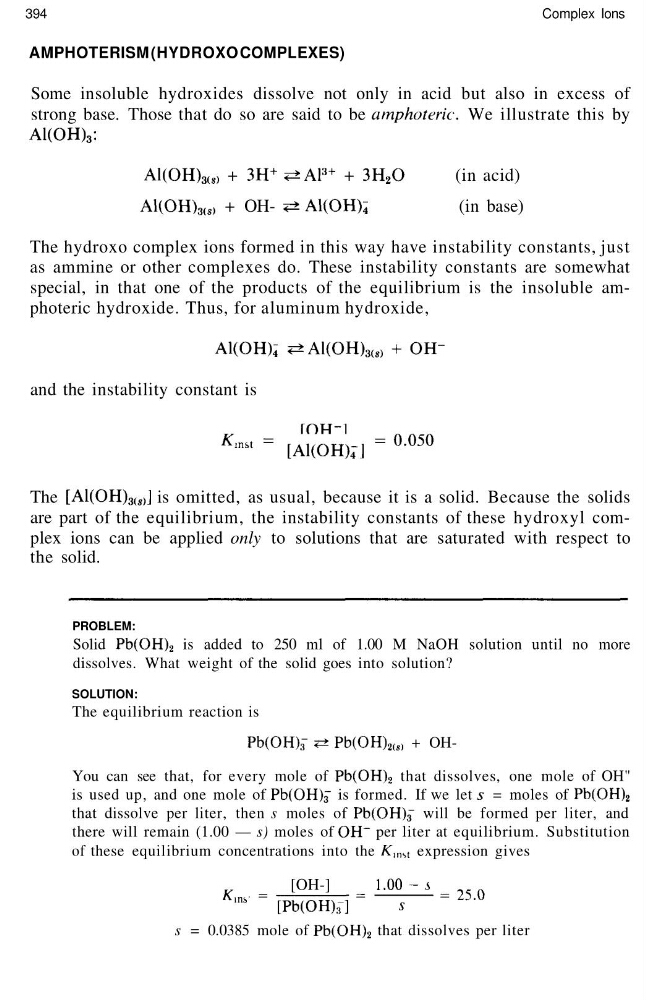
A1(OH) 3(S) + 3H
+ *± A1
3+ + 3H 2 O
(in acid)
A1(OH) 3(S) + OH- *± A1(OH)4
(in base)
The hydroxo complex ions formed in this way have instability constants, just
as ammine or other complexes do. These instability constants are somewhat
special, in that one of the products of the equilibrium is the insoluble amphoteric hydroxide. Thus, for aluminum hydroxide,
A1(OH)4 +± A1(OH) 3(S)
and the instability constant is
K ™
1 = [A1(OH) 4 -J
=
The [A1(OH) 3(S) J is omitted, as usual, because it is a solid. Because the solids
are part of the equilibrium, the instability constants of these hydroxyl complex ions can be applied only to solutions that are saturated with respect to
the solid.
PROBLEM:
Solid Pb(OH) 2 is added to 250 ml of 1.00 M NaOH solution until no more
dissolves. What weight of the solid goes into solution?
SOLUTION:
The equilibrium reaction is
Pb(OH) 3 - ?± Pb(OH) 2(sl + OHYou can see that, for every mole of Pb(OH) 2 that dissolves, one mole of OH"
is used up, and one mole of Pb(OH)g" is formed. If we let 5 = moles of Pb(OH) 2
that dissolve per liter, then s moles of Pb(OH)g" will be formed per liter, and
there will remain (1.00 — s) moles of OH~ per liter at equilibrium. Substitution
of these equilibrium concentrations into the AT, nst expression gives
[OH-]
1.00 -i
ms
[Pb(OH) s -]
s
s = 0.0385 mole of Pb(OH) 2 that dissolves per liter
Complex Ions
AMPHOTERISM (HYDROXO COMPLEXES)
Some insoluble hydroxides dissolve not only in acid but also in excess of
strong base. Those that do so are said to be amphoteric. We illustrate this by
A1(OH) 3 :
A1(OH) 3(S) + 3H
+ *± A1
3+ + 3H 2 O
(in acid)
A1(OH) 3(S) + OH- *± A1(OH)4
(in base)
The hydroxo complex ions formed in this way have instability constants, just
as ammine or other complexes do. These instability constants are somewhat
special, in that one of the products of the equilibrium is the insoluble amphoteric hydroxide. Thus, for aluminum hydroxide,
A1(OH)4 +± A1(OH) 3(S)
and the instability constant is
K ™
1 = [A1(OH) 4 -J
=
The [A1(OH) 3(S) J is omitted, as usual, because it is a solid. Because the solids
are part of the equilibrium, the instability constants of these hydroxyl complex ions can be applied only to solutions that are saturated with respect to
the solid.
PROBLEM:
Solid Pb(OH) 2 is added to 250 ml of 1.00 M NaOH solution until no more
dissolves. What weight of the solid goes into solution?
SOLUTION:
The equilibrium reaction is
Pb(OH) 3 - ?± Pb(OH) 2(sl + OHYou can see that, for every mole of Pb(OH) 2 that dissolves, one mole of OH"
is used up, and one mole of Pb(OH)g" is formed. If we let 5 = moles of Pb(OH) 2
that dissolve per liter, then s moles of Pb(OH)g" will be formed per liter, and
there will remain (1.00 — s) moles of OH~ per liter at equilibrium. Substitution
of these equilibrium concentrations into the AT, nst expression gives
[OH-]
1.00 -i
ms
[Pb(OH) s -]
s
s = 0.0385 mole of Pb(OH) 2 that dissolves per liter