

392
Complex Ions
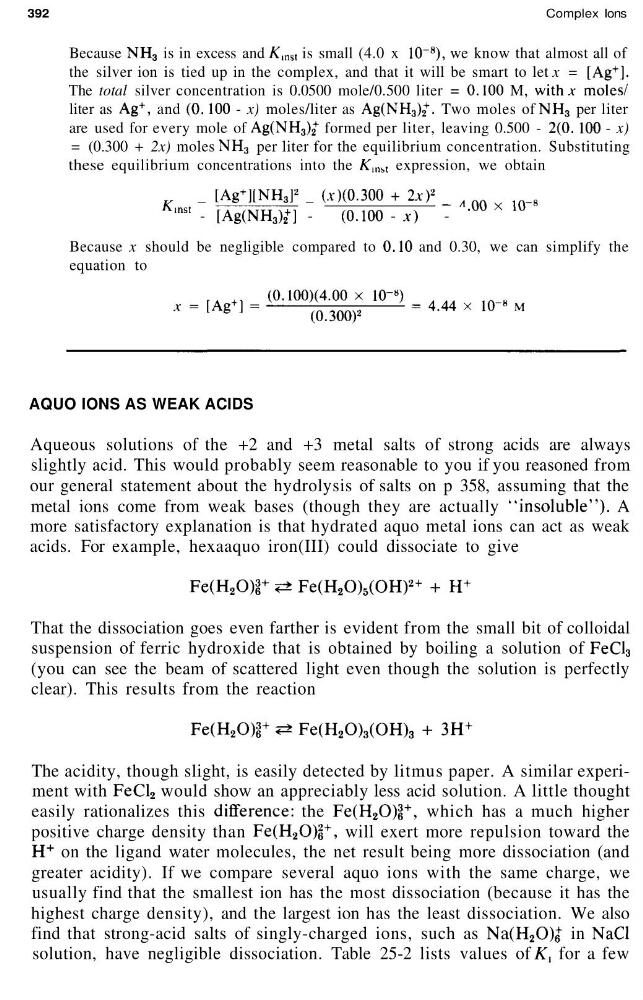
Because NH 3 is in excess and K mst is small (4.0 x 10~
8 ), we know that almost all of
the silver ion is tied up in the complex, and that it will be smart to let x = [Ag
+ ].
The total silver concentration is 0.0500 mole/0.500 liter = 0.100 M, with* moles/
liter as Ag
+ , and (0. 100 - x) moles/liter as Ag(NH 3 ) 2
+ . Two moles of NH 3 per liter
are used for every mole of Ag(NH 3 )^ formed per liter, leaving 0.500 - 2(0. 100 - x)
= (0.300 + 2x) moles NH 3 per liter for the equilibrium concentration. Substituting
these equilibrium concentrations into the A^ im , t expression, we obtain
_ [Ag+][NH 3 ]* _ UX0.300 + 2x?
'
ns < - [Ag(NH 3 ) 2 +] -
(0.100 - *)
- '
Because x should be negligible compared to 0.10 and 0.30, we can simplify the
equation to
AQUO IONS AS WEAK ACIDS
Aqueous solutions of the +2 and +3 metal salts of strong acids are always
slightly acid. This would probably seem reasonable to you if you reasoned from
our general statement about the hydrolysis of salts on p 358, assuming that the
metal ions come from weak bases (though they are actually "insoluble")- A
more satisfactory explanation is that hydrated aquo metal ions can act as weak
acids. For example, hexaaquo iron(III) could dissociate to give
Fe(H 2 0)i
+ «± Fe(H 2 0) 5 (OH)
2+ + H
+
That the dissociation goes even farther is evident from the small bit of colloidal
suspension of ferric hydroxide that is obtained by boiling a solution of FeCl 3
(you can see the beam of scattered light even though the solution is perfectly
clear). This results from the reaction
Fe(H 2 0)i
+ ?± Fe(H 2 0) 3 (OH) 3 + 3H+
The acidity, though slight, is easily detected by litmus paper. A similar experiment with FeCl 2 would show an appreciably less acid solution. A little thought
easily rationalizes this difference: the Fe(H 2 O)i
+ , which has a much higher
positive charge density than Fe(H 2 O)|
+ , will exert more repulsion toward the
H
+ on the ligand water molecules, the net result being more dissociation (and
greater acidity). If we compare several aquo ions with the same charge, we
usually find that the smallest ion has the most dissociation (because it has the
highest charge density), and the largest ion has the least dissociation. We also
find that strong-acid salts of singly-charged ions, such as Na(H 2 O)£ in NaCl
solution, have negligible dissociation. Table 25-2 lists values of K t for a few
Complex Ions
Because NH 3 is in excess and K mst is small (4.0 x 10~
8 ), we know that almost all of
the silver ion is tied up in the complex, and that it will be smart to let x = [Ag
+ ].
The total silver concentration is 0.0500 mole/0.500 liter = 0.100 M, with* moles/
liter as Ag
+ , and (0. 100 - x) moles/liter as Ag(NH 3 ) 2
+ . Two moles of NH 3 per liter
are used for every mole of Ag(NH 3 )^ formed per liter, leaving 0.500 - 2(0. 100 - x)
= (0.300 + 2x) moles NH 3 per liter for the equilibrium concentration. Substituting
these equilibrium concentrations into the A^ im , t expression, we obtain
_ [Ag+][NH 3 ]* _ UX0.300 + 2x?
'
ns < - [Ag(NH 3 ) 2 +] -
(0.100 - *)
- '
Because x should be negligible compared to 0.10 and 0.30, we can simplify the
equation to
AQUO IONS AS WEAK ACIDS
Aqueous solutions of the +2 and +3 metal salts of strong acids are always
slightly acid. This would probably seem reasonable to you if you reasoned from
our general statement about the hydrolysis of salts on p 358, assuming that the
metal ions come from weak bases (though they are actually "insoluble")- A
more satisfactory explanation is that hydrated aquo metal ions can act as weak
acids. For example, hexaaquo iron(III) could dissociate to give
Fe(H 2 0)i
+ «± Fe(H 2 0) 5 (OH)
2+ + H
+
That the dissociation goes even farther is evident from the small bit of colloidal
suspension of ferric hydroxide that is obtained by boiling a solution of FeCl 3
(you can see the beam of scattered light even though the solution is perfectly
clear). This results from the reaction
Fe(H 2 0)i
+ ?± Fe(H 2 0) 3 (OH) 3 + 3H+
The acidity, though slight, is easily detected by litmus paper. A similar experiment with FeCl 2 would show an appreciably less acid solution. A little thought
easily rationalizes this difference: the Fe(H 2 O)i
+ , which has a much higher
positive charge density than Fe(H 2 O)|
+ , will exert more repulsion toward the
H
+ on the ligand water molecules, the net result being more dissociation (and
greater acidity). If we compare several aquo ions with the same charge, we
usually find that the smallest ion has the most dissociation (because it has the
highest charge density), and the largest ion has the least dissociation. We also
find that strong-acid salts of singly-charged ions, such as Na(H 2 O)£ in NaCl
solution, have negligible dissociation. Table 25-2 lists values of K t for a few