

390
Complex Ions
there is an excess of ligand present in solution, there will be a whole collection
of related complex ions in equilibrium with each other—such as Zn(NH 3 )
2+ ,
Zn(NH 3 )l
+ , Zn(NH 3 )§+, and Zn(NH 3 )|
+ , each with its characteristic and somewhat different dissociation constant. Problems that deal with solutions not having an excess of ligand are too messy for consideration at the elementary level
but, in solutions with an excess of ligand, all of the intermediate stages of
complexation can be ignored, and we can deal solely with the equilibrium
between the fully complexed ion and its completely dissociated components.
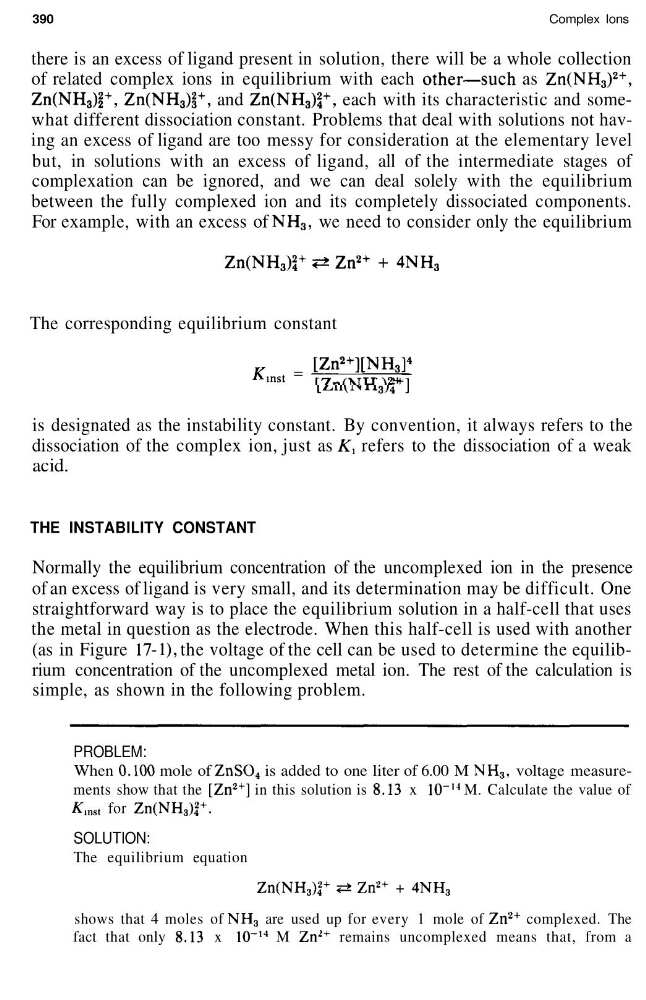
For example, with an excess of NH 3 , we need to consider only the equilibrium
Zn(NH 3 )|
+ ?± Zn
2+ + 4NH 3
The corresponding equilibrium constant
[Zn
2
+][NH 3 ]"
[Zn(NH 3 )
2 +]
K
=
Jv mst
fy^/XTU \2 +
is designated as the instability constant. By convention, it always refers to the
dissociation of the complex ion, just as K l refers to the dissociation of a weak
acid.
THE INSTABILITY CONSTANT
Normally the equilibrium concentration of the uncomplexed ion in the presence
of an excess of ligand is very small, and its determination may be difficult. One
straightforward way is to place the equilibrium solution in a half-cell that uses
the metal in question as the electrode. When this half-cell is used with another
(as in Figure 17-1), the voltage of the cell can be used to determine the equilibrium concentration of the uncomplexed metal ion. The rest of the calculation is
simple, as shown in the following problem.
PROBLEM:
When 0.100 mole of ZnSO 4 is added to one liter of 6.00 M NH 3 , voltage measurements show that the [Zn
2+ ] in this solution is 8.13 x 10~
14 M. Calculate the value of
K msl for Zn(NH 3 )f+.
SOLUTION:
The equilibrium equation
Zn(NH 3 ) 4
2+ ?± Zn
2+ + 4NH 3
shows that 4 moles of NH 3 are used up for every 1 mole of Zn
2+ complexed. The
fact that only 8.13 x 10~
14 M Zn
2+ remains uncomplexed means that, from a
Complex Ions
there is an excess of ligand present in solution, there will be a whole collection
of related complex ions in equilibrium with each other—such as Zn(NH 3 )
2+ ,
Zn(NH 3 )l
+ , Zn(NH 3 )§+, and Zn(NH 3 )|
+ , each with its characteristic and somewhat different dissociation constant. Problems that deal with solutions not having an excess of ligand are too messy for consideration at the elementary level
but, in solutions with an excess of ligand, all of the intermediate stages of
complexation can be ignored, and we can deal solely with the equilibrium
between the fully complexed ion and its completely dissociated components.
For example, with an excess of NH 3 , we need to consider only the equilibrium
Zn(NH 3 )|
+ ?± Zn
2+ + 4NH 3
The corresponding equilibrium constant
[Zn
2
+][NH 3 ]"
[Zn(NH 3 )
2 +]
K
=
Jv mst
fy^/XTU \2 +
is designated as the instability constant. By convention, it always refers to the
dissociation of the complex ion, just as K l refers to the dissociation of a weak
acid.
THE INSTABILITY CONSTANT
Normally the equilibrium concentration of the uncomplexed ion in the presence
of an excess of ligand is very small, and its determination may be difficult. One
straightforward way is to place the equilibrium solution in a half-cell that uses
the metal in question as the electrode. When this half-cell is used with another
(as in Figure 17-1), the voltage of the cell can be used to determine the equilibrium concentration of the uncomplexed metal ion. The rest of the calculation is
simple, as shown in the following problem.
PROBLEM:
When 0.100 mole of ZnSO 4 is added to one liter of 6.00 M NH 3 , voltage measurements show that the [Zn
2+ ] in this solution is 8.13 x 10~
14 M. Calculate the value of
K msl for Zn(NH 3 )f+.
SOLUTION:
The equilibrium equation
Zn(NH 3 ) 4
2+ ?± Zn
2+ + 4NH 3
shows that 4 moles of NH 3 are used up for every 1 mole of Zn
2+ complexed. The
fact that only 8.13 x 10~
14 M Zn
2+ remains uncomplexed means that, from a