

396
Complex Ions
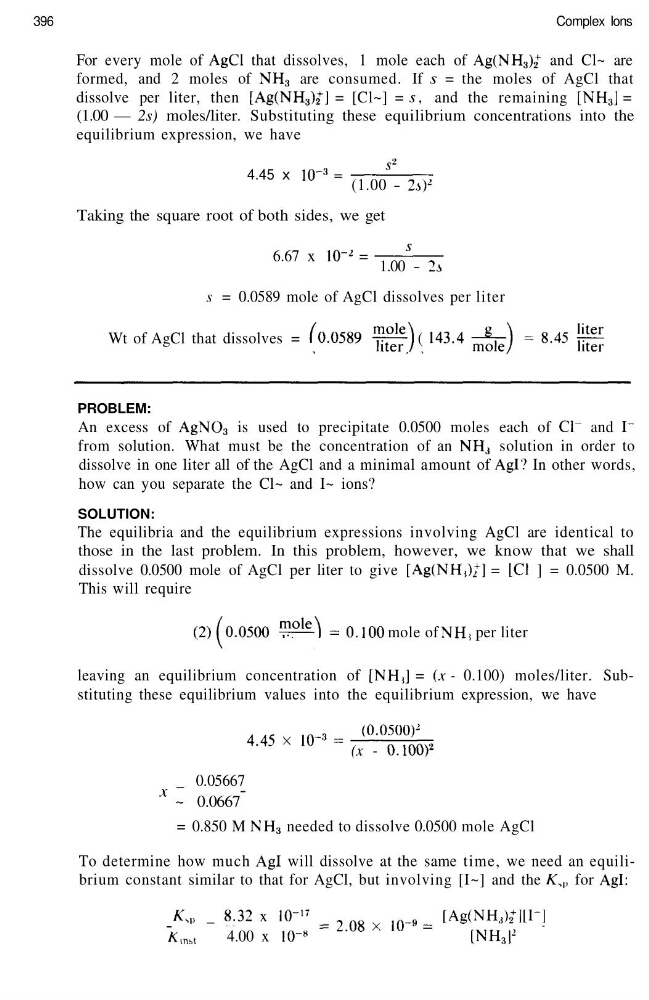
For every mole of AgCl that dissolves, 1 mole each of Ag(NH 3 )2" and Cl~ are
formed, and 2 moles of NH 3 are consumed. If s = the moles of AgCl that
dissolve per liter, then [Ag(NH 3 )2"] = [Cl~] = s, and the remaining [NH 3 J =
(1.00 — 2s) moles/liter. Substituting these equilibrium concentrations into the
equilibrium expression, we have
4.45 x 10'
3 = (1.00 - 2i
Taking the square root of both sides, we get
6.67 x 10~
2 = 1.00 - 2i
s = 0.0589 mole of AgCl dissolves per liter
Wt of AgCl that dissolves = ( 0.0589 -j^Tjr) (
14 3-4
PROBLEM:
An excess of AgNO 3 is used to precipitate 0.0500 moles each of Cl~ and I"
from solution. What must be the concentration of an NH 3 solution in order to
dissolve in one liter all of the AgCl and a minimal amount of Agl? In other words,
how can you separate the Cl~ and I~ ions?
SOLUTION:
The equilibria and the equilibrium expressions involving AgCl are identical to
those in the last problem. In this problem, however, we know that we shall
dissolve 0.0500 mole of AgCl per liter to give [Ag(NH,)/l = [Cl ] = 0.0500 M.
This will require
(2) (o.0500 ^~-} = 0.1 00 mole of NH 5 per liter
leaving an equilibrium concentration of [NHJ = (x - 0.100) moles/liter. Substituting these equilibrium values into the equilibrium expression, we have
4.45X10-= (x - 0.100)
2
_ 0.05667
X ~ 0.0667
= 0.850 M NH 3 needed to dissolve 0.0500 mole AgCl
To determine how much Agl will dissolve at the same time, we need an equilibrium constant similar to that for AgCl, but involving [I~] and the K^, for Agl:
*, _ 8 ; 32 x ,0- = ^ Q8 x 1Q _ 9 = [Ag(NH,tfl[I-l
4.00 x 10-"
[NH 3 p
Complex Ions
For every mole of AgCl that dissolves, 1 mole each of Ag(NH 3 )2" and Cl~ are
formed, and 2 moles of NH 3 are consumed. If s = the moles of AgCl that
dissolve per liter, then [Ag(NH 3 )2"] = [Cl~] = s, and the remaining [NH 3 J =
(1.00 — 2s) moles/liter. Substituting these equilibrium concentrations into the
equilibrium expression, we have
4.45 x 10'
3 = (1.00 - 2i
Taking the square root of both sides, we get
6.67 x 10~
2 = 1.00 - 2i
s = 0.0589 mole of AgCl dissolves per liter
Wt of AgCl that dissolves = ( 0.0589 -j^Tjr) (
14 3-4
PROBLEM:
An excess of AgNO 3 is used to precipitate 0.0500 moles each of Cl~ and I"
from solution. What must be the concentration of an NH 3 solution in order to
dissolve in one liter all of the AgCl and a minimal amount of Agl? In other words,
how can you separate the Cl~ and I~ ions?
SOLUTION:
The equilibria and the equilibrium expressions involving AgCl are identical to
those in the last problem. In this problem, however, we know that we shall
dissolve 0.0500 mole of AgCl per liter to give [Ag(NH,)/l = [Cl ] = 0.0500 M.
This will require
(2) (o.0500 ^~-} = 0.1 00 mole of NH 5 per liter
leaving an equilibrium concentration of [NHJ = (x - 0.100) moles/liter. Substituting these equilibrium values into the equilibrium expression, we have
4.45X10-= (x - 0.100)
2
_ 0.05667
X ~ 0.0667
= 0.850 M NH 3 needed to dissolve 0.0500 mole AgCl
To determine how much Agl will dissolve at the same time, we need an equilibrium constant similar to that for AgCl, but involving [I~] and the K^, for Agl:
*, _ 8 ; 32 x ,0- = ^ Q8 x 1Q _ 9 = [Ag(NH,tfl[I-l
4.00 x 10-"
[NH 3 p