

Control of Precipitation
381
Kv,
[Ca"J[HC,0«-J _ 2.29 x 10AT,
[H
+ ]
~ 5.25 x 10~
5 ~ ^
X 1U
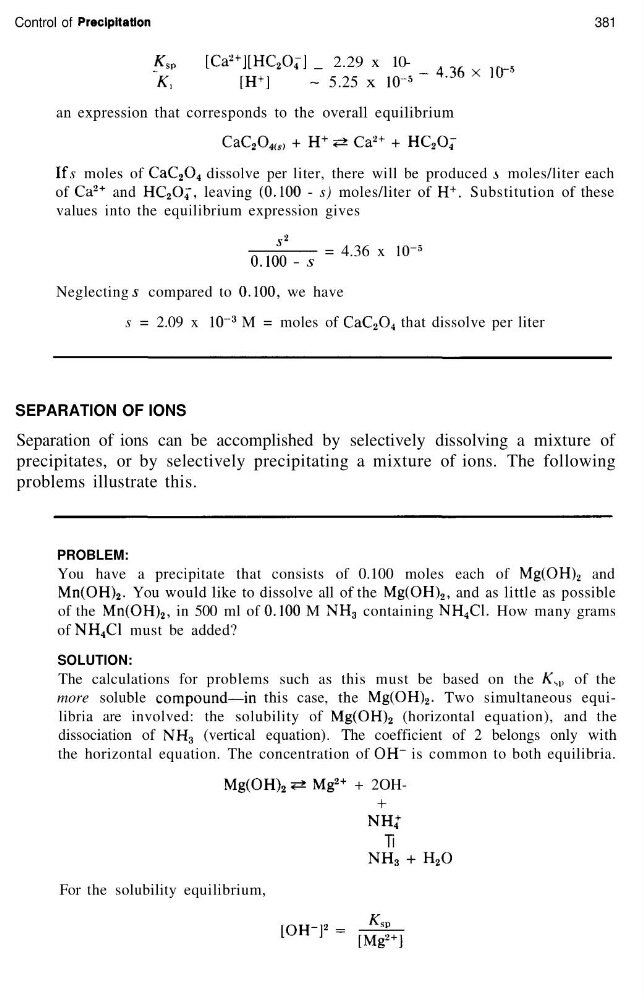
an expression that corresponds to the overall equilibrium
CaC 2 O 4(s) + H
+ <=* Ca
2+ + HC 2 O 4 -
If s moles of CaC 2 O 4 dissolve per liter, there will be produced i moles/liter each
of Ca
2+ and HC 2 O 4 -, leaving (0.100 - s) moles/liter of H
+ . Substitution of these
values into the equilibrium expression gives
= 4.36 x 10⁵
0.100 - s
Neglecting j compared to 0.100, we have
s = 2.09 x 10~
3 M = moles of CaC 2 O 4 that dissolve per liter
SEPARATION OF IONS
Separation of ions can be accomplished by selectively dissolving a mixture of
precipitates, or by selectively precipitating a mixture of ions. The following
problems illustrate this.
PROBLEM:
You have a precipitate that consists of 0.100 moles each of Mg(OH) 2 and
Mn(OH) 2 . You would like to dissolve all of the Mg(OH) 2 , and as little as possible
of the Mn(OH) 2 , in 500 ml of 0.100 M NH 3 containing NH 4 C1. How many grams
of NH 4 C1 must be added?
SOLUTION:
The calculations for problems such as this must be based on the K^, of the
more soluble compound—in this case, the Mg(OH) 2 . Two simultaneous equilibria are involved: the solubility of Mg(OH) 2 (horizontal equation), and the
dissociation of NH 3 (vertical equation). The coefficient of 2 belongs only with
the horizontal equation. The concentration of OH~ is common to both equilibria.
Mg(OH) 2 <=* Mg
2+ + 2OHNH 4
+
Ti
NH 3 + H 2 0
For the solubility equilibrium,
[
°
H
"
]2 = [fe
381
Kv,
[Ca"J[HC,0«-J _ 2.29 x 10AT,
[H
+ ]
~ 5.25 x 10~
5 ~ ^
X 1U
an expression that corresponds to the overall equilibrium
CaC 2 O 4(s) + H
+ <=* Ca
2+ + HC 2 O 4 -
If s moles of CaC 2 O 4 dissolve per liter, there will be produced i moles/liter each
of Ca
2+ and HC 2 O 4 -, leaving (0.100 - s) moles/liter of H
+ . Substitution of these
values into the equilibrium expression gives
= 4.36 x 10⁵
0.100 - s
Neglecting j compared to 0.100, we have
s = 2.09 x 10~
3 M = moles of CaC 2 O 4 that dissolve per liter
SEPARATION OF IONS
Separation of ions can be accomplished by selectively dissolving a mixture of
precipitates, or by selectively precipitating a mixture of ions. The following
problems illustrate this.
PROBLEM:
You have a precipitate that consists of 0.100 moles each of Mg(OH) 2 and
Mn(OH) 2 . You would like to dissolve all of the Mg(OH) 2 , and as little as possible
of the Mn(OH) 2 , in 500 ml of 0.100 M NH 3 containing NH 4 C1. How many grams
of NH 4 C1 must be added?
SOLUTION:
The calculations for problems such as this must be based on the K^, of the
more soluble compound—in this case, the Mg(OH) 2 . Two simultaneous equilibria are involved: the solubility of Mg(OH) 2 (horizontal equation), and the
dissociation of NH 3 (vertical equation). The coefficient of 2 belongs only with
the horizontal equation. The concentration of OH~ is common to both equilibria.
Mg(OH) 2 <=* Mg
2+ + 2OHNH 4
+
Ti
NH 3 + H 2 0
For the solubility equilibrium,
[
°
H
"
]2 = [fe